
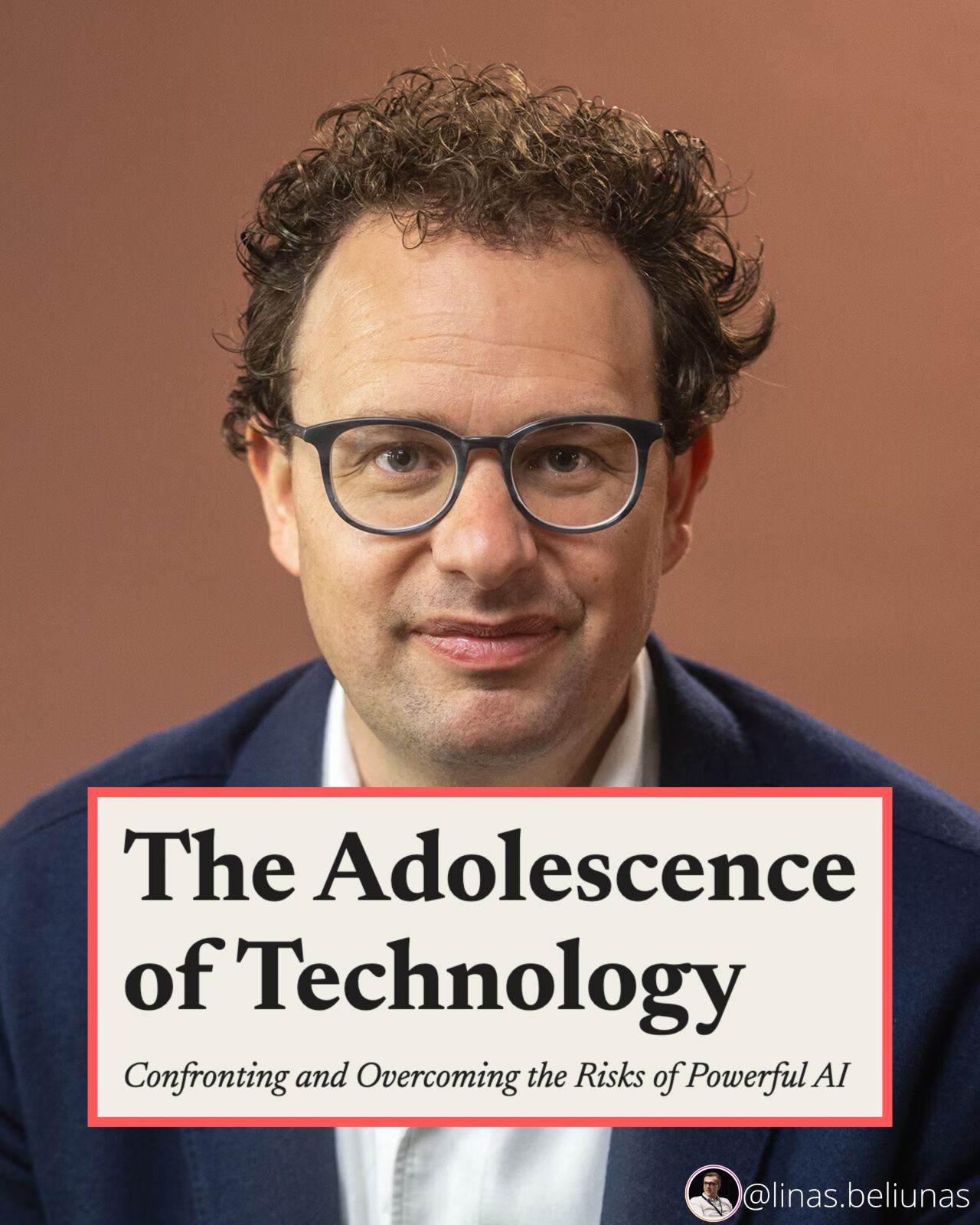
In a recent LinkedIn post, Linas Beliūnas highlights a significant thesis from Anthropic founder Dario Amodei concerning the future trajectory of artificial intelligence, framing it as humanity’s entry into a ‘technological adolescence.’ Beliūnas emphasizes Amodei’s core argument that the world is approaching a critical juncture where immense technological power is developing faster than the collective wisdom to manage it responsibly.
Beliūnas draws a parallel to Carl Sagan’s historical query about civilizational survival during periods of rapid technological advancement. According to Beliūnas, Amodei posits that artificial intelligence represents the current, defining test for humanity in this regard.
“Humanity is entering the adolescence of technology. The moment when immense power arrives before the maturity to handle it.”
Beliūnas elaborates on Amodei’s vision of advanced AI, describing a scenario where millions of minds, far exceeding human intellectual capacity and operating at exponentially greater speeds, could function autonomously within datacenters. This, Beliūnas relays from Amodei’s perspective, is rapidly transitioning from science fiction to a tangible reality with frontier AI development.
The Peril of Power Outpacing Wisdom
A central theme Beliūnas conveys from Amodei’s essay is that the primary danger of advanced AI does not stem from malicious intent, but rather from the sheer magnitude of power that can become detached from human wisdom and ethical oversight. As Linas Beliūnas notes, Amodei warns about the implications of intelligence becoming cheap and readily accessible.
- Capability detaching from motive
- Empowerment of small actors with civilization-level leverage
- The possibility that a single failure could be catastrophic
Beliūnas shares Amodei’s concern that this scenario presents a spectrum of potential nightmares, including biological, cyber, and propaganda-related threats. “One failure is enough,” Beliūnas quotes from the essay, underscoring the fragility of systems under such advanced technological influence.
“And the most chilling part? The biggest risk isn’t chaos. It’s control. Because AI doesn’t just automate work. It automates power.”
Beyond Doomerism: The Urgency of AI Governance
Despite the gravity of these potential risks, Beliūnas highlights that Amodei does not subscribe to apocalyptic ‘AGI kills everyone’ narratives. Instead, Amodei’s focus, as relayed by Beliūnas, is on the critical nature of this developmental phase for the human species. Linas Beliūnas emphasizes Amodei’s assertion that this period of technological adolescence is when irreversible mistakes can occur, and AI will not pause for humanity to feel adequately prepared.
The Imperative for Serious Consideration
Beliūnas concludes by echoing Amodei’s call for engagement with these issues, particularly for those involved in AI, policy, startups, and understanding the dynamics of power. According to Linas Beliūnas, Amodei’s essay is essential reading not for its comforting reassurances, but for its direct confrontation with the challenges and realities of the coming era of advanced AI.
“If you care about AI, policy, startups, or power – this essay is required reading. Not because it reassures. Because it forces you to look straight at what’s coming.”
The post also includes a promotional note from Beliūnas for his own newsletter at linas.substack.com, which focuses on the intersection of finance and technology for founders, builders, and leaders.
📝 About This Content
This article is based on insights shared by Linas Beliūnas on LinkedIn.
📅 Originally posted on January 26, 2026 | View original post on LinkedIn →