
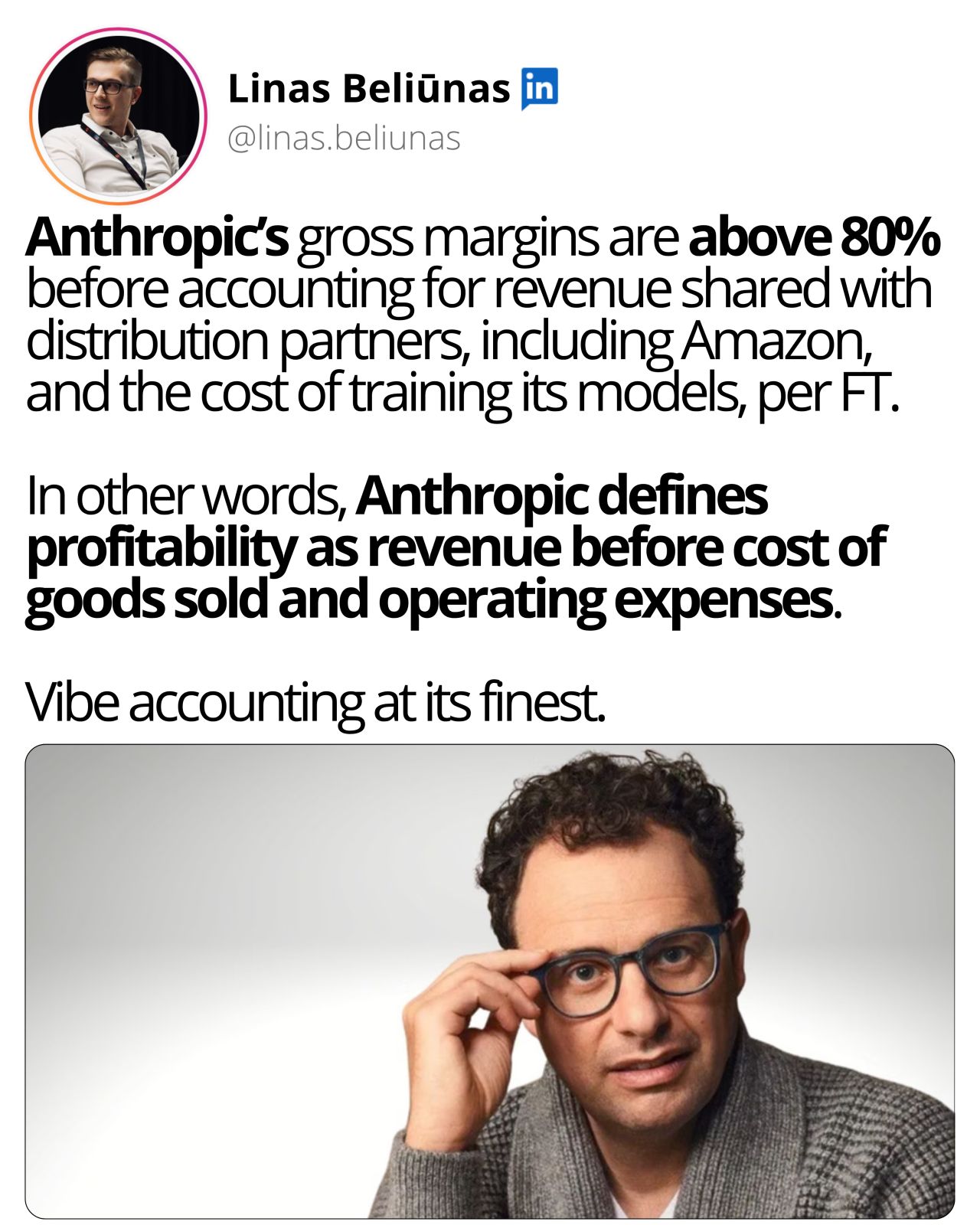
In a recent LinkedIn post, Linas Beliūnas critically examines the financial reporting of AI company Anthropic, particularly their claims of profitability. Beliūnas questions the accounting methods used, suggesting they may present an incomplete economic picture to investors.
Linas Beliūnas highlights a recent report indicating Anthropic expects a second consecutive quarter of adjusted operating profit with gross margins exceeding 80%. However, he immediately points out the caveats presented in the Financial Times report that underpins these figures.
“According to FT, Anthropic’s gross margins are now >80% before accounting for revenue shared with distribution partners, including Amazon, and the cost of training its models.”
Beliūnas further elaborates on the exclusions made in Anthropic’s adjusted profit calculations, noting that stock compensation is also not factored in. This leads him to a stark conclusion about the company’s definition of profitability.
Questioning ‘Adjusted’ Profitability
The core of Linas Beliūnas’s analysis revolves around what he terms “vibe accounting.” He argues that Anthropic’s reported margins appear to exclude significant costs typically considered fundamental to the cost of goods sold and operating expenses in many industries.
“In other words, Anthropic basically defines profitability as revenue before cost of goods sold and operating expenses 🙃”
To illustrate his point, Beliūnas draws a parallel to his own newsletter business. He contends that, by a similar logic, his newsletter could claim 100% gross margins if it ignored expenses like Substack’s platform fees, payment processing costs from Stripe, and taxes.
The Reality of Growth vs. Reported Margins
While Beliūnas is critical of the accounting methods, he acknowledges the substantial real growth Anthropic is experiencing. He cites figures indicating that the company’s second-quarter revenue surpassed $11.5 billion, with an annualized run rate exceeding $65 billion in July.
Linas Beliūnas concedes that the company’s AI models, like Claude, might achieve software-like margins when serving existing models. However, he maintains that the way these figures are presented to investors, particularly in the context of potential IPO aspirations, omits crucial economic realities.
“On the other hand, when you want to IPO at a $2 trillion valuation, even accounting needs some good prompt engineering…”
He concludes his post by suggesting that such accounting practices, which he dubs “vibe accounting,” may be employed to present a more favorable financial picture, especially when aiming for extremely high valuations. Beliūnas implies that this approach, while potentially “technically defensible” in its narrow definition, does not offer a “complete economic picture” to stakeholders.
The analysis by Linas Beliūnas prompts a broader discussion about financial transparency in the rapidly evolving AI sector, where novel business models and cost structures are challenging traditional accounting norms.
📝 About This Content
This article is based on insights shared by Linas Beliūnas on LinkedIn.
📅 Originally posted on September 14, 2026 | View original post on LinkedIn →