
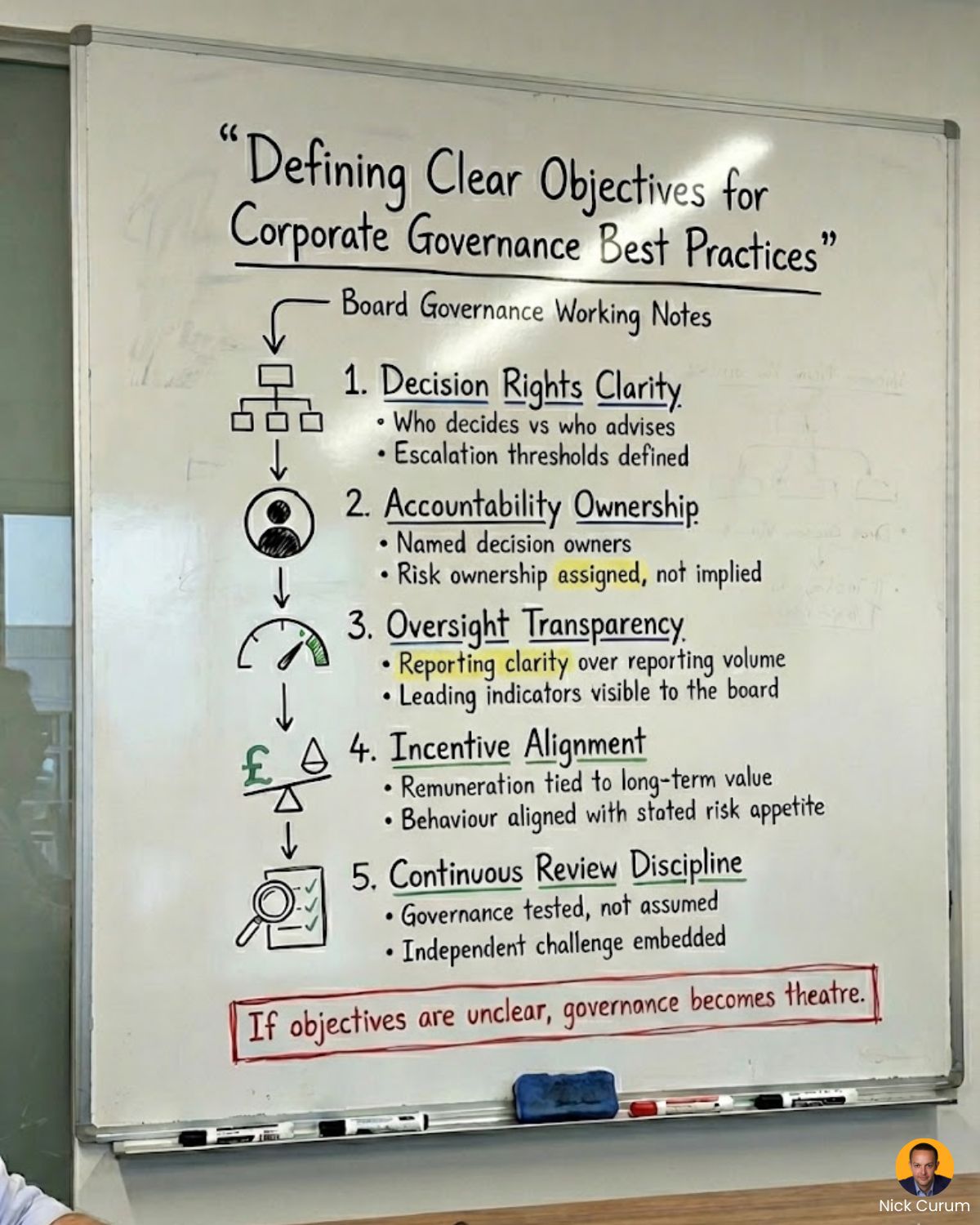
In a recent LinkedIn post, Nick Curum challenges the conventional metrics of corporate governance, suggesting that many boards focus on the artifacts of governance rather than its actual impact on decision-making. Curum argues that while structured frameworks and documented processes are essential, they often fail to answer the fundamental question of whether these mechanisms lead to better decisions.
Curum highlights the common pitfalls in how governance is assessed:
“Most boards measure governance by artefacts. Minutes. Committees. Papers. Frameworks. Evidence that governance happened. Not evidence that it worked.”
The post posits that the true measure of effective governance lies not in the existence of policies and procedures, but in their tangible effect on the quality of decisions made by the board. Curum points out that many boards are diligent in documenting their activities, yet this diligence doesn’t necessarily translate into improved outcomes.
The Gap Between Governance Artifacts and Impact
Nick Curum contends that a significant disconnect exists between the formal structures of governance and its practical effectiveness. He observes that the very principles that underpin good governance – decision rights, accountability, oversight, incentives, and review – can be meticulously documented and presented in a “board-ready” format, yet still fail to influence critical choices.
According to Curum, the issue arises when the focus shifts from the outcome of governance to the process itself. He states:
“And somewhere inside a well-structured framework — just like the one on this board — a weak decision passes through untouched.”
This observation suggests that even robust governance frameworks can become mere formalities if they do not actively challenge and improve the decisions being made. The emphasis, Curum implies, should be on the proactive improvement of decision-making, not just the adherence to procedural norms.
The Crucial Question Boards Aren’t Asking
Curum identifies a critical question that he believes most boards neglect to ask: “What decision did we make better because of this process?” He notes that only a handful of boards actively track this specific outcome.
The implication is that without this direct inquiry into decision improvement, boards may be operating under a false sense of security, believing their governance structures are effective simply because they exist and are maintained. Curum challenges leaders to move beyond abstract principles and concrete evidence of process, and to focus on the actual, measurable impact on decisions.
To drive this point home, Curum concludes his post with a direct challenge:
“Name one decision your governance process actively improved in the last 12 months. A real one. Not a principle. Not a framework. A decision.”
This call to action underscores Curum’s view that the ultimate test of governance is its ability to demonstrably enhance the quality and effectiveness of board decisions, urging a shift towards outcome-oriented evaluation.
📝 About This Content
This article is based on insights shared by Nick Curum on LinkedIn.
📅 Originally posted on March 7, 2026 | View original post on LinkedIn →