
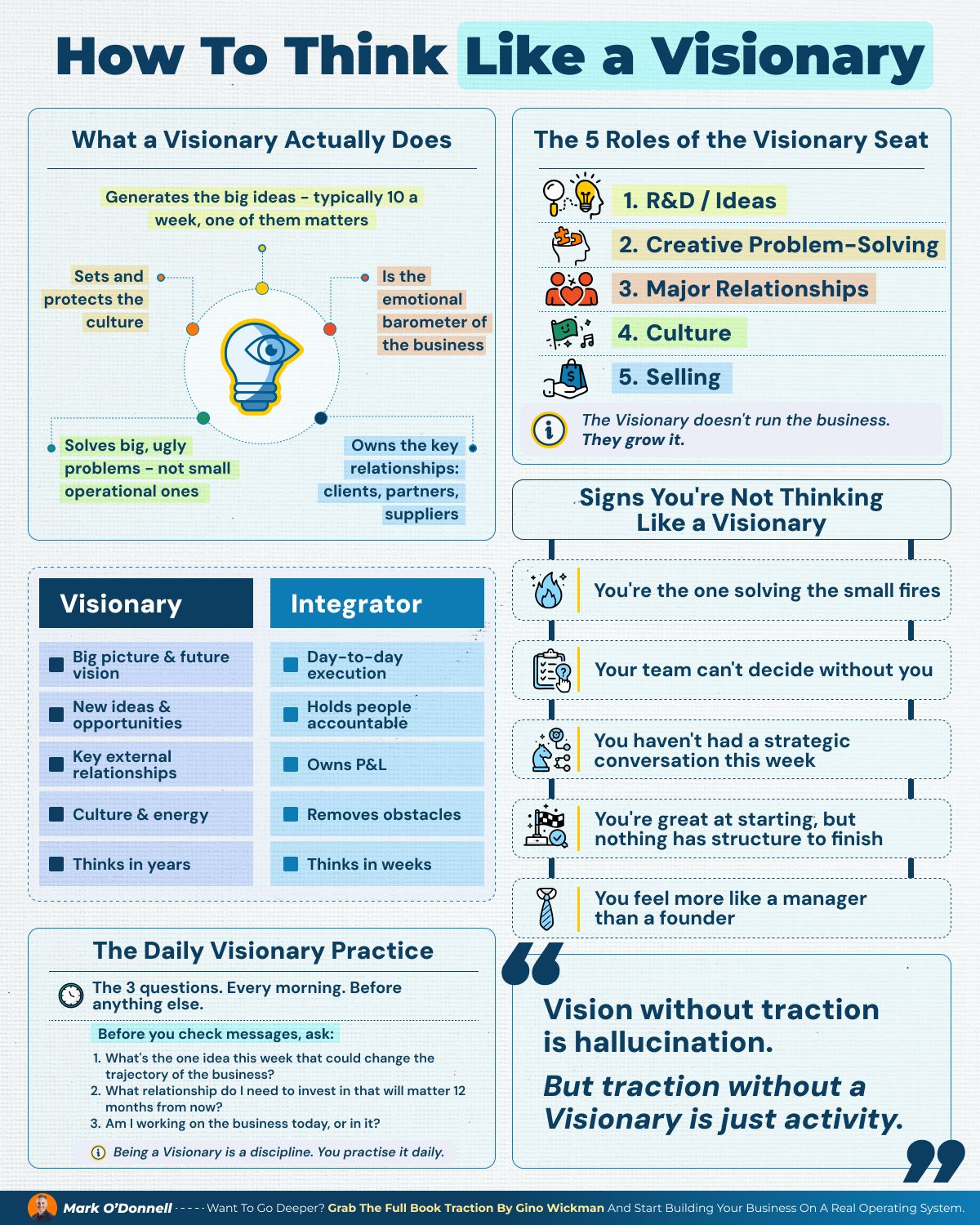
In a recent LinkedIn post, Mark O’Donnell clarifies the often-misunderstood role of the “Visionary” within a business, particularly in the context of the Entrepreneurial Operating System (EOS). O’Donnell, who lives the Visionary role daily at EOS Worldwide, argues that many founders mistake the title for the actual discipline required, leading them to become the primary bottleneck in their own organizations.
O’Donnell emphasizes that the Visionary role is not about personality but about a specific set of responsibilities and a disciplined approach. He writes:
“Calling yourself the Visionary doesn’t make you one. Most founders are just the biggest bottleneck in the room.”
He elaborates on the practical application of this role, distinguishing it from common misconceptions. According to O’Donnell, the true Visionary is characterized by their ability to generate significant ideas, safeguard company culture, cultivate crucial relationships, solve complex problems, and foresee the company’s future direction.
The True Responsibilities of a Visionary
The Visionary’s core functions, as outlined by O’Donnell, are geared towards growth and strategic direction. These include:
- Generating big ideas
- Protecting the culture
- Owning relationships that open doors
- Solving complex problems others cannot
- Seeing the company’s future path
Conversely, O’Donnell points out what the role is NOT. It does not involve being the person everyone depends on for approvals, constantly fighting daily fires, or acting as a manager who hasn’t delegated effectively. He states:
“This right here is just a founder who hasn’t let go yet.”
When founders fail to step fully into the Visionary seat, their personal involvement can inadvertently cap the business’s growth. O’Donnell suggests that a true shift occurs when the founder moves from ‘doing’ to ‘leading’ and from ‘managing’ to ‘building’.
The Crucial Partnership with the Integrator
Central to O’Donnell’s analysis is the symbiotic relationship between the Visionary and the Integrator. He highlights their fundamentally different, yet complementary, operational styles. The Visionary operates with a long-term perspective, thinking in years, while the Integrator focuses on the short to medium term, thinking in weeks. This division of focus ensures that ideas are generated and effectively executed.
As Mark O’Donnell notes, “One generates the ideas, while the other gets them executed. You need both. They’re not interchangeable.”
Identifying Bottlenecks: Signs a Founder Isn’t Operating as a Visionary
O’Donnell provides clear indicators that a founder may still be acting as a bottleneck rather than a true Visionary. These signs suggest a lack of delegation and an over-involvement in day-to-day operations that should be handled by other team members.
He lists several tell-tale signs:
- Handling small problems that the team should own.
- Requiring approval for every decision, hindering team autonomy.
- A lack of purely strategic conversations due to constant fire-fighting.
- Starting initiatives but lacking the structured follow-through for completion.
- Feeling more like a manager bogged down in tasks than a strategic founder.
Ultimately, O’Donnell concludes that operating as a Visionary is an ongoing practice, built into daily operations. He encourages founders to honestly assess their roles and transition from doing jobs that belong to others to truly leading and growing their businesses.
“Being a Visionary is something you build into how you operate. Every single day.”
O’Donnell invites founders to reflect on their current operational style and consider whether they are truly embodying the Visionary role or are still caught in the operational weeds.
📝 About This Content
This article is based on insights shared by Mark O'Donnell on LinkedIn.
📅 Originally posted on April 6, 2026 | View original post on LinkedIn →