
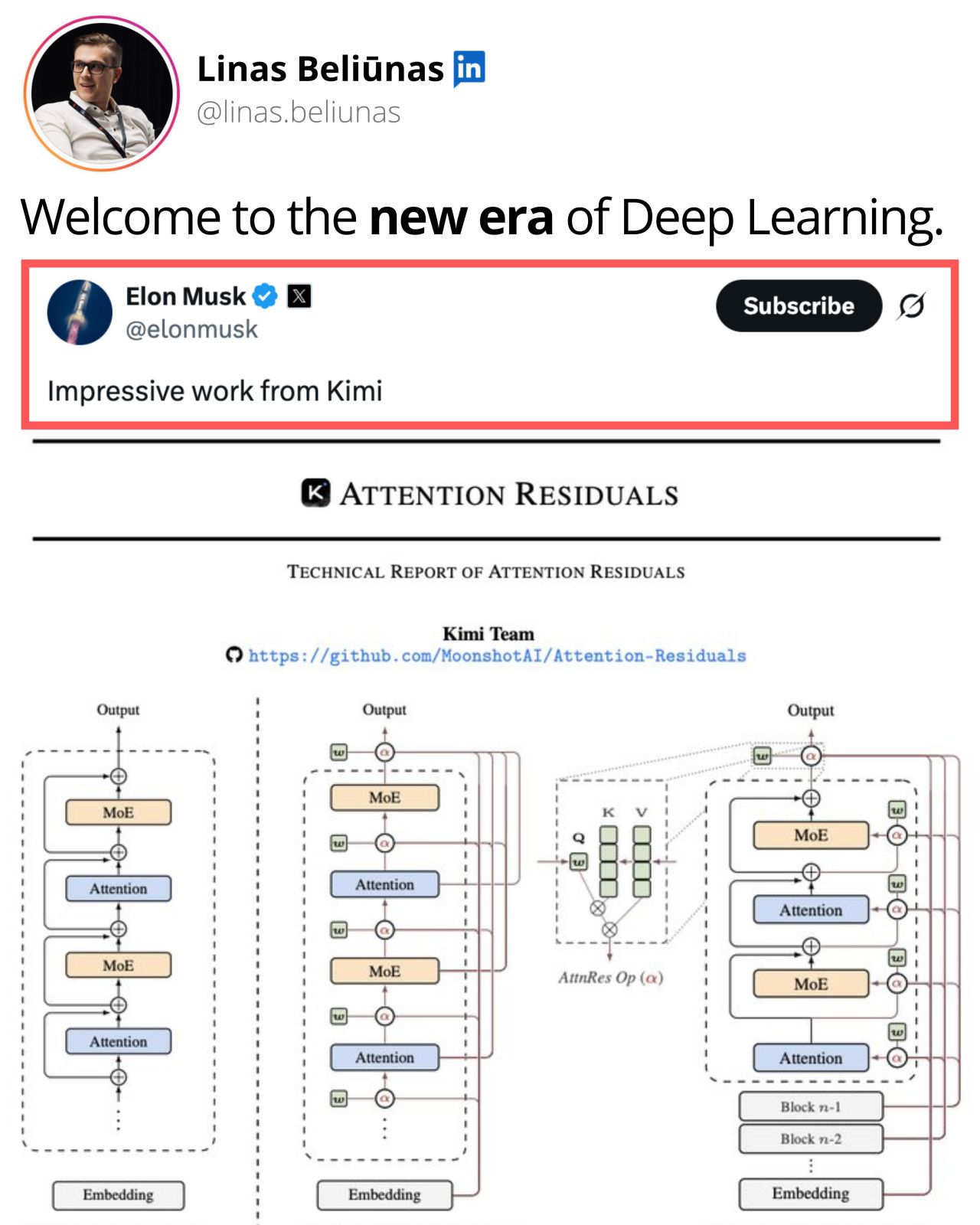
In a recent LinkedIn post, Linas Beliūnas highlights a potentially groundbreaking development in artificial intelligence architecture, focusing on a new concept termed “Attention Residuals” introduced by Moonshot AI (Kimi). Beliūnas suggests this innovation could address a fundamental flaw in existing Transformer models and pave the way for the next generation of AI.
Beliūnas frames the core issue with current AI models, explaining that standard Transformers add each layer to the previous one, leading to information dilution over time. He likens this to “50 people shouting in the same room,” where the clarity of individual signals is lost.
“The problem is that today’s models blindly add each layer to the previous one. Over time, information gets diluted – like 50 people shouting in the same room.”
Addressing Information Dilution with Attention Residuals
According to Linas Beliūnas, Moonshot AI’s approach replaces this additive process with “attention across layers.” This means the model can selectively refer back to specific, relevant layers rather than indiscriminately mixing information. Beliūnas elaborates on this concept, stating:
“Instead of mixing everything, the model can look back and retrieve the exact layer that mattered. Think of it as giving the network memory of its own thinking.”
This architectural shift, as described by Beliūnas, offers significant performance improvements. He points to the results observed on Moonshot’s 48B-parameter Kimi model, which reportedly achieved:
- 1.25× compute efficiency
- Less than 4% training overhead
- A +7.5 point increase on GPQA-Diamond (a challenging science reasoning benchmark)
- Gains across other key benchmarks like MMLU, HumanEval, and math
In essence, Beliūnas interprets these results to mean that the quality of a model trained with significantly more computational resources can be achieved with less. “In simple terms, you get the quality of a model trained with ~25% more compute without actually spending it,” he notes.
Open Source Innovation vs. Closed Development
A significant aspect of Moonshot AI’s release, as emphasized by Beliūnas, is that they have open-sourced all related materials, including the repository, paper, and code. This move, Beliūnas suggests, allows for immediate adoption by other developers and researchers.
“Moonshot open-sourced everything. Repo. Paper. Code 🤯 Anyone can plug it into their stack tomorrow.”
Linas Beliūnas draws a parallel to past events in the AI industry, hinting at the potential impact of such open-source contributions. He then posits a broader tension within the AI development landscape:
The Ingenuity Race
Beliūnas highlights the contrast between large, closed AI labs raising substantial capital to build massive GPU clusters and open initiatives releasing fundamental architectural breakthroughs for free. “The biggest & most interesting tension in AI right now is this: Closed labs are raising billions to build bigger GPU clusters. Meanwhile, Open Labs are shipping architectural breakthroughs for FREE,” he writes.
Ultimately, Beliūnas argues that this dynamic shifts the competitive landscape beyond geographical or scale-based rivalries. “Which means that race is no longer just US vs China. It’s scale vs ingenuity. And ingenuity compounds much faster,” he concludes, suggesting that innovation in AI architecture, particularly when shared openly, could be a more potent driver of progress than sheer computational scale.
📝 About This Content
This article is based on insights shared by Linas Beliūnas on LinkedIn.
📅 Originally posted on March 16, 2026 | View original post on LinkedIn →