
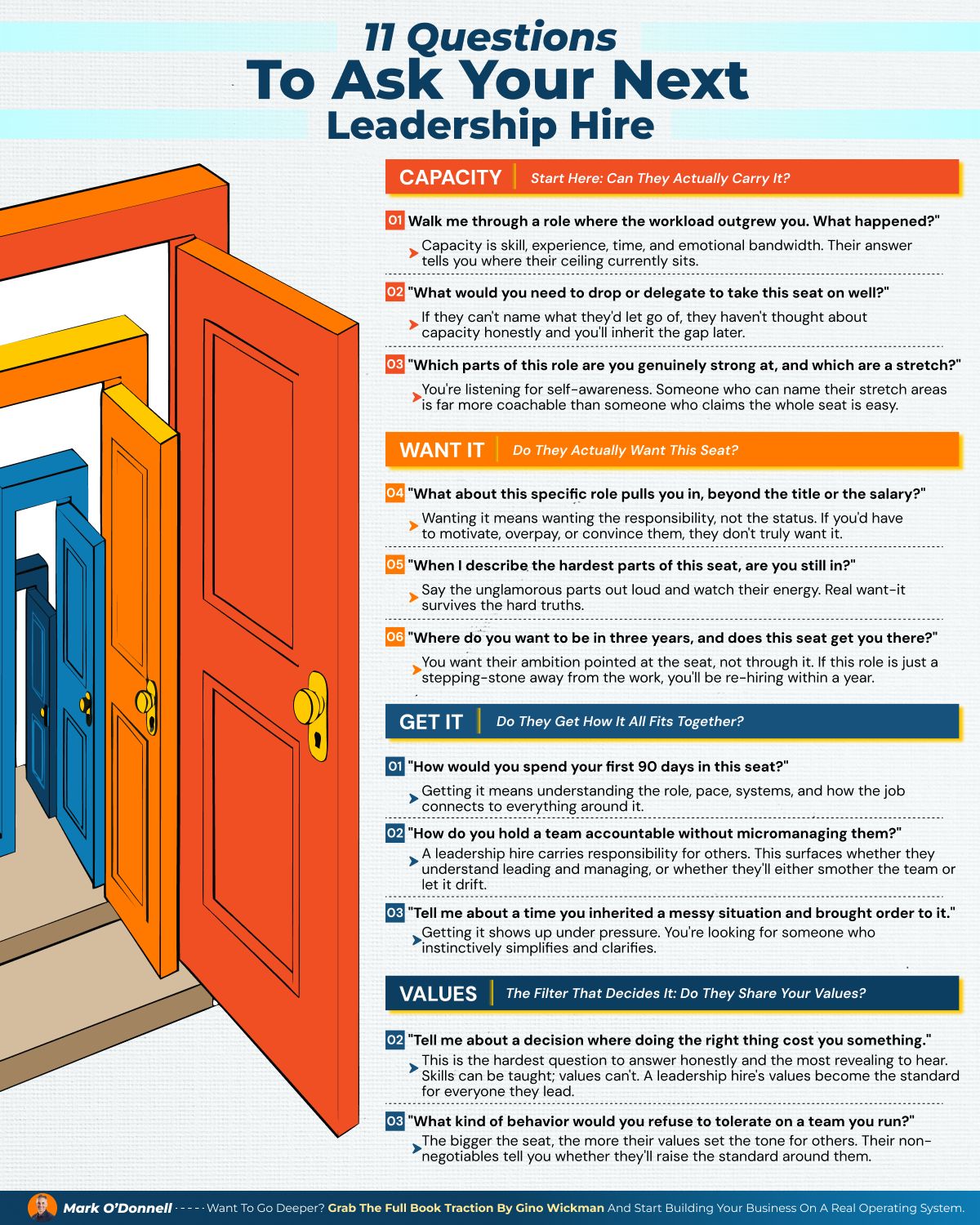
In a recent LinkedIn post, Mark O’Donnell offers a robust framework for avoiding critical leadership hiring mistakes, emphasizing the profound impact these roles have on an organization’s culture and performance. O’Donnell stresses that unlike individual contributors who primarily manage their own output, leaders fundamentally shape the environment for their teams.
As O’Donnell states:
“The way they operate becomes how the team operates. What they tolerate becomes what the team tolerates.”
This dynamic, he argues, means a misstep in leadership hiring can have cascading negative effects throughout the entire company.
The ‘Right Person, Right Seat’ Framework for Leaders
Mark O’Donnell introduces a refined approach to the established EOS (Entrepreneurial Operating System) principles of hiring the ‘Right Person’ and placing them in the ‘Right Seat’ (defined by Get It, Want It, Capacity – GWC). For leadership positions, O’Donnell advocates for even more stringent application of these filters.
Assessing Leadership Capacity
When evaluating a candidate’s capacity, O’Donnell suggests probing questions designed to reveal their ability to handle increased responsibility and potential limitations. He poses questions such as:
“Walk me through a role where the work outgrew you.”
This question, according to O’Donnell, is crucial for understanding a candidate’s perceived ceiling. He further elaborates on the importance of understanding what a candidate would relinquish to take on a new leadership role, noting that failure to identify this could lead to inheriting existing problems:
“If they can’t answer, you’ll inherit the gap.”
Another key question in this category, “Which parts of this role are a stretch?”, is designed to assess self-awareness rather than mere confidence, as O’Donnell points out.
Uncovering Genuine Desire for the Role
Beyond capability, O’Donnell emphasizes the need to ascertain if candidates truly ‘Want It’ – the work itself, not just the title or compensation. He suggests asking:
“What pulls you to this role beyond title and salary?”
According to O’Donnell, if a hiring manager finds themselves needing to persuade a candidate about the role’s merits, it’s a clear indicator that the candidate lacks genuine desire.
Ensuring Role Comprehension and Fit
The ‘Get It’ aspect focuses on a leader’s understanding of the role’s intricacies and its place within the broader organizational systems. O’Donnell recommends asking about their initial 90-day plan to gauge their grasp of the responsibilities and associated systems. Furthermore, he proposes asking:
“How do you hold a team accountable without micromanaging?”
This question, as Mark O’Donnell explains, helps discern whether a leader tends towards over-involvement or neglect.
The Primacy of Core Values
Perhaps the most critical filter, according to O’Donnell, is ensuring candidates align with the company’s Core Values. He underscores the long-term implications of value misalignment:
“Hire the wrong skills and you fix it in a quarter. But hire the wrong values and you live with it for years.”
To assess this, O’Donnell suggests questions like, “Tell me about a time doing the right thing cost you something,” and “What behavior would you refuse to tolerate on your team?” He asserts that while skills can be taught, core values are intrinsic and far more difficult to change, making them the non-negotiable foundation of a successful leadership hire.
📝 About This Content
This article is based on insights shared by Mark O'Donnell on LinkedIn.
📅 Originally posted on June 30, 2026 | View original post on LinkedIn →