
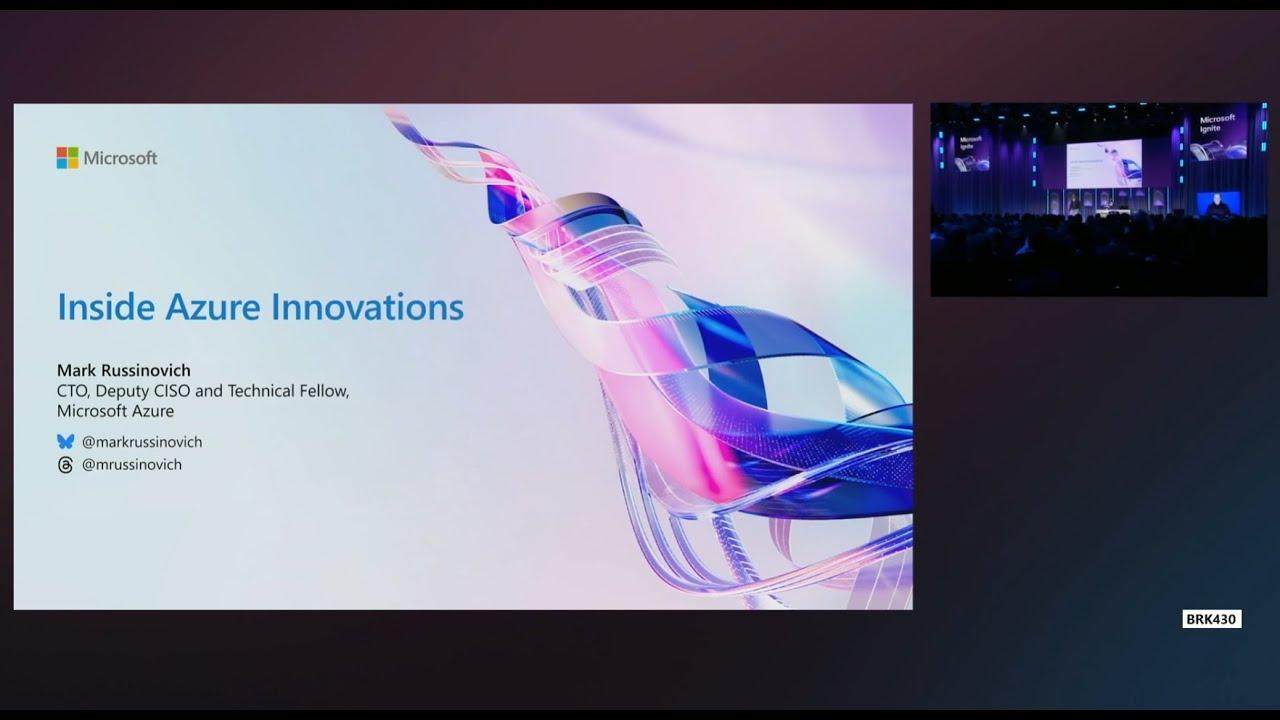
In a recent LinkedIn post, Mark Russinovich, a prominent figure at Microsoft, shared insights from an “energizing, demo-heavy session” at Microsoft Ignite, detailing recent advancements and future developments in Azure infrastructure. Russinovich’s post serves as a journalistic highlight of the innovations showcased, covering a broad spectrum of Azure’s core components including servers, compute infrastructure, serverless capabilities, storage, and networking.
The session, as described by Russinovich, delved into several cutting-edge demonstrations that push the boundaries of cloud technology. Among the key innovations highlighted were advancements in connectivity and container management.
“RDMA across cloud regions (pushing the boundaries of low-latency, high-throughput connectivity).”
This particular demonstration, as Russinovich noted, underscores Microsoft’s commitment to enabling high-performance computing scenarios within the cloud environment. The ability to leverage Remote Direct Memory Access (RDMA) across different cloud regions signifies a significant leap in network performance, crucial for demanding applications like high-frequency trading, large-scale scientific simulations, and real-time big data analytics.
Advancements in Cloud Compute and Networking
Russinovich’s post further detailed innovations in containerization and network traffic management. The live migration for Direct Virtualization containers, including scenarios involving Azure Container Instances and Manifold, was presented as a key feature for enhanced operational flexibility and resilience.
Additionally, the introduction of VTAP for Azure Virtual Network was highlighted as a tool for simplifying network monitoring and security workflows. As Mark Russinovich explained, this feature is designed to streamline traffic mirroring and inspection, making it easier for organizations to maintain visibility and control over their cloud networks.
“VTAP for Azure Virtual Network for streamlined traffic mirroring and inspection workflows.”
The scale of Azure’s storage capabilities was also a focal point. Russinovich reported on a significant milestone achieved in storage performance:
“Scaled Azure Storage hitting 50 Tb/s read bandwidth in a multi-VM push.”
This remarkable figure demonstrates the immense scalability of Azure Storage, capable of delivering petabits per second of read bandwidth, which is essential for data-intensive workloads and large-scale deployments.
Exploring Unconventional Computing with Optical Technology
Perhaps the most forward-looking aspect of the session, as detailed in Russinovich’s post, was the exploration of unconventional computing approaches for AI workloads. The finale of the demonstration involved a neural optical computer capable of recognizing handwritten digits.
This groundbreaking technology is built upon Microsoft Research’s work with Analog Optical Computers (AOCs). Russinovich pointed out the significance of this approach:
“a neural optical computer recognizing handwritten digits —built on Microsoft Research’s Analog Optical Computer (AOC) work, an unconventional computing approach aimed at accelerating AI inference and optimization workloads.”
According to Mark Russinovich, this venture into optical computing represents a strategic effort to accelerate Artificial Intelligence inference and optimization tasks. This area of research holds the potential to overcome the limitations of traditional electronic computing for certain AI workloads, offering a glimpse into the future of high-performance, energy-efficient computation.
The session, which Russinovich invited his audience to watch, particularly the segment on optical computing starting around 41:20, provides a comprehensive look at Microsoft’s ongoing commitment to innovation across the entire Azure infrastructure stack and its exploration of next-generation computing paradigms.
📝 About This Content
This article is based on insights shared by Mark Russinovich on LinkedIn.
📅 Originally posted on December 12, 2025 | View original post on LinkedIn →