
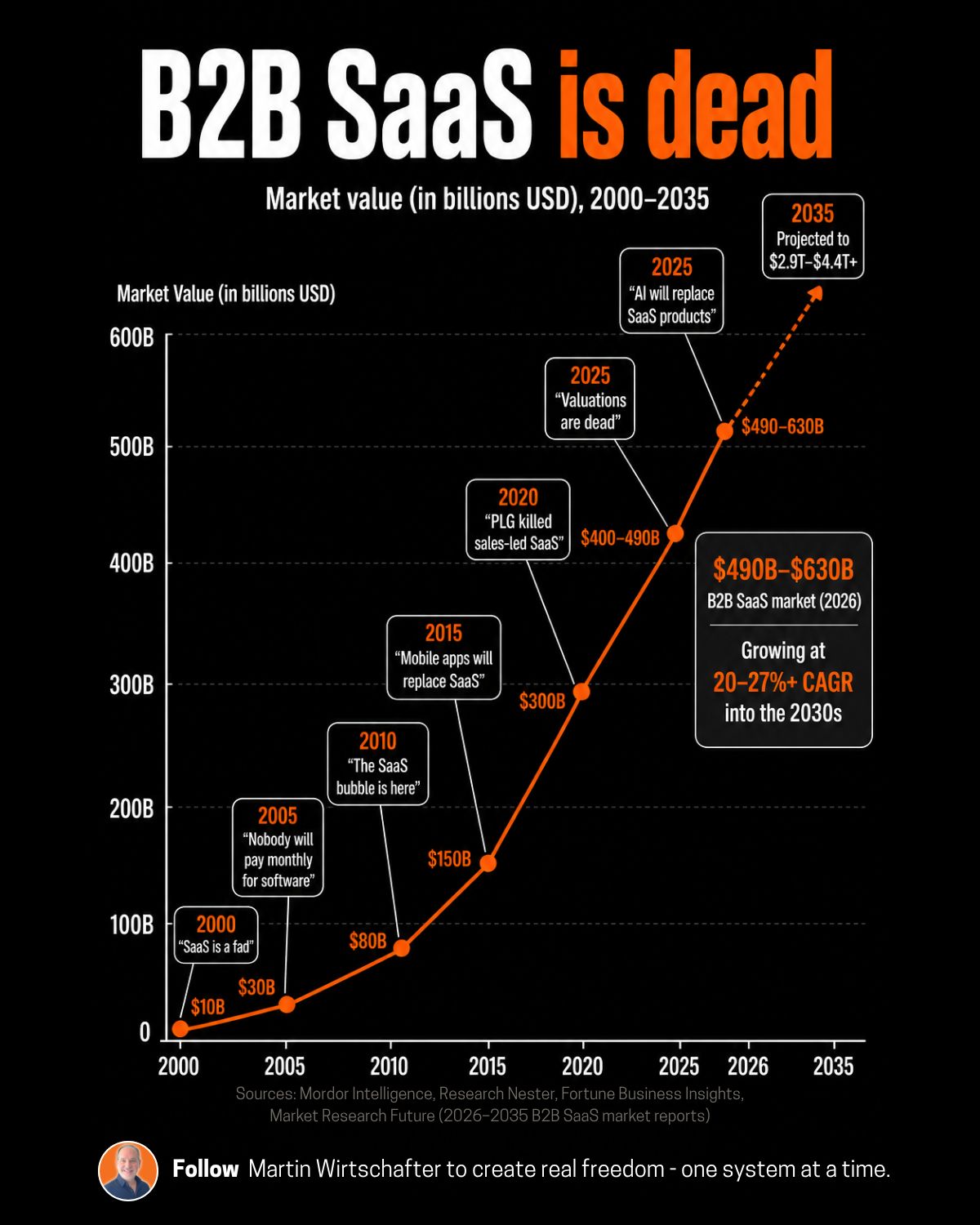
In a recent LinkedIn post, Martin Wirtschafter tackles the recurring narrative that Business-to-Business Software-as-a-Service (B2B SaaS) is on its last legs. Wirtschafter argues that despite perennial predictions of its demise, B2B SaaS continues to demonstrate resilience and growth, often absorbing or building upon the very technologies and trends that are proclaimed to replace it. He highlights a historical pattern of skepticism followed by integration, suggesting that the current anxieties are merely the latest iteration of an ongoing cycle.
The Persistent ‘Death’ of B2B SaaS
Wirtschafter opens by listing a series of past pronouncements and events that have been framed as the end of B2B SaaS, from the dot-com crash and the SaaS bubble to more recent concerns about mobile apps, crowded cloud markets, niche vertical SaaS, Product-Led Growth (PLG), and valuation resets. He points out that even as prominent figures like Microsoft CEO Satya Nadella and various venture capitalists and investors publicly question the future of traditional SaaS models, the underlying market continues to expand.
“B2B SaaS has been dying since 2000.”
This sentiment, Wirtschafter suggests, has been a constant undercurrent. He notes that in the early 2000s, analysts doubted that network-based applications could truly supplant on-premise software. Today, similar doubts are being voiced about the impact of AI and autonomous agents on established SaaS products.
SaaS as a Foundation for Innovation
Despite these recurring doubts, Wirtschafter presents data illustrating the robust growth of the SaaS market. He cites figures indicating the market is already worth over $490 billion and is projected to exceed $630 billion in the current year, with long-term forecasts placing it between $2.9 trillion and $4.4 trillion by 2034-2035. This sustained growth, according to Wirtschafter, underscores the fundamental value and adaptability of the SaaS model.
Innovation Builds on SaaS
A key argument made by Wirtschafter is that technologies and approaches often heralded as SaaS killers have, in practice, become extensions or enablers of SaaS itself. He asserts:
“Every ‘SaaS killer’ so far has ended up building on SaaS.”
This perspective suggests that rather than being replaced, SaaS is evolving. Whether it’s the integration of AI capabilities into existing platforms or the use of mobile interfaces to access SaaS solutions, the core delivery model of software via subscription and network access remains a foundational element for innovation and market expansion.
The Enduring Principles for SaaS Founders
Wirtschafter concludes by reminding SaaS founders that the core tenets of building a successful business remain constant, regardless of market predictions. He emphasizes the importance of:
- Building a product that addresses a genuine market need.
- Continuously improving the product in response to market changes.
- Structuring the company for growth that is independent of the founder’s direct involvement.
As Martin Wirtschafter puts it:
“Build something people genuinely need. Keep improving it as the market changes. Most importantly, build the company so its growth is no longer limited by your presence. That’s the work.”
His overall message is one of measured optimism, viewing the current discourse not as an existential threat to B2B SaaS, but as a sign of its ongoing maturation and integration with new technological paradigms. Wirtschafter firmly believes that B2B SaaS is not over, but rather is in a dynamic phase of evolution.
📝 About This Content
This article is based on insights shared by Martin Wirtschafter on LinkedIn.
📅 Originally posted on July 24, 2026 | View original post on LinkedIn →