
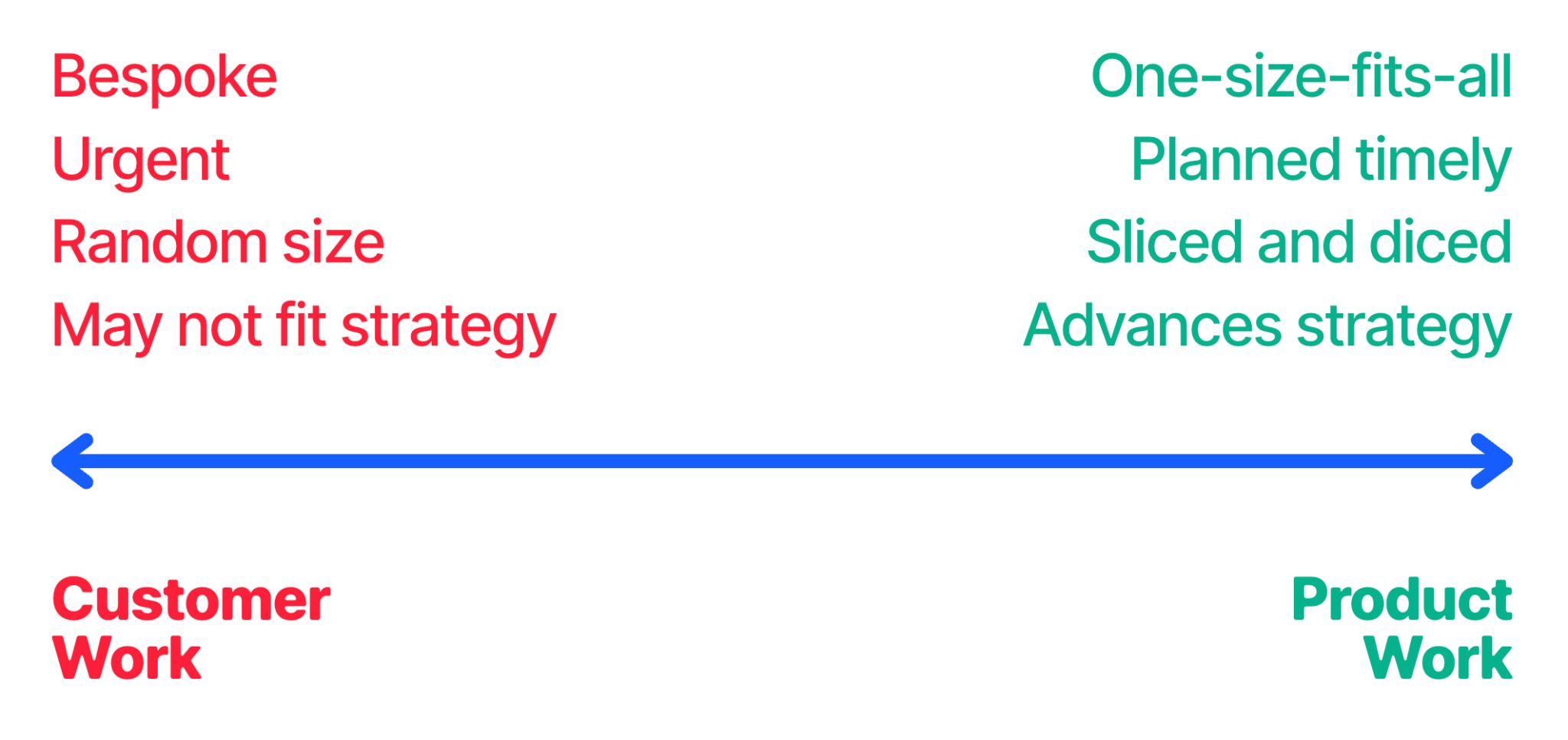
In a recent LinkedIn post, 🌀 Luca Rossi explores the complex challenge that enterprise B2B engineering teams face when balancing their product roadmap with bespoke customer requests. Rossi highlights the fundamental conflict that arises when a high-value customer asks for a feature that wasn’t part of the original product plan, posing the critical question of whether to accept or decline such requests and how to manage them without derailing ongoing development.
Rossi contends that the core of the issue lies in the inherent differences between dedicated product development and custom client work. “Customer work and product work are fundamentally different,” Rossi states, emphasizing that they diverge in urgency, scope, and strategic alignment. Attempting to manage both under a single, unified process is, in his view, a common pitfall that leads to operational inefficiencies and strategic drift.
“So trying to manage both under the same process, with the same people, is a recipe for failure.”
Distinguishing Roles for Customer-Specific Work
To navigate this challenge, 🌀 Luca Rossi proposes a strategic separation of roles and responsibilities. He advocates for the creation of specialized teams, such as Field Development Engineers (FDEs), solution engineers, and sales engineers, to act as a buffer between customer demands and the core product engineering team. These roles, he suggests, should operate closer to the sales function, allowing them to address client needs swiftly without disrupting the product team’s focus.
Shielding the Roadmap
According to Rossi, the primary function of these specialized roles is to protect the product roadmap. By fielding and managing customer requests, these teams ensure that the product development cycle remains dedicated to the strategic vision, rather than being constantly sidetracked by individual client needs. Rossi explains that these individuals are equipped to solve problems rapidly, thereby minimizing the impact on the main engineering effort.
“[Roles like] FDEs, solution engineers, and sales engineers exist to shield your roadmap from customer requests.”
Leveraging Platform Investments
Beyond structural changes, 🌀 Luca Rossi also stresses the importance of a robust underlying platform. He argues that investing in strong APIs, component frameworks, and design systems empowers these specialized customer-facing teams. A well-built platform enables them to develop solutions more efficiently and ensures that the code produced for customer-specific features is closer to being product-ready, facilitating potential future integration into the main product.
Strategic Divergence and Convergence
Rossi’s approach involves a deliberate strategy of allowing customer work to diverge from the main product development path, with planned points of convergence. He advises against forcing immediate integration of customer requests into the real-time product process. Instead, he suggests allowing this work to exist separately and then periodically evaluating which elements are valuable enough to be merged back into the core product. This allows for flexibility while maintaining a clear product direction.
“Let it diverge, then converge — don’t force customer work into your product process in real time.”
Validating Product Input
Furthermore, 🌀 Luca Rossi views customer-specific work, when handled correctly, as a highly validated form of product input. He posits that features developed to meet a paying customer’s needs have already undergone a crucial real-world test. “Treat customer work as validated product input,” Rossi urges, noting that this provides a stronger signal of market need than many items typically found in a product backlog.
Due Diligence on Customer Requests
Before committing to any customer-specific development, Rossi emphasizes the need for rigorous evaluation. He encourages teams to ask critical questions to ensure that the proposed work aligns with business objectives and product strategy. Key considerations include evaluating the cost of development against the customer’s lifetime value, discerning genuine need from arbitrary requests, and assessing the long-term impact on the product’s evolution.
“Ask hard questions before saying yes — how much does it cost vs the customer’s LTV? Is it really needed, or just a random ask?”
By implementing these strategies, 🌀 Luca Rossi suggests that B2B startups can better manage the inherent tension between serving their existing high-value customers and maintaining a focused, strategic product development roadmap.
📝 About This Content
This article is based on insights shared by 🌀 Luca Rossi on LinkedIn.
📅 Originally posted on July 8, 2026 | View original post on LinkedIn →