
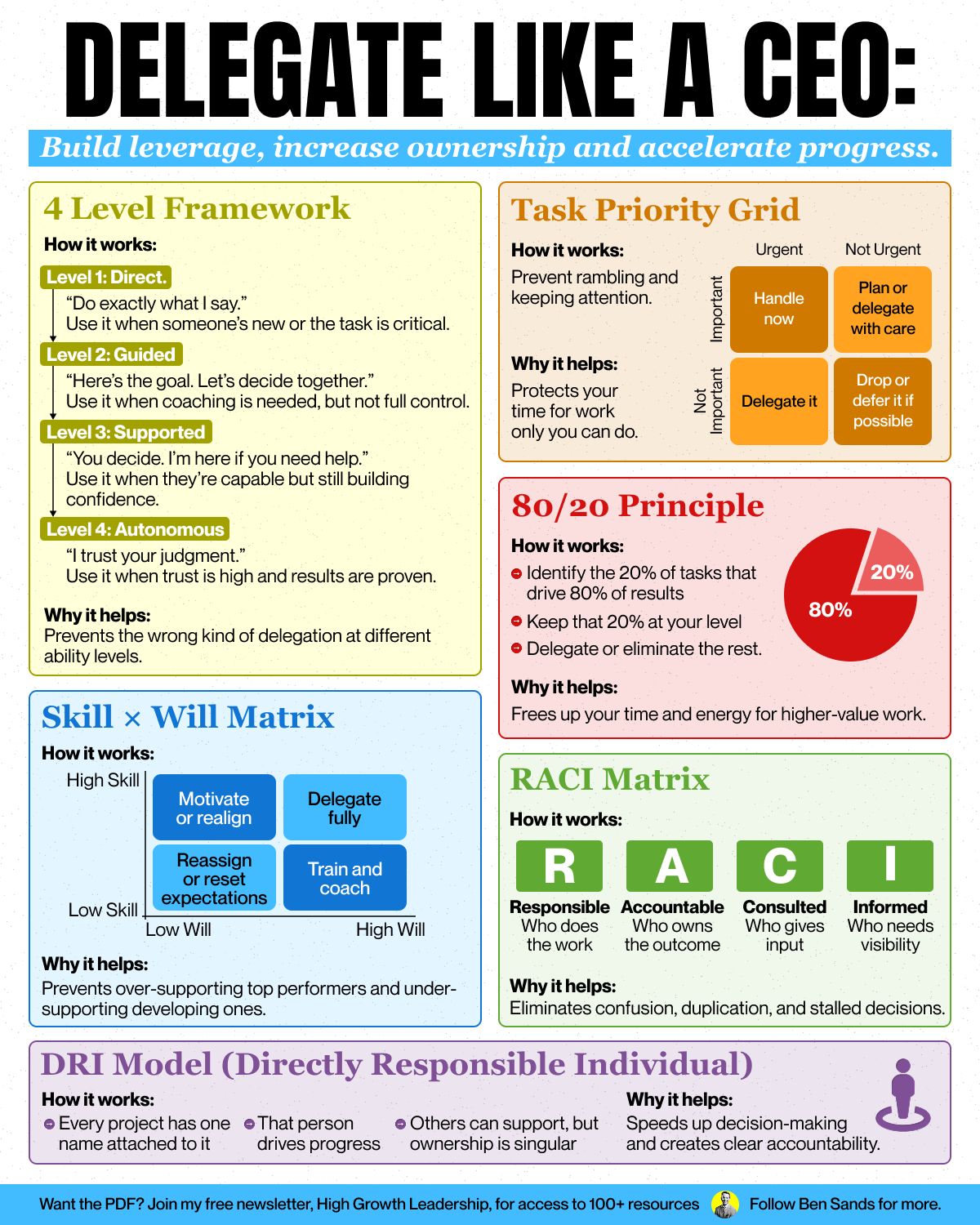
In a recent LinkedIn post, Ben Sands delves into the common pitfalls of delegation and offers a structured approach to ensure tasks are not only completed but also foster team growth and leadership. Sands highlights a recurring cycle where leaders, after handing off tasks, often find themselves redoing the work, which he posits stems from a misunderstanding of delegation as a mere behavior rather than a robust system.
He emphasizes the transformative potential of effective delegation, stating:
Delegation isn’t just a behavior. It’s a system. When that system works, you get: More ownership from your team, Faster decisions, Stronger future leaders.
Sands argues that the failure to delegate effectively can lead to leaders becoming bottlenecks, preventing both their own advancement and the development of their team members. To combat this, he introduces six frameworks designed to build a successful delegation system.
Frameworks for Mastering Delegation
Ben Sands outlines several practical frameworks to help leaders delegate more effectively. These tools are designed to clarify roles, match tasks to capabilities, and ensure accountability.
1. The 4 Levels of Autonomy
According to Sands, matching the level of autonomy to an individual’s capability is crucial. He breaks this down into four levels:
- Level 1: Direct – Used for critical tasks or when onboarding new team members.
- Level 2: Guided – The team member leads, with the manager providing coaching.
- Level 3: Supported – Progress is checked periodically, not at every step.
- Level 4: Autonomous – Full ownership and accountability are granted.
This approach, as Sands notes, allows for progressive empowerment of the team.
2. Task Priority Grid
Sands suggests using a Task Priority Grid to help leaders protect their time for high-impact activities. The grid categorizes tasks based on urgency and importance:
- Important + Urgent: To be done immediately.
- Important + Not Urgent: To be scheduled.
- Not Important + Urgent: Ideal candidates for delegation.
- Not Important + Not Urgent: Should be eliminated.
“Protect time for work only you should do,” Sands advises, underscoring the need for strategic time management.
3. The 80/20 Principle (Pareto Principle)
Applying the 80/20 principle to delegation means identifying the critical 20% of tasks that yield 80% of the results. Sands advocates for keeping this high-impact work at the leader’s level while delegating or removing the rest. This ensures that leadership focus remains on the most valuable activities.
4. RACI Matrix
To prevent work from stalling due to unclear responsibilities, Sands recommends the RACI Matrix. This framework defines roles as:
- Responsible: Those who perform the work.
- Accountable: The one who owns the outcome.
- Consulted: Those who provide input.
- Informed: Those who need to be kept updated.
As Ben Sands points out, clarifying these roles ensures smoother project execution.
5. DRI Model (Directly Responsible Individual)
The DRI model, according to Sands, assigns a single owner to drive each project’s result, with others providing support. This singular ownership prevents confusion and ensures clear accountability.
6. Skill × Will Matrix
Finally, Sands introduces the Skill × Will Matrix to tailor support based on an employee’s capability and motivation. This matrix guides leaders on whether to delegate fully (High Skill, High Will), re-engage (High Skill, Low Will), train and coach (Low Skill, High Will), or reset expectations (Low Skill, Low Will).
Sands concludes his post by reiterating that delegation, when done correctly, is not just about freeing up a leader’s time but is fundamental to building future leaders. He encourages leaders to shift from delegating tasks to delegating outcomes, thereby removing themselves as the primary bottleneck.
📝 About This Content
This article is based on insights shared by Ben Sands on LinkedIn.
📅 Originally posted on March 12, 2026 | View original post on LinkedIn →