
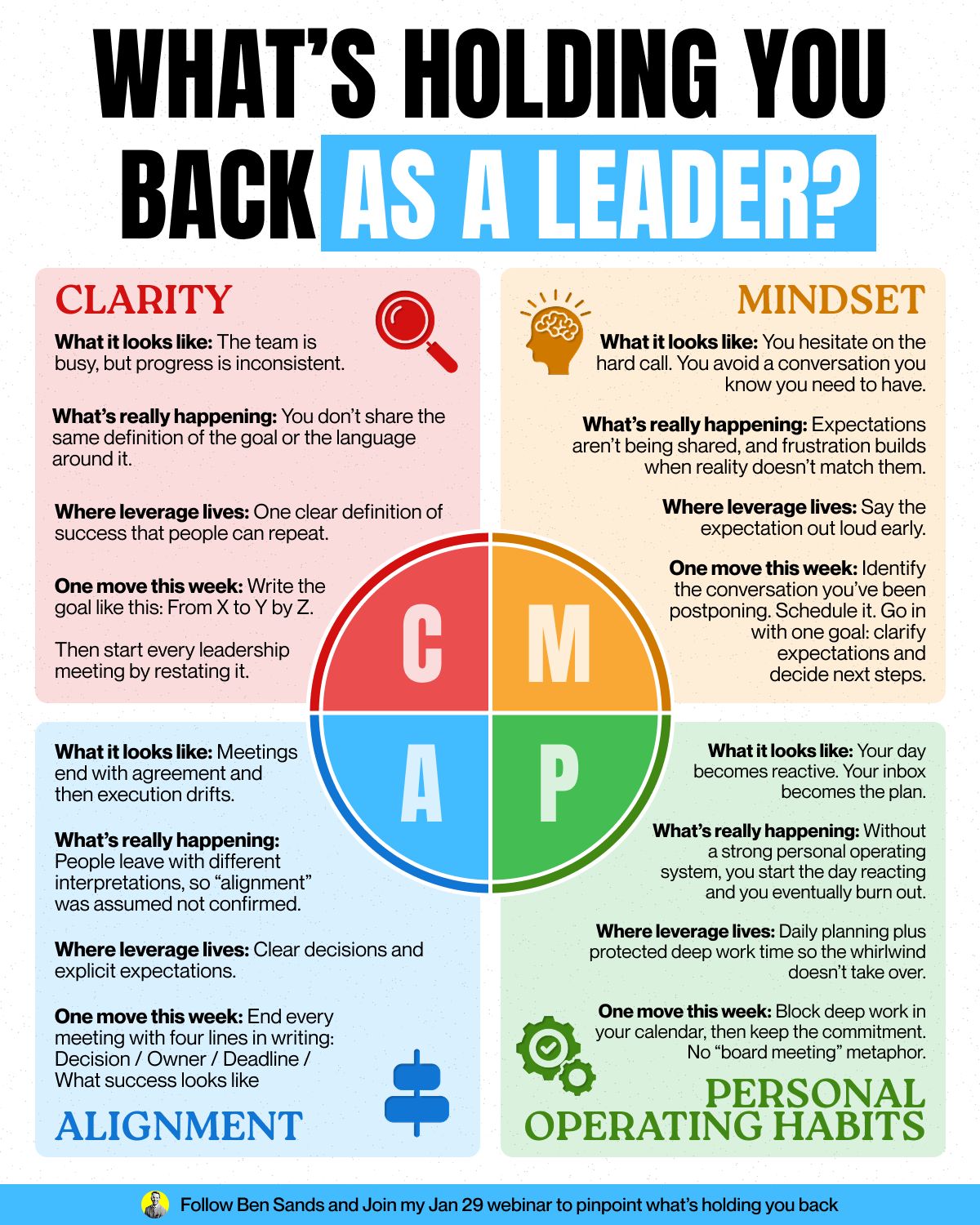
In a recent LinkedIn post, Ben Sands discusses the critical issue of “execution drift” and offers actionable strategies for business leaders to counteract it before it derails their Q2 objectives. Sands frames the problem as a common pitfall that emerges as the initial New Year’s energy wanes, leading to reactive “inbox fires” and “quick fixes” that consume time without advancing core business goals.
Sands highlights that this slowdown isn’t due to a lack of effort but rather the subtle slipping of key operational “levers.” He identifies four primary areas where this drift commonly occurs:
“Inbox fires.”
“Quick fixes.”
Calendar Tetris.End result?
Your day is full… but none of the work that actually moves the business forward gets done.
The Four Levers of Execution
According to Ben Sands, the erosion of effective execution can be attributed to a decline in clarity, mindset, alignment, and personal operating habits. He emphasizes that even a single lever slipping can cause significant drift, while all four can leave a company feeling “stuck.”
1. Clarity: Defining Success
Sands points out that a lack of clarity leads to busy teams making inconsistent progress. To combat this, he advises leaders to ensure goals are sharply defined, suggesting a format like: “From X to Y by Z.” This approach provides a clear target and timeline, fostering accountability and measurable progress.
2. Mindset: Tackling Difficult Tasks
Under the umbrella of mindset, Sands addresses the tendency for leaders to hesitate on tough decisions or avoid necessary conversations. He advocates for a proactive approach, urging leaders to “Name the thing you’ve been postponing. Put it on the calendar. Do it.” This direct confrontation of avoidance is presented as crucial for maintaining momentum.
3. Alignment: Ensuring Follow-Through
Execution drift is often exacerbated by a gap between meeting agreements and actual follow-through. Ben Sands observes that while teams may “agree” in meetings, this often doesn’t translate into action. To rectify this, he proposes a rigorous meeting structure: “End every meeting with: decision, owner, deadline, success criteria.” This ensures that every discussion concludes with clear ownership and measurable outcomes.
The team is busy, but progress is inconsistent.
4. Personal Operating Habits: Protecting Deep Work
Finally, Sands addresses personal operating habits, noting how leaders can become overly reactive, allowing their inboxes to displace top priorities. His solution is to “Block deep work and defend it.” This proactive scheduling and protection of focused work time is presented as essential for leaders to tackle the strategic initiatives that truly move the business forward.
Your day becomes reactive and your top priorities get displaced by your inbox.
Ben Sands concludes by posing a critical question to his audience: “If you had to fix just one lever this quarter, which would move the needle the most?” He also announced a live session on January 29th at 1:30 pm ET, aimed at senior leaders, to delve deeper into world-class performance skills, the distinction between A-Players and A-Teams, scaling strategies, and a 90-Day Breakthrough Plan.
Even one of these can cause drift. All four together can make a company feel stuck. Stalled projects, frustrated teams, exhausted operators.
📝 About This Content
This article is based on insights shared by Ben Sands on LinkedIn.
📅 Originally posted on January 19, 2026 | View original post on LinkedIn →