
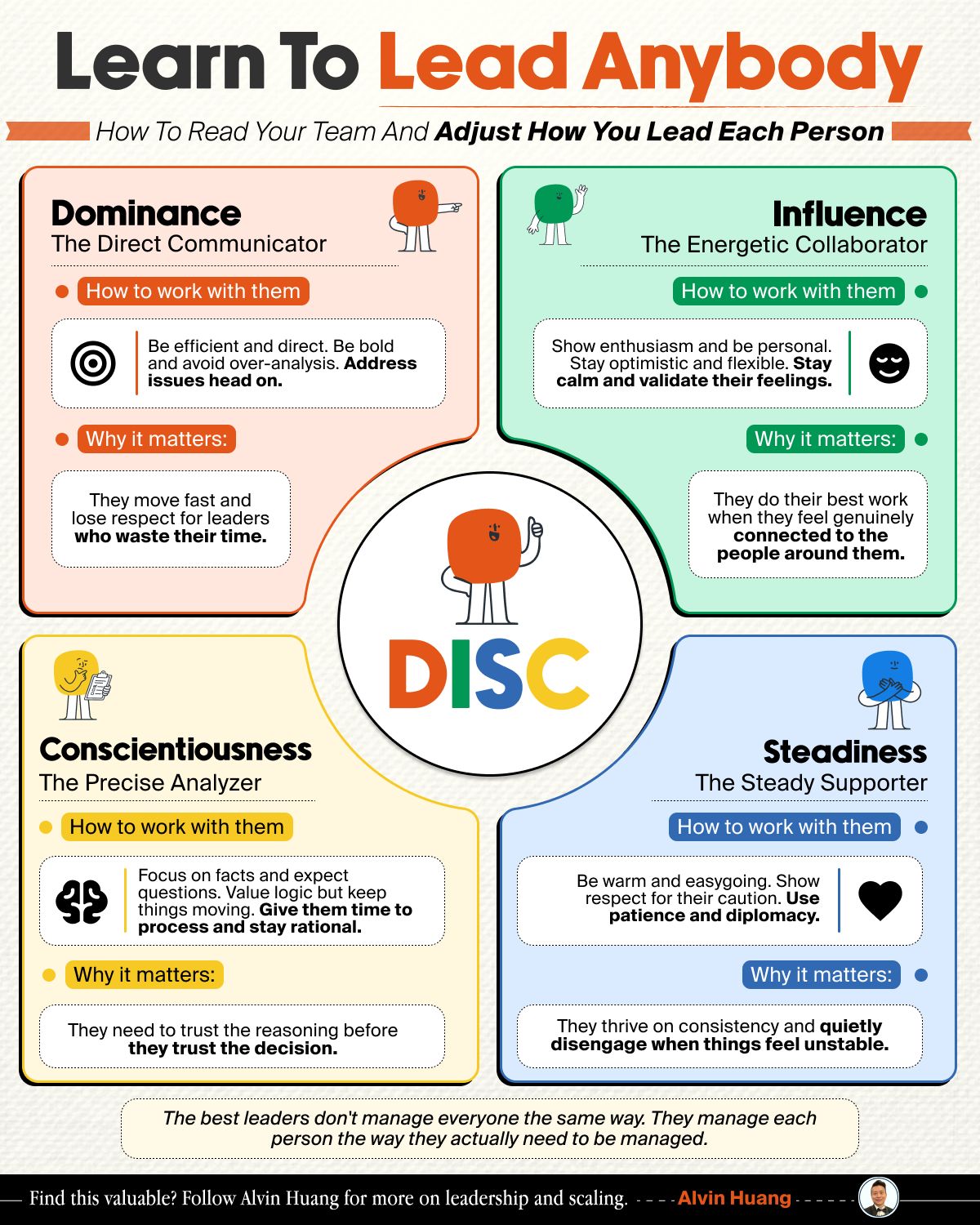
In a recent LinkedIn post, Alvin Huang shares a powerful personal lesson on leadership, emphasizing the critical need to adapt management styles to individual team members rather than adhering to a single, uniform approach. Huang recounts how two of his best managers perceived his leadership in diametrically opposed ways – one finding him too harsh, the other too indirect – despite him using the exact same communication methods with both. This experience, he explains, underscored a fundamental flaw in his early management: treating all four of his direct reports as if they would respond identically.
The Pitfalls of a Scripted Leadership Style
Alvin Huang highlights the detrimental effects of a standardized leadership approach. His post details how this method, while functional for some, ultimately began to damage relationships with others on his team. He emphasizes that a mismatch in communication styles can easily be mistaken for a personality clash, leading to misunderstandings and friction.
“I had been managing four different people as if they would all respond the same way to me. And that approach worked fine for two people on my team, but slowly damaged my relationship with the other two.”
This realization, according to Huang, was a turning point, prompting him to develop a more nuanced understanding of individual differences in the workplace. He stresses that the individuals often perceived as most challenging may, in fact, be the most valuable team members, simply being led in an incongruent manner.
Decoding Different Communication Preferences
Huang’s post breaks down four distinct communication and leadership archetypes, offering strategies for effectively engaging with each:
1. The Direct Communicator
This individual values speed and directness. Huang advises leaders to “Lead with the decision, not the backstory” and to avoid softening negative feedback, as it can be perceived as a waste of their time. Checking in too frequently can feel like micromanagement to this type.
2. The Energetic Collaborator
For those who thrive on enthusiasm and thinking aloud, Huang suggests providing flexibility rather than rigid structure, as the latter can stifle their energy. Public recognition is particularly important for this group. He notes that they often process problems by talking through them extensively.
3. The Steady Supporter
Patience is key when managing the Steady Supporter. Huang recommends giving advance notice for changes, as abrupt shifts can be unsettling. He points out that these individuals may not readily admit when they are overwhelmed, requiring leaders to ask directly. Consistency from the leader is highly valued.
4. The Precise Analyzer
This type requires facts, logic, and time to process information before making decisions. Huang cautions against demanding immediate gut reactions, as this can lead to poorer outcomes. He advocates for showing the reasoning behind conclusions and providing specific, rather than vague, praise.
“A mismatch in style looks like a personality clash from the outside. But the people you find hardest to manage are often your best people, led the wrong way.”
Leveraging Tools for Enhanced Communication
To solidify these learnings and improve his own communication, Alvin Huang mentions utilizing AI-powered strength finders. He explains that this approach significantly enhances his ability to communicate effectively with each individual based on their unique profile.
“This is what it taught me about reading people since then, instead of leading everyone off one script:”
Huang concludes by posing a question to his audience, inviting them to identify which communication style resonates most with their own work behavior. He implies that understanding these differences is not just beneficial for the leader but crucial for unlocking the full potential of their teams.
“Which one sounds like you at work?”
The post also includes a promotional mention of “The Vault,” a resource containing systems and templates Huang developed for managing 1:1s across a large global team, available for free download.
📝 About This Content
This article is based on insights shared by Alvin Huang on LinkedIn.
📅 Originally posted on July 24, 2026 | View original post on LinkedIn →