
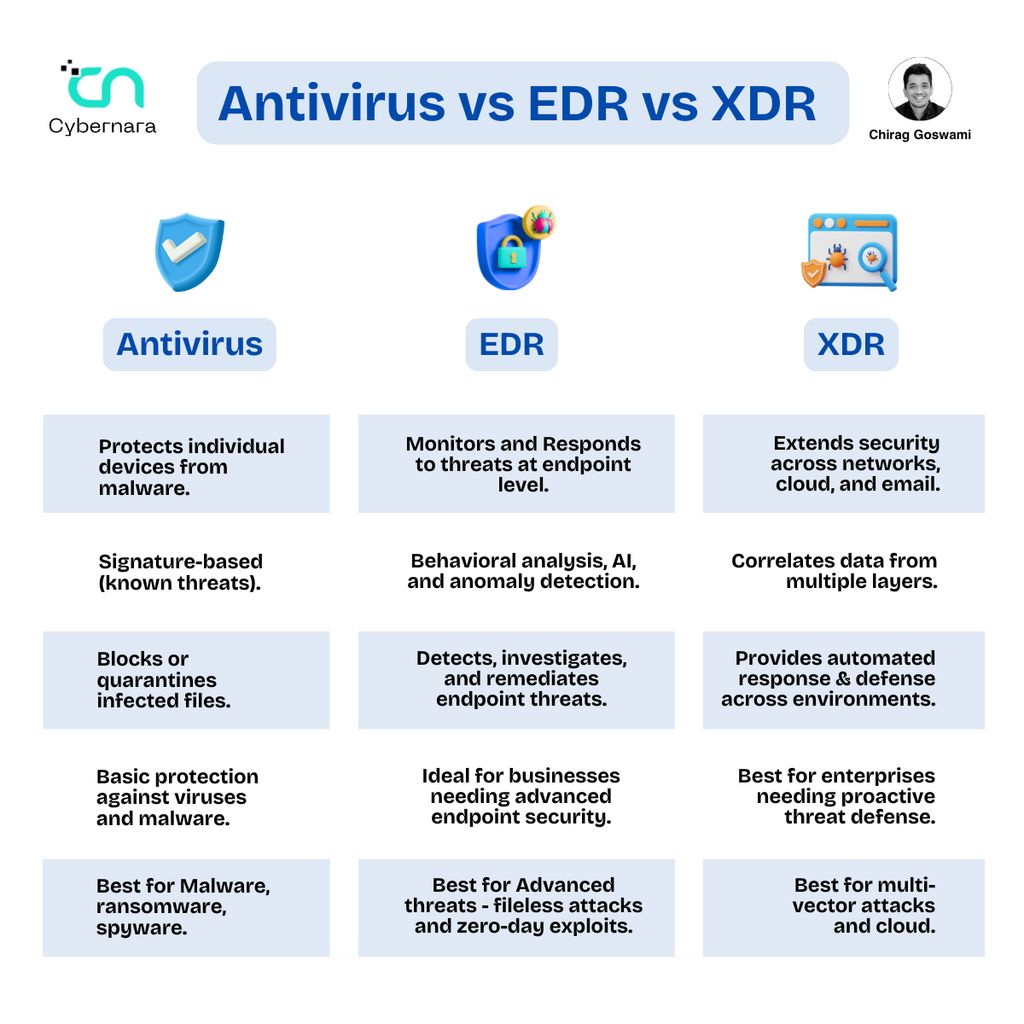
In a recent LinkedIn post, Chirag Goswami explores the evolving landscape of cybersecurity defenses, questioning the sufficiency of traditional antivirus solutions in today’s threat environment. Goswami highlights the limitations of legacy systems and advocates for more integrated approaches like Extended Detection and Response (XDR) to effectively combat sophisticated cyberattacks.
Goswami begins by clearly defining the roles of different security tools:
Antivirus stops known malware.
EDR hunts suspicious behavior.
XDR connects the dots across endpoints, cloud, network, and email.
This foundational explanation sets the stage for his argument that a multi-layered defense is no longer optional but a necessity. As Goswami points out, the nature of cyber threats has changed dramatically. Attackers are no longer relying on single vectors of attack, which means defensive strategies must adapt accordingly.
The Inadequacy of Traditional Antivirus
Goswami argues that relying solely on traditional antivirus software leaves organizations in a reactive posture. He states:
If your security stack still relies only on traditional antivirus, you’re reacting — not defending. 🚨
This perspective underscores a critical shift in cybersecurity philosophy. While antivirus has historically been a cornerstone of endpoint protection, its effectiveness against advanced persistent threats (APTs) and fileless malware is increasingly limited. Goswami’s emphasis on ‘reacting, not defending’ suggests that traditional methods are insufficient for proactive threat hunting and rapid incident response.
The Case for Integrated Security: EDR and XDR
The post then pivots to the more advanced solutions that Goswami believes are crucial for modern enterprises. Endpoint Detection and Response (EDR) tools are presented as a step up from antivirus, focusing on identifying anomalous behavior rather than just known threats. However, Goswami champions XDR as the ultimate solution for comprehensive security.
XDR, as described by Goswami, offers a unified view by correlating data across multiple security layers – endpoints, cloud infrastructure, network traffic, and email systems. This holistic approach is vital because, as he notes,
Attackers don’t use just one technique anymore.
Therefore, defenders cannot afford to operate in silos. The interconnectedness of XDR allows security teams to gain deeper visibility, detect complex attack chains, and respond more swiftly and effectively to emerging threats. This integration is key to moving beyond basic protection towards a truly robust defense strategy.
Designing Layered Defense Strategies
Goswami concludes by positioning his company, Cybernara, as a partner for organizations seeking to implement these advanced security models. He emphasizes the need for ‘layered, modern detection and response strategies’ rather than a superficial approach to security compliance.
For businesses struggling to navigate the complexities of choosing and implementing the right security stack, Goswami offers his expertise. His message is clear: the era of single-point security solutions is over, and a comprehensive, integrated approach is the only way to stay ahead of sophisticated cyber adversaries.
📝 About This Content
This article is based on insights shared by Chirag Goswami on LinkedIn.
📅 Originally posted on December 18, 2025 | View original post on LinkedIn →