
In a recent LinkedIn post, Eric Partaker challenges the common misconception that busyness equates to productivity. He shares a pivotal moment where a mentor’s question, “Are you actually getting anything done?”, shifted his perspective from mere activity to meaningful accomplishment. Partaker argues that the hallmark of effective leadership isn’t working harder, but working smarter by guarding time, focusing on high-impact tasks, and ruthlessly eliminating distractions.
From Busywork to Breakthroughs
Partaker recounts his past tendency to pride himself on a packed schedule, characterized by back-to-back meetings and an overflowing inbox. However, he realized this constant state of activity was not yielding significant results. “I was busy. But I wasn’t productive,” he states, highlighting a critical distinction many professionals grapple with. This realization prompted him to seek strategies that distinguish genuine productivity from the appearance of it.
“The best leaders don’t work harder. They guard their time, Focus on high-impact work, Eliminate nearly everything else.”
A Toolkit for Time Mastery
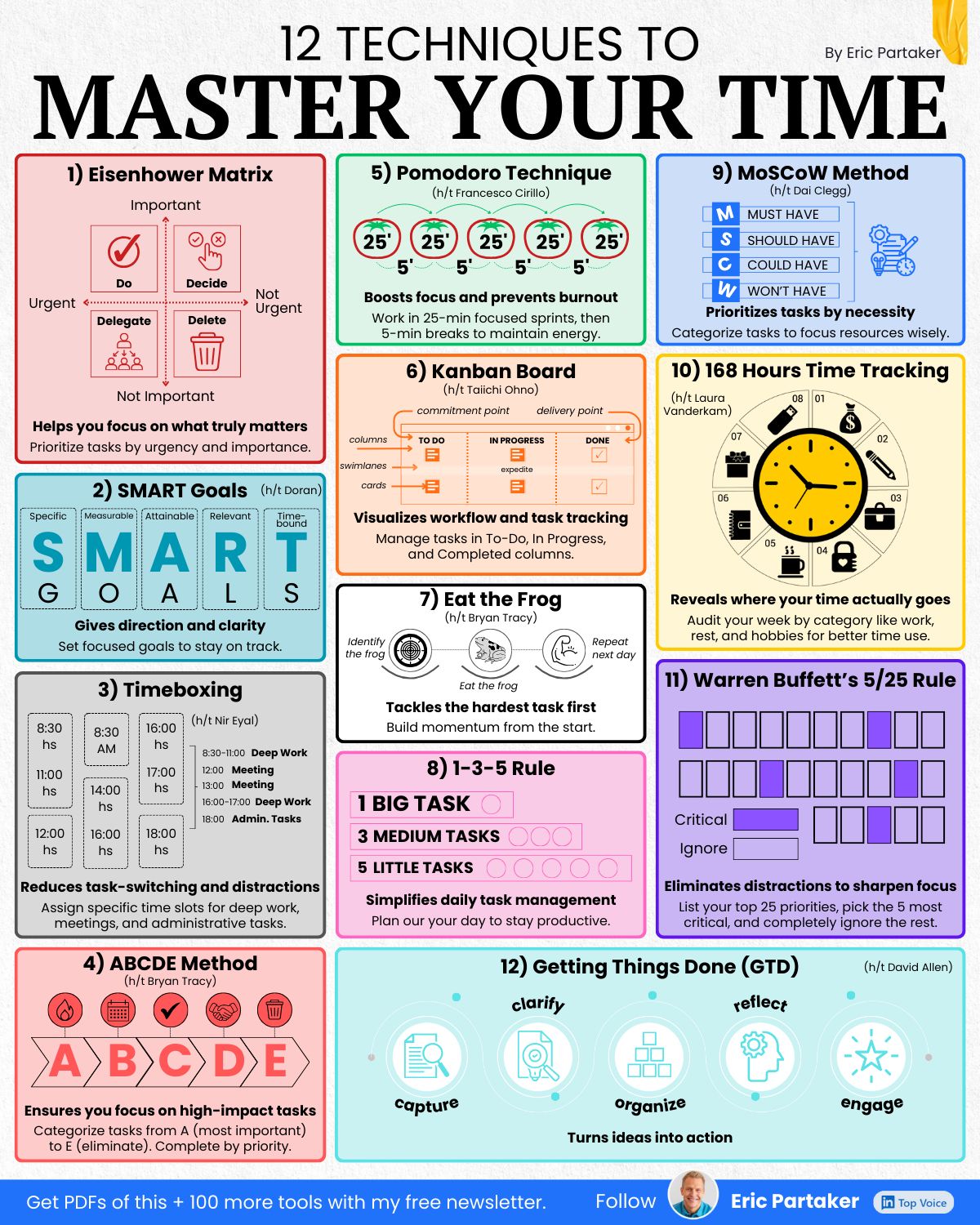
To help others navigate this challenge, Partaker outlines 12 proven tools and methods designed to help individuals master their time, drawing parallels to the efficiency expected of Fortune 500 CEOs. These tools offer practical frameworks for prioritizing, focusing, and managing workflow.
Prioritization Frameworks
Several of the tools focus on distinguishing urgent tasks from important ones. The Eisenhower Matrix, for instance, is presented as a method to separate these two categories, preventing individuals from getting caught in a cycle of urgent but unimportant activities. Similarly, the ABCDE Method encourages ranking tasks to ensure that focus remains on what truly matters. Partaker also highlights Warren Buffett’s 5/25 Rule, which advocates for listing numerous goals but concentrating efforts on a select few while completely disregarding the rest.
Focus and Workflow Management
Partaker emphasizes techniques that foster deep work and minimize distractions. Timeboxing is recommended to block out specific periods for focused work, countering the detrimental effects of multitasking. The Pomodoro Technique, with its intervals of focused work followed by short breaks, is suggested for maintaining energy and sharpness throughout the day. For managing overwhelm, a Kanban Board with its simple “To-Do, In Progress, Done” columns is offered as a way to quickly clear mental clutter.
“You can’t scale your impact if you’re drowning in busywork.”
Other tools introduced include the SMART Goals framework for effective planning, the Eat the Frog principle for tackling the most challenging task first, the 1-3-5 Rule for a manageable daily task list, the MoSCoW Method for clarifying task necessity, and Getting Things Done (GTD) for systematic execution. Partaker also suggests 168 Hours Time Tracking to identify hidden time gaps.
Implementing Change for Greater Impact
Crucially, Partaker advises that mastering time management doesn’t require adopting all 12 tools at once. He encourages readers to “Start with one. Build from there.” His core message is that incremental shifts in how time is allocated can lead to significant improvements in outcomes.
“Small shifts in how you spend your hours create massive changes in your results.”
Concluding with an empowering metaphor, Partaker reminds his audience, “The bad news is time flies. The good news? You’re the pilot.” He prompts engagement by asking about their favorite time management tools and offers a free “Master Your Time” cheat sheet for those interested in further developing their skills.
📝 About This Content
This article is based on insights shared by Eric Partaker on LinkedIn.
📅 Originally posted on May 8, 2026 | View original post on LinkedIn →