
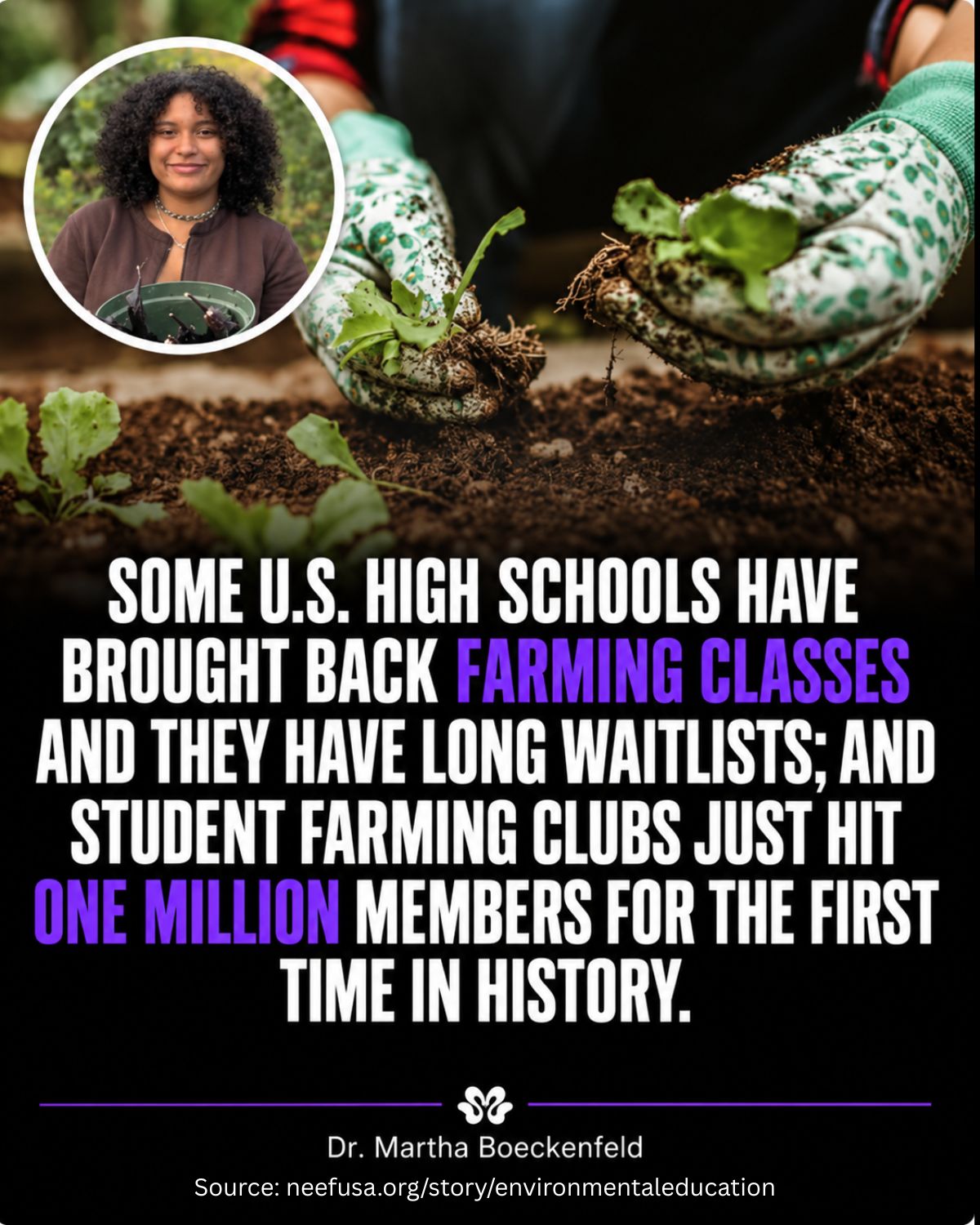
In a recent LinkedIn post, Dr. Martha Boeckenfeld highlights a significant, yet often overlooked, trend in education and technology: the surging interest among high school students in modern agriculture. While headlines are frequently dominated by discussions of software and artificial intelligence, Dr. Boeckenfeld points to a substantial movement of over a million students actively engaged in the complex, science-driven field of food production.
Dr. Boeckenfeld emphasizes the sheer scale of this engagement, noting the impressive statistics from organizations like the National FFA Organization. “1,053,847 National FFA Organization members,” she states, underscoring the widespread participation across the country.
“While tech headlines focus on software and chatbots, students across the country are working on food, soil, biology, robotics, and crop systems.”
The post details how agriculture is no longer confined to traditional farming methods. Instead, it has evolved into a sophisticated interdisciplinary field. As Dr. Boeckenfeld explains, modern agriculture now sits at the nexus of biology, engineering, robotics, sensors, and computation. This evolution is attracting students with diverse interests, as illustrated by the story of Valerie Gray, who discovered a passion for agricultural science through advanced programs in hydroponics and food science at her high school.
The Evolving Landscape of Agricultural Technology
Dr. Boeckenfeld delves into the specific technologies transforming food production, painting a picture of an industry on the cutting edge. She points out advancements that are revolutionizing how food is grown, managed, and harvested. These innovations address critical issues such as soil health, nutritional content, and environmental sustainability.
According to Dr. Boeckenfeld, several key technologies are at the forefront:
- Soil microbiome genomics and bio-inoculants are being used to enhance nutrient density without relying on synthetic pesticides.
- Spectral imaging and optical sensors offer new capabilities for assessing ripeness and nutrient density prior to harvest.
- Precision hydroponics and closed-loop aeroponics systems are enabling precise control over mineral uptake, minimizing chemical runoff.
- Autonomous micro-robotics and laser weeding are emerging as alternatives to traditional chemical spraying methods.
“This work happens in soil, water, roots, microbes, and plants. The goal is concrete: healthier soil, better food, and fewer inputs that can harm human health.”
These technological advancements are not abstract concepts but are being applied in real-world settings to achieve tangible outcomes. Dr. Boeckenfeld highlights that the focus is on practical results: improving soil quality, producing healthier food, and reducing the use of harmful inputs.
Bridging the Gap Between Digital and Physical Innovation
A central theme in Dr. Boeckenfeld’s post is the profound difference between theoretical modeling and hands-on application. She poses a reflective question to her audience:
“When was the last time you felt the difference between modeling something on a screen and applying science with your own hands in the physical world?”
This rhetorical question serves to emphasize the tangible, experiential nature of modern agricultural work. It suggests that while digital tools and simulations are valuable, the direct engagement with biological and physical systems offers a unique and deeply rewarding form of innovation. Dr. Boeckenfeld’s insights underscore that the future of food production is being shaped by a new generation of students who are not only tech-savvy but also deeply connected to the physical processes of growing and sustaining life.
📝 About This Content
This article is based on insights shared by Dr. Martha Boeckenfeld on LinkedIn.
📅 Originally posted on September 12, 2026 | View original post on LinkedIn →