
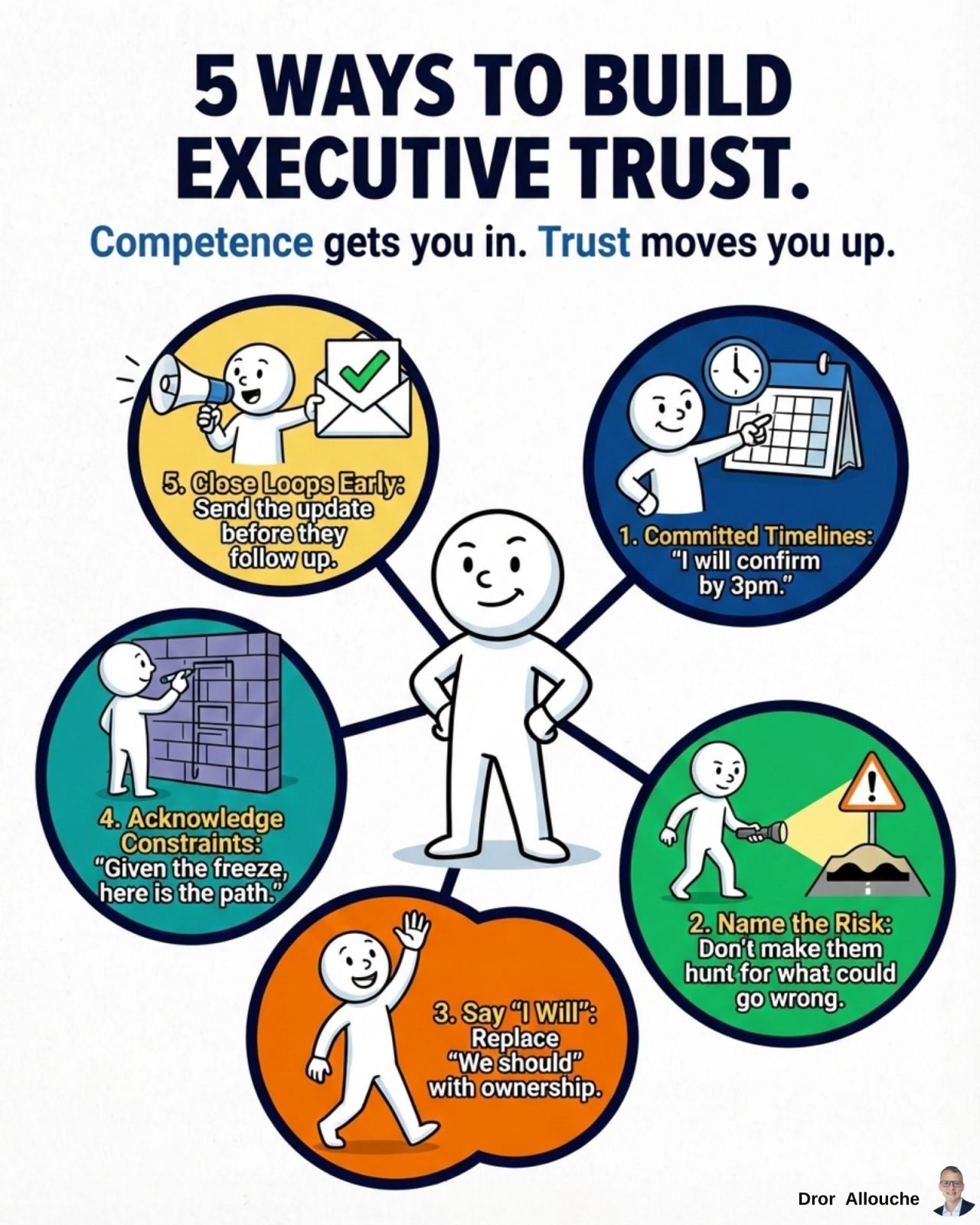
In a recent LinkedIn post, Dror Allouche challenges the conventional wisdom that sheer competence is the primary driver for executive promotions, arguing instead that trust is the more critical, yet often overlooked, factor. Allouche asserts that while competence might secure a seat at the table, it is trust that ultimately determines who receives greater responsibilities and opportunities.
“Competence gets you in the room. Trust determine who gets the bigger role.”
Allouche contends that trust is built through subtle, consistent actions—’micro-patterns’—that many leaders fail to recognize or implement effectively. The post outlines five key communication strategies designed to cultivate this essential executive trust.
The Power of Commitment and Clarity
One of the core themes Dror Allouche addresses is the importance of clear communication and ownership. He suggests that vague assurances can undermine confidence, while specific commitments foster reliability.
As Allouche points out, the way leaders handle inquiries can significantly impact perceptions of their dependability. He contrasts hesitant phrasing with decisive action:
“Replace ‘Let me check’ with committed timelines. Weak: ‘I’ll need to verify that with my team.’ Strong: ‘I’ll confirm by 3pm and send you the update.'”
This distinction, according to Allouche, highlights the difference between uncertainty and accountability. By providing concrete deadlines, leaders demonstrate ownership and a commitment to delivering results, thereby building trust.
Proactive Risk Management and Ownership
Another critical area Dror Allouche emphasizes is the proactive identification and communication of risks. He argues that executives value leaders who anticipate potential problems rather than those who try to hide them or wait to be discovered.
Allouche’s advice in this regard is direct:
“Name the risk before they dig for it. Don’t make executives hunt for what could go wrong. ‘Here’s the plan. The biggest risk is X. We’re mitigating with Y.'”
This approach, as Dror Allouche explains, signals maturity and sound judgment. Hiding risks can be perceived as inexperience, while surfacing them openly shows strategic thinking and a willingness to tackle challenges head-on.
Demonstrating Decisiveness and Strategic Acumen
The shift from passive suggestions to active commitments is also a cornerstone of Allouche’s argument. He advocates for leaders to take a more decisive stance in their communication.
Allouche suggests replacing tentative language like ‘We should’ with stronger, action-oriented statements like ‘I will.’ He elaborates on this by stating:
“Replace ‘We should’ with ‘I will.’ Weak: ‘We should probably explore that option.’ Strong: ‘I’ll analyze three scenarios and present Friday.'”
In Dror Allouche’s view, the use of ‘should’ implies contemplation, whereas ‘will’ signifies a commitment to action and decision-making. Furthermore, Allouche stresses the importance of acknowledging real-world constraints, such as budget limitations or tight deadlines, and demonstrating the ability to strategize within these boundaries, rather than ignoring them.
The Value of Closing Loops Proactively
Finally, Dror Allouche highlights the impact of proactive follow-through. He advises leaders to close communication loops—providing updates—before being prompted.
This consistent, unsolicited communication, as Allouche notes, reinforces reliability. He provides an example: “Update: Completed. Vendor signed. Here’s what we learned.” This proactive approach, according to the author, positions leaders as dependable and ready, contrasting sharply with those who require constant reminders.
In conclusion, Dror Allouche’s insights on LinkedIn underscore that while competence is a prerequisite, it is the consistent demonstration of trust through clear commitments, proactive risk management, decisive action, and proactive communication that truly accelerates an executive’s career path.
📝 About This Content
This article is based on insights shared by Dror Allouche on LinkedIn.
📅 Originally posted on April 3, 2026 | View original post on LinkedIn →