
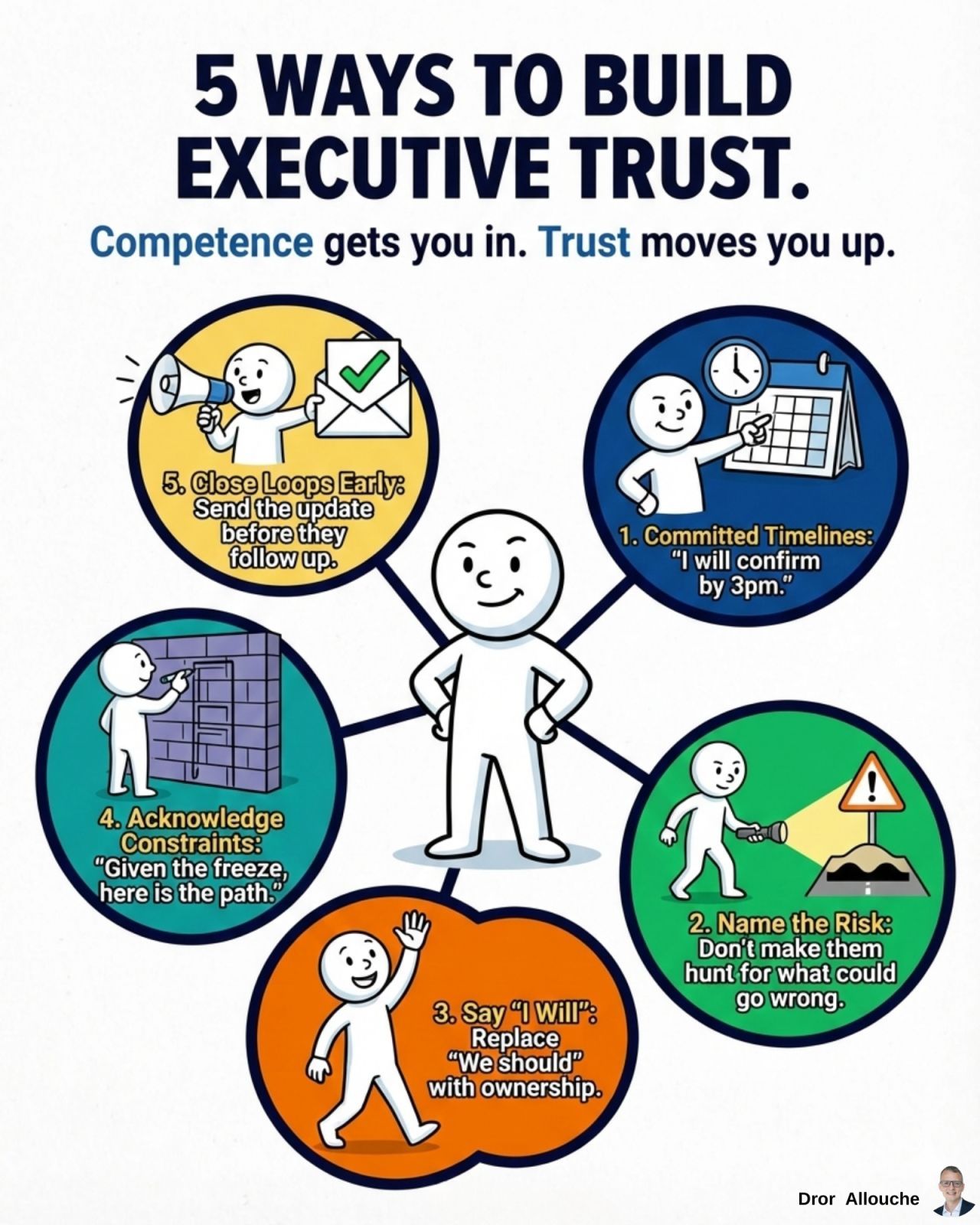
In a recent LinkedIn post, Dror Allouche challenges the conventional wisdom that sheer competence is the primary driver for executive promotion. Instead, Allouche argues that while competence may secure a seat at the table, it is the cultivation of trust that ultimately determines who receives greater responsibilities and opportunities. This trust, he contends, is built through subtle yet crucial communication patterns that many leaders overlook.
Allouche emphasizes that the path to the C-suite is paved not just with knowing the right answers, but with demonstrating reliability and proactive engagement. He writes:
“Competence gets you in the room. Trust determines who gets the bigger role.”
According to Allouche, the development of this essential trust hinges on mastering five specific communication micro-patterns that signal ownership, foresight, and accountability.
The Five Pillars of Executive Trust
Dror Allouche outlines a series of actionable communication shifts designed to build and solidify trust with senior leadership. These are not grand gestures, but rather consistent, small-scale interactions that accumulate into a strong reputation.
1. Replacing Vague Commitments with Clear Timelines
A common pitfall, as identified by Allouche, is the use of vague phrases like “Let me check.” This can create uncertainty for executives who need definitive information. Allouche advocates for replacing such ambiguity with concrete deadlines.
He provides a clear contrast:
“Weak: ‘I’ll need to verify that with my team.’ Strong: ‘I’ll confirm by 3pm and send you the update.'”
As Allouche points out, “Vague checking = uncertainty. Clear deadlines = ownership.” This simple change demonstrates respect for the executive’s time and a commitment to delivering results promptly.
2. Proactively Naming and Mitigating Risks
Allouche asserts that experienced leaders do not shy away from potential problems; they address them head-on. Instead of waiting for executives to uncover risks, leaders should proactively identify and present mitigation strategies.
“Don’t make executives hunt for what could go wrong,” Allouche advises. He suggests framing potential issues clearly: “Here’s the plan. The biggest risk is X. We’re mitigating with Y.” This approach, according to Allouche, signals sound judgment and preparedness, contrasting sharply with the perception of inexperience that arises from hiding potential downsides.
3. Shifting from Tentative Suggestions to Decisive Action
The use of tentative language, such as “We should,” can signal a lack of decisiveness. Allouche encourages leaders to adopt more assertive phrasing that indicates a commitment to action.
He contrasts weak and strong phrasing: “Weak: ‘We should probably explore that option.’ Strong: ‘I’ll analyze three scenarios and present Friday.'” In Allouche’s view, the shift from “should” to “will” signifies a transition from mere contemplation to concrete decision-making and execution.
4. Acknowledging and Navigating Constraints
Ignoring real-world limitations like budget freezes or tight deadlines is a sign of naivety, according to Allouche. He stresses the importance of acknowledging these constraints upfront and then demonstrating a strategic approach to working within them.
His recommended approach is to state the reality clearly, such as, “Given the Q1 hiring freeze, here’s the path forward.” This demonstrates an understanding of the broader business context and the ability to devise practical solutions despite challenges, rather than pretending obstacles don’t exist.
5. Closing Communication Loops Proactively
Finally, Allouche highlights the significance of closing loops – providing updates and information before being prompted. This proactive communication demonstrates reliability and a commitment to keeping stakeholders informed.
He illustrates this with an example update: “Update: Completed. Vendor signed. Here’s what we learned.” Allouche argues that “Needing reminders = unreliable. Proactive updates = ready.” This practice ensures that executives are always aware of progress and outcomes without having to chase information.
The Executive Ascent
In conclusion, Dror Allouche’s insights on LinkedIn underscore a critical leadership truth: consistent, trust-building communication is paramount for career advancement. As he notes, “The executives who rise fastest don’t wait to be managed. They take ownership. Surface risks early. Close loops without being asked.” By mastering these micro-patterns, leaders can effectively demonstrate their value and accelerate their journey to senior executive roles.
📝 About This Content
This article is based on insights shared by Dror Allouche on LinkedIn.
📅 Originally posted on June 18, 2026 | View original post on LinkedIn →