
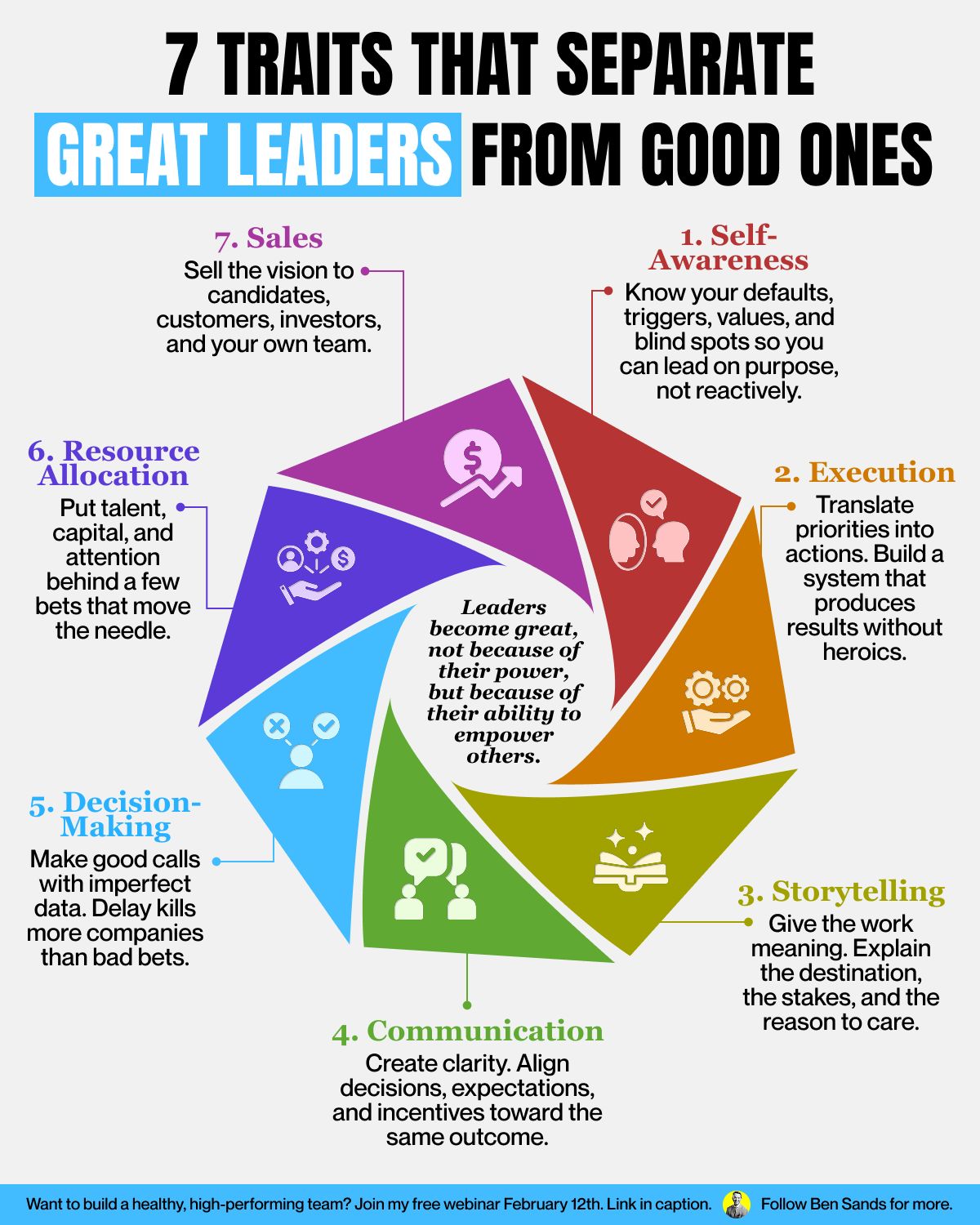
In a recent LinkedIn post, Ben Sands challenges the conventional wisdom that high growth is solely a product of increased effort, arguing instead that it hinges on cultivating specific leadership capabilities. Sands posits that the true differentiator between average and exceptional leaders in fast-paced environments is not sheer hours logged, but rather the development of skills that enable greater efficiency and impact.
“The gap between the best leaders and everyone else isn’t effort or hours. It’s capability,” Sands states in his post. He elaborates that many leaders become so engrossed in daily operations that they neglect to upgrade their skill sets, while superior leaders focus on building capabilities that offer compounding returns.
The Core of High-Growth Leadership: Capability Over Effort
Sands identifies a critical distinction: good leaders often get bogged down in the ‘work’ itself, failing to recognize the need for skill enhancement. Great leaders, however, proactively invest in capabilities that yield disproportionately large results over time. This shift in focus, from simply doing more to enabling more through enhanced skills, is central to his argument.
“Good leaders get caught up in work, not realizing they need to upgrade their skills. Great leaders invest in capabilities that compound.”
According to Sands, when leaders prioritize skill development, the organization experiences a smoother, more sustainable growth trajectory. He outlines seven specific skills that he believes are paramount for leaders navigating high-growth environments.
Seven Essential Skills for Scaling Leaders
Sands breaks down the seven core capabilities that distinguish effective leaders in high-growth scenarios:
- Self-Awareness: Understanding one’s own defaults, triggers, values, and blind spots to lead intentionally rather than reactively.
- Execution: The ability to translate strategic priorities into concrete actions and establish systems that deliver results consistently, without relying on constant heroic efforts.
- Storytelling: Imbuing the work with meaning by clearly articulating the vision, the stakes, and the reasons for the team to be invested.
- Communication: Fostering clarity by aligning decisions, expectations, and incentives towards a unified outcome.
- Decision-Making: Making sound choices with incomplete information, emphasizing that delays can be more detrimental than imperfect decisions.
- Resource Allocation: Strategically deploying talent, capital, and attention towards a select few initiatives that have the potential to significantly move the business forward.
- Sales (Internal + External): Effectively promoting the vision and value proposition to a wide range of stakeholders, including candidates, customers, investors, and the internal team.
Sands argues that when these traits are robustly developed within leadership, the outcomes are significant:
“When these traits are strong in high-growth environments: strategy gets sharper, decisions come faster, teams don’t need babysitting, growth feels lighter.”
Conversely, he points out the detrimental effect when these capabilities are lacking. “When one of them is weak, the organization compensates with effort. That’s the first sign of strain,” Sands warns.
The Compounding Effect of Leadership Capabilities
The core message from Sands is that while hard work is a component of success, it is insufficient on its own for sustained high growth. The real leverage comes from developing a leader’s intrinsic capabilities. These skills don’t just help a leader perform their current role better; they create a foundation for future success that grows exponentially as the organization scales.
“The gap between the best leaders and everyone else isn’t effort or hours. It’s capability.”
Sands also announced an upcoming live session for senior leaders on February 12th at 12:30 PM ET, titled “7 Core Skills of Healthy, High-Growth Leaders.” The session aims to delve deeper into these capabilities, explaining why effort can supersede execution as teams grow, what hinders capable leaders, and practical methods for building immediate leverage. He frames this session as beneficial for leaders seeking clarity, leverage, and smoother outcomes.
📝 About This Content
This article is based on insights shared by Ben Sands on LinkedIn.
📅 Originally posted on February 10, 2026 | View original post on LinkedIn →