
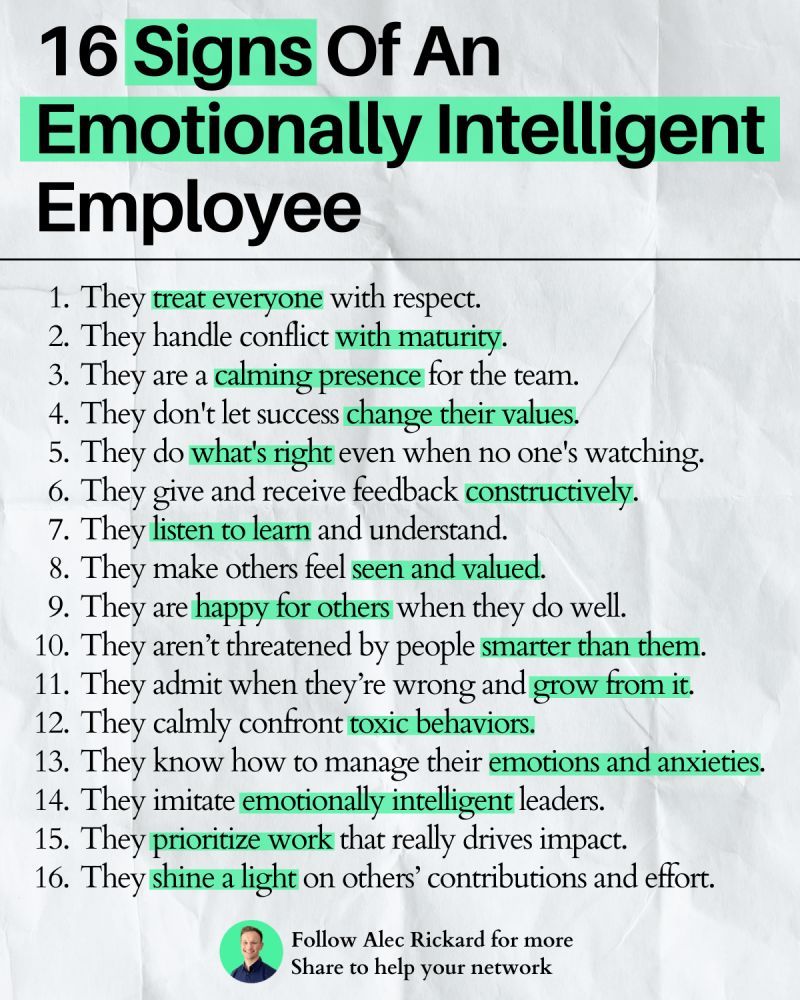
In a recent LinkedIn post, Alec Rickard explores the critical role of emotional intelligence (EQ) in distinguishing top performers in the workplace. Rickard emphasizes that professional success hinges not only on technical knowledge but significantly on how individuals interact with and manage relationships.
Rickard opens his post by stating,
“Emotional intelligence sets top performers apart. It’s not just what you know, but how you treat others.”
This sentiment sets the stage for his detailed breakdown of what constitutes an emotionally intelligent employee.
The Pillars of Emotionally Intelligent Employees
Alec Rickard outlines 17 distinct signs that characterize an emotionally intelligent employee, categorizing them under key behaviors and attitudes. These signs collectively paint a picture of a well-rounded professional who contributes positively to team dynamics and organizational success.
Respect, Maturity, and Stability
Among the initial points, Rickard highlights the importance of treating everyone with respect, defining EQ as the means by which collaboration leads to success. He also points to the ability to handle conflict with maturity, suggesting that composure is essential for clarity during tense situations. Furthermore, Rickard notes that an emotionally intelligent employee acts as a calming presence, using their emotional stability to steady the entire team.
As Rickard argues,
“Feedback isn’t personal, it’s a powerful development tool.”
This perspective underscores the constructive nature of how these individuals approach criticism and growth opportunities.
Integrity, Humility, and Growth
Rickard emphasizes that success should not alter core values, linking development and performance to humility. He stresses the significance of integrity, stating,
“They do what’s right even when no one’s watching.”
This points to an internal moral compass that guides actions regardless of external observation.
The ability to admit mistakes and learn from them is also a key indicator for Rickard. He posits that accountability builds trust and drives personal growth, a crucial element for continuous improvement.
Interpersonal Skills and Self-Awareness
A significant portion of Rickard’s analysis focuses on interpersonal dynamics. He highlights the power of active listening for building stronger relationships and the importance of making others feel seen and valued, recognizing that success is rarely a solo endeavor. Rickard also points out that true confidence is quiet and that being happy for others’ success is a sign of self-assurance, contrasting it with insecurity that leads to competition.
Rickard also touches upon managing one’s own emotions, noting that
“Self-awareness stops emotions from derailing decisions.”
This self-management is presented as vital for effective decision-making, especially under pressure.
Beyond IQ: The Comprehensive Skillset
Concluding his post, Rickard reiterates that a career’s success is built on more than just intellectual capacity. He invites his audience to contribute their own insights, fostering a community discussion around the multifaceted nature of professional excellence. The underlying message from Rickard is that cultivating emotional intelligence is an ongoing process that yields significant returns in both personal and professional realms.
📝 About This Content
This article is based on insights shared by Alec Rickard on LinkedIn.
📅 Originally posted on July 1, 2026 | View original post on LinkedIn →