
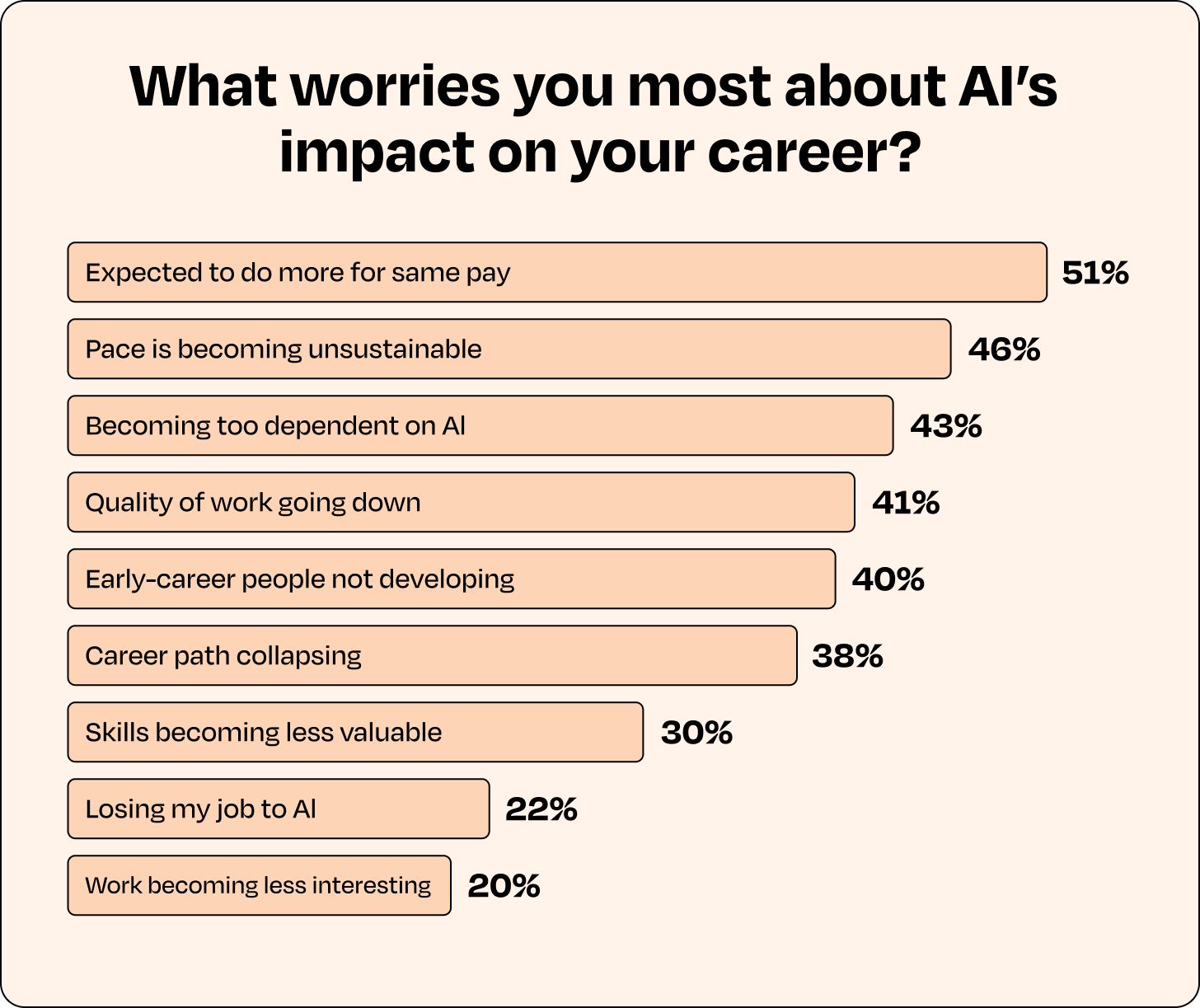
In a recent LinkedIn post, Lenny Rachitsky explores the nuanced anxieties surrounding Artificial Intelligence (AI) in the workplace, moving beyond the common narrative of job displacement. Rachitsky highlights that while the fear of AI replacing jobs exists, it’s not the primary concern for many in the tech industry.
According to a survey mentioned in his post, only 22% of respondents feared ‘Losing my job to AI.’ This suggests a deeper, more insidious worry is at play.
“What people are actually worried about is being asked to do more for the same pay, and watching the quality of their work slip.”
Rachitsky argues that the rapid advancements in AI, rather than leading to reduced workloads, are instead being absorbed into increased expectations. The productivity gains unlocked by AI are not translating into more breathing room for employees but are instead becoming the new standard.
The Shifting Landscape of Workplace Expectations
As Lenny Rachitsky points out, the prevailing sentiment among the workforce is one of quiet dread, despite record levels of productivity. This paradox stems from the way AI’s efficiency is being leveraged.
“Every gain becomes the new baseline, and the people expected to hit it are running out of room to breathe.”
This dynamic, Rachitsky suggests, creates a pressure cooker environment where employees are expected to constantly achieve at a higher level without commensurate rewards or adjustments to their workload. The focus shifts from job security to the sustainability of performance under escalating demands.
Productivity Gains vs. Employee Well-being
The core of Rachitsky’s analysis centers on the disconnect between technological advancement and employee well-being. While AI offers the potential for significant efficiency improvements, the current implementation appears to be prioritizing output over the human element of work.
“We have a workforce that’s more productive than ever but quietly dreading what comes next.”
Rachitsky’s insights challenge the simplistic view of AI as a job-destroying force. Instead, he presents a more complex picture where the immediate threat is not outright replacement, but the gradual erosion of work-life balance and the potential decline in the quality of work due to unsustainable pressure. This perspective calls for a re-evaluation of how businesses integrate AI, ensuring that productivity gains benefit both the company and its employees.
📝 About This Content
This article is based on insights shared by Lenny Rachitsky on LinkedIn.
📅 Originally posted on July 9, 2026 | View original post on LinkedIn →