
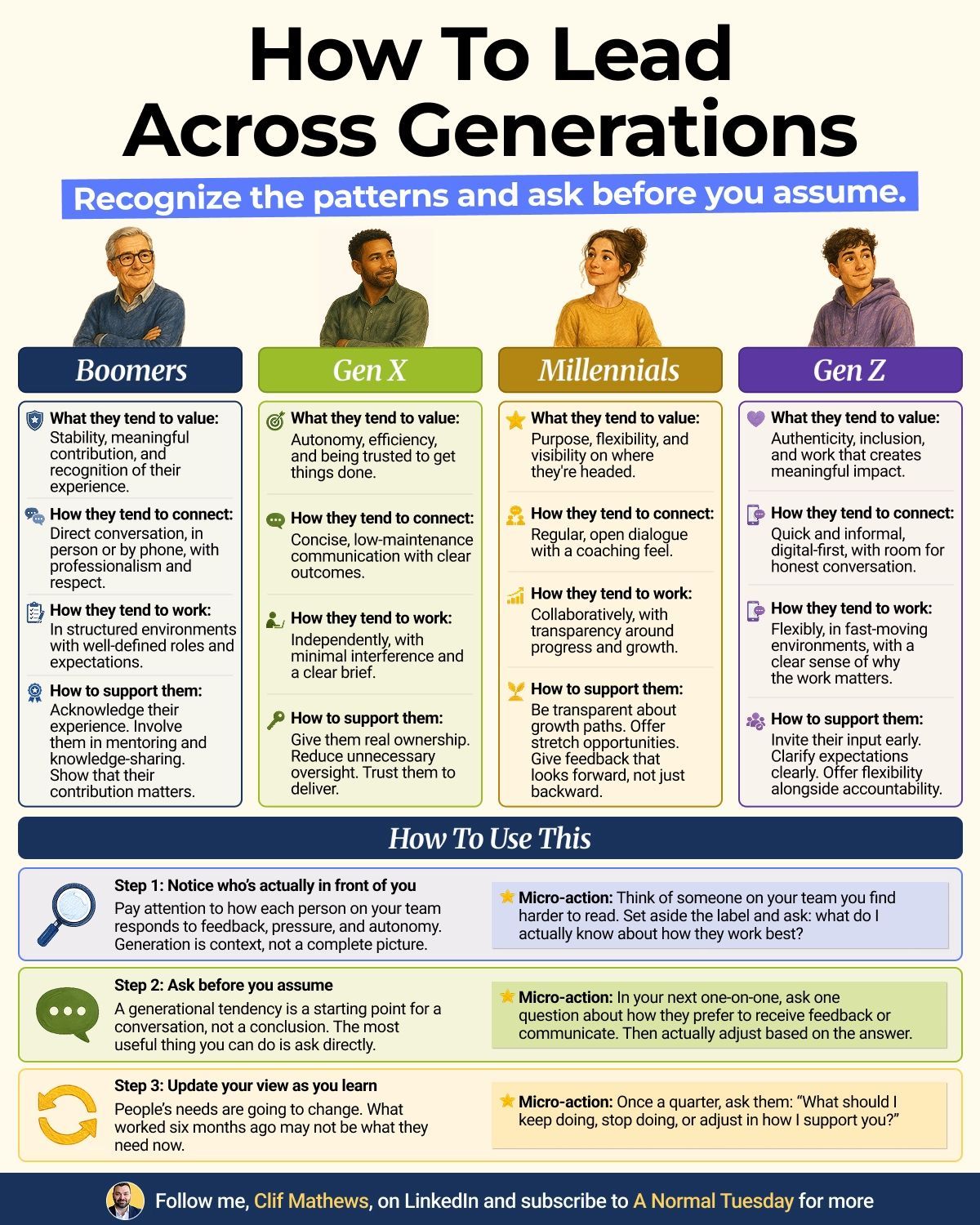
In a recent LinkedIn post, Mark O’Donnell urges business leaders to look beyond generational stereotypes and focus on the unique needs of each individual employee. O’Donnell critiques the common practice of categorizing team members based on their birth year, suggesting that such an approach oversimplifies the complexity of human motivation and work styles.
O’Donnell highlights the pitfalls of generational advice, stating:
“A lot of generational advice does exactly this. It spots a pattern, then hardens it into a rule you’re not allowed to break.”
He elaborates that while generational patterns might exist, they should serve as a starting point for understanding, not as rigid scripts for management. The core of O’Donnell’s message is that effective leadership requires recognizing the individuality of each person on the team.
The Limitations of Generational Boxes
Mark O’Donnell points out that traditional advice often groups employees into broad generational categories, providing generalized characteristics and corresponding management strategies. He outlines these common groupings:
- Boomers: Tend to value direct conversation and earned respect. O’Donnell suggests acknowledging their experience and involving them in mentoring.
- Gen X: Tend to value autonomy and room to work. He advises giving them ownership and trusting them to deliver.
- Millennials: Tend to value open dialogue and a clear path forward. O’Donnell recommends transparency about growth and forward-looking feedback.
- Gen Z: Tend to value honest communication and work that has meaning. He suggests early involvement and pairing flexibility with accountability.
However, O’Donnell quickly pivots from these generalized frameworks, emphasizing their role as a mere “rough map.” He argues that the true challenge lies in how leaders interpret and apply these patterns.
Individuality Over Cohort Identity
The central thesis of O’Donnell’s post is that every individual is unique, irrespective of their generational cohort. He illustrates this by noting the diversity of preferences even within a single generation.
“Someone in Gen Z might want a quick message. Someone else wants to talk it through face to face.”
This statement underscores O’Donnell’s belief that a one-size-fits-all approach is fundamentally flawed. He contends that an employee’s communication style, preferred work environment, and motivational drivers cannot be accurately predicted by their birth year alone. Some may prefer collaborative settings, while others excel when working independently.
Focusing on the ‘Actual Human’
O’Donnell introduces the concept of GWC – Gets It, Wants It, and has the Capacity for their seat – as a more effective framework for understanding employees. He asserts that this crucial assessment cannot be made based on generational affiliation.
“You can’t tell whether someone Gets it, Wants it, and has the Capacity for their seat by reading their generation. You have to learn it by paying attention to the actual human in the seat.”
According to O’Donnell, genuine insight comes from direct observation and engagement. Leaders must cultivate curiosity and actively seek to understand how each team member operates best. By paying attention to the individual, leaders can tailor their approach to foster greater engagement, productivity, and satisfaction.
The Call for Curious Leadership
Mark O’Donnell encourages leaders to move beyond assumptions and embrace a more personalized leadership style. His advice is to “get curious. Ask how each person works best, then lead them that way.” This proactive approach, he suggests, is key to unlocking the full potential of a diverse workforce. The post concludes with a question to the audience, inviting discussion on their own experiences managing multi-generational teams, further emphasizing the communal aspect of leadership learning.
📝 About This Content
This article is based on insights shared by Mark O'Donnell on LinkedIn.
📅 Originally posted on June 24, 2026 | View original post on LinkedIn →