
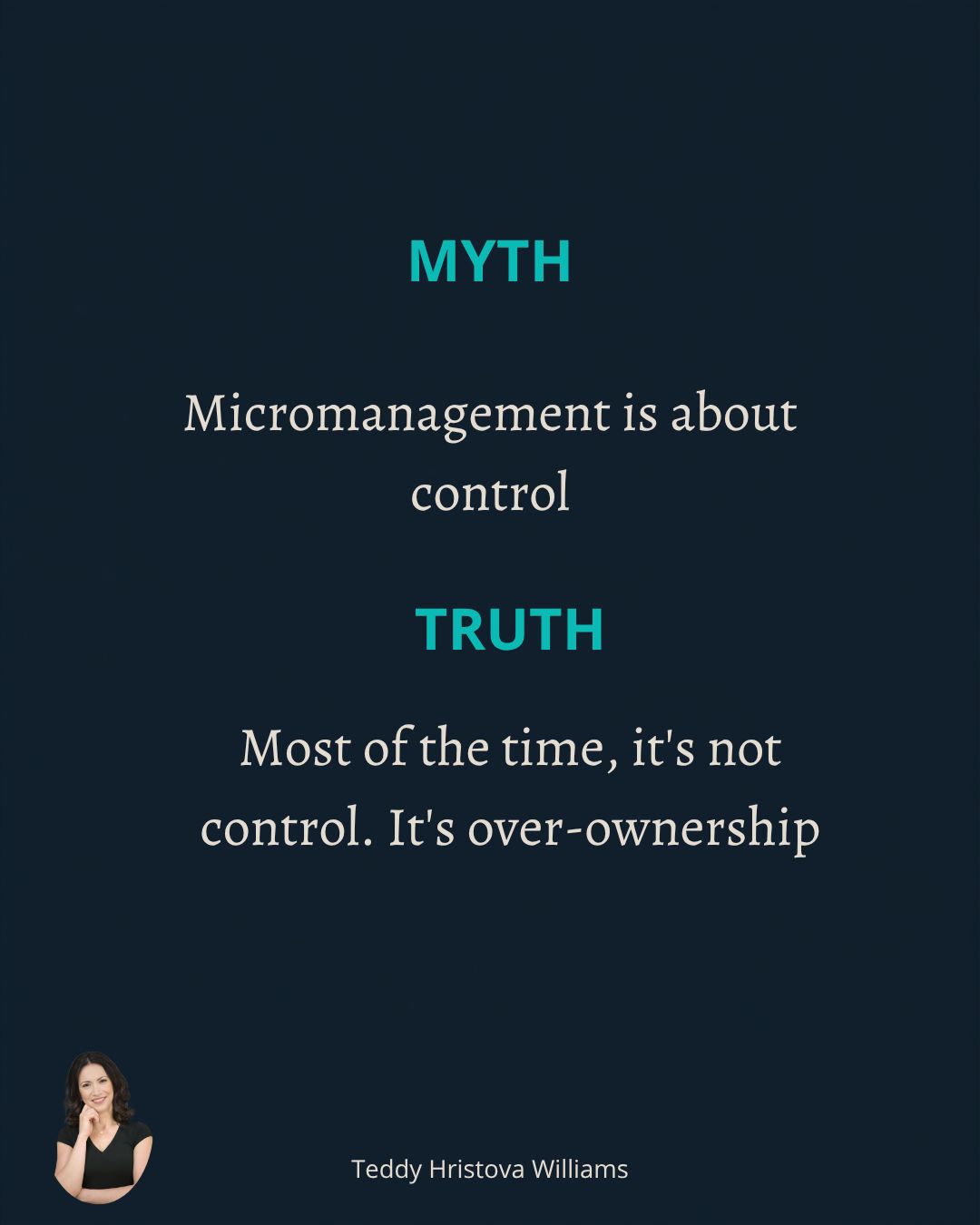
In a recent LinkedIn post, Teddy Hristova Williams offers a nuanced perspective on micromanagement, suggesting that many leaders labeled as micromanagers are not driven by a desire for control, but rather by a need to protect outcomes. This distinction, Williams argues, is crucial as it dictates the appropriate solutions.
Williams highlights the core difference in approach based on the underlying issue:
“If it’s control: examine what you’re afraid of losing. If it’s over-ownership: build a system you trust.”
Understanding the Root Cause: Control vs. Over-Ownership
Teddy Hristova Williams posits that the path to addressing so-called micromanagement depends entirely on identifying whether the behavior stems from a fear of losing something (a mindset issue) or an excessive sense of responsibility for every detail (a design issue). This framing shifts the conversation from a purely psychological one to one that includes systemic design.
According to Williams, mistaking one for the other leads to ineffective interventions:
“Treating a design problem like a mindset problem is why most traditional leadership training doesn’t stick.”
This suggests that traditional leadership development, often focused on introspection and changing thought patterns, may fall short when the actual problem lies in the absence of robust systems that foster trust and delegation.
The Power of System Design in Leadership
Williams emphasizes that certain leadership challenges cannot be overcome through sheer willpower or a change in perspective alone. The concept of ‘over-ownership,’ for instance, requires a tangible solution in the form of a well-designed system.
As Teddy Hristova Williams explains:
“You can’t think your way out of a missing system. You have to build it.”
This perspective underscores the importance of operational design in leadership. It implies that leaders need to focus on creating frameworks, processes, and structures that enable their teams to succeed autonomously. When a system is in place and trusted, the leader’s need to micromanage diminishes because the desired outcomes are being reliably produced through the established design.
Mindset vs. Design: A Call for Self-Assessment
The article concludes with a direct call to action for leaders to critically assess their own behaviors and the environments they create. Williams poses a fundamental question:
“Which one are you actually dealing with a mindset problem, or a missing system?”
This self-reflection is key to unlocking more effective leadership strategies. By correctly diagnosing the issue – whether it’s an internal mindset hurdle or an external lack of a supportive system – leaders can then implement the correct interventions. Williams’s insights suggest that a focus on building trustworthy systems is often the more impactful, yet less frequently addressed, solution to challenges perceived as micromanagement.
📝 About This Content
This article is based on insights shared by Teddy Hristova Williams on LinkedIn.
📅 Originally posted on July 14, 2026 | View original post on LinkedIn →