
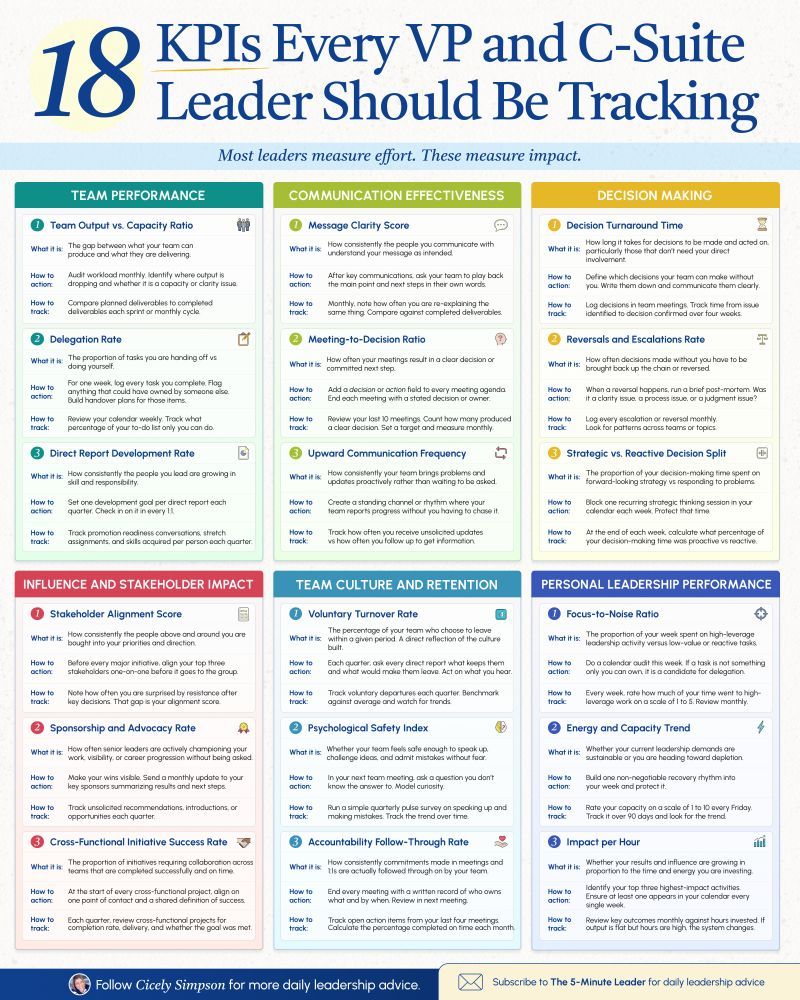
In a recent LinkedIn post, Ben Sands discusses a critical oversight many companies make regarding performance measurement: focusing on financial outcomes while neglecting the performance of the leadership team itself. Sands argues that this narrow focus eventually creates a ceiling for growth.
According to Sands, traditional business metrics such as revenue, margins, pipeline, utilization, and headcount are valuable but insufficient. He states:
“Most leadership teams are measuring business performance… but not leadership performance. And eventually that creates a ceiling.”
The Hidden Cause of Execution Slowdowns
Sands highlights that when execution falters, companies often look for problems in strategy, talent, or market conditions. However, he proposes that the root cause is frequently a weaker “leadership operating system.” This system, he explains, encompasses the underlying processes and dynamics through which the leadership team functions.
Leading Indicators of Success
The business leader points out that the true drivers of success are often not the widely tracked financial metrics, but rather the leading indicators of effective leadership. He elaborates on this distinction:
“Because when execution slows down, most companies assume: strategy is the problem, talent is the problem, market conditions is the problem. Sometimes the issue is simpler: The leadership operating system is weak.”
Sands identifies several key metrics that the most effective leadership teams track. These include decision speed, stakeholder alignment, message clarity, delegation rate, psychological safety, and impact per hour. As Sands notes, these are the “metrics underneath the metrics” that provide a clearer view of operational health.
Visibility: The Key to Improvement
A core theme in Sands’s analysis is the importance of visibility. He argues that many leadership problems stem not from a lack of effort, but from a lack of insight into the patterns that influence performance. Without this visibility, improvement becomes difficult, if not impossible.
“Most leadership problems are not effort problems. They’re visibility problems. If you cannot see the patterns driving performance, you cannot improve them.”
Therefore, Sands concludes, strong leadership teams prioritize measuring the health of their operating system, not just the financial outcomes it produces. He emphasizes that understanding these underlying dynamics is crucial for sustainable success.
A Tool for Self-Assessment
To assist leaders in evaluating their own team’s effectiveness, Sands has developed a free “Leadership Readiness Quiz.” This tool is designed to assess critical areas such as clarity, decision-making, execution, accountability, communication, and team effectiveness, offering a practical way for leaders to benchmark their current operating system.
📝 About This Content
This article is based on insights shared by Ben Sands on LinkedIn.
📅 Originally posted on May 12, 2026 | View original post on LinkedIn →