
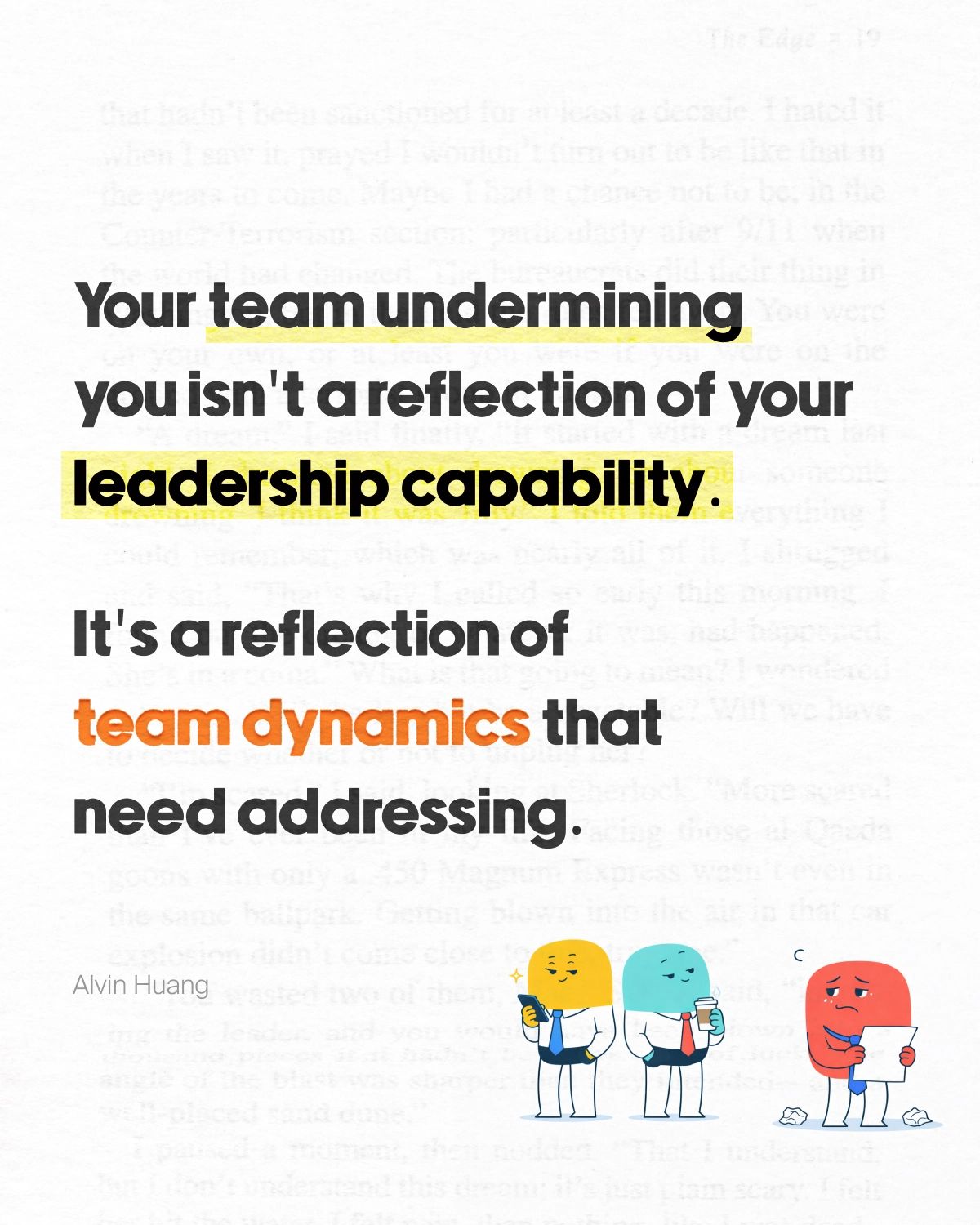
In a recent LinkedIn post, Alvin Huang explores a common but often misunderstood challenge faced by leaders: feeling undermined. Huang shifts the focus from personal inadequacy to systemic issues, arguing that the root cause of feeling undermined is rarely about individual capability and more often a symptom of structural problems within an organization.
Huang begins by detailing the internal monologue many leaders experience when facing this challenge, questioning their own perceived shortcomings. “The immediate instinct is to look inward: Am I too soft? Too inexperienced? Not commanding enough respect?” he writes. However, he contends that these introspective questions are “almost always pointed in the wrong direction.”
“It’s rarely about you. Undermining behaviour is usually a structural problem.”
The Structural Roots of Undermining
According to Alvin Huang, undermining behaviour typically surfaces when organizational structures lack clarity. He identifies several key scenarios where this occurs:
- Blurry Authority Lines: When roles and responsibilities are not clearly defined, uncertainty about ownership creates a vacuum.
- Undefined Decision Rights: In the absence of clear decision-making authority, the most vocal or confident individual often steps in to fill the void.
- Unaligned Informal Leaders: Long-tenured employees or individuals with significant informal influence may not be aligned with new directions, leading to passive resistance or undermining.
Huang emphasizes that power naturally flows to fill these structural gaps. “The thing about power is that it doesn’t sit still,” he notes. “When leadership isn’t backed by clear structure, power moves into the gaps on its own.” This dynamic leads to a crucial distinction, as Huang points out:
“A leader who loses trust has a capability problem. A leader who loses authority usually has a structural one.”
Auditing the Structure for Leadership Clarity
Instead of solely focusing on self-improvement, Huang advises leaders to conduct a structural audit. He outlines actionable steps to diagnose and rectify these issues:
Mapping Decision Rights
Huang stresses the importance of clarity in decision-making. “If it’s unclear to you, it’s definitely unclear to everyone else,” he states, urging leaders to explicitly define and document who has the authority to make specific decisions.
Identifying and Engaging Informal Leaders
Recognizing the influence of informal leaders is key. Huang suggests identifying who people turn to for validation or approval and actively bringing them into the process rather than working against them. “Who do people go to when they want something approved or validated? Bring them into the process rather than competing with them,” he advises.
Aligning Incentives
When individual or team incentives conflict with the desired direction, undermining becomes a logical response for those involved. Huang argues for aligning reward systems with the strategic goals to prevent this rational resistance.
Making Authority Visible
The traditional org chart is often insufficient. Huang advocates for consistently reinforcing authority through transparent decision-making processes and clear communication, making leadership roles and powers evident.
Addressing Misalignment Promptly
Structural gaps, if left unaddressed, become more entrenched over time. Huang warns that “The longer structural gaps stay open, the more entrenched the workarounds become,” underscoring the need for early intervention.
In conclusion, Alvin Huang’s insights on LinkedIn suggest that effective leadership hinges on deliberately building and maintaining a supportive organizational structure. As he puts it, “Leadership is a system that has to be deliberately built, not just assumed into existence.” For leaders feeling undermined, the solution lies not in asserting authority more forcefully, but in constructing the robust framework that solidifies their leadership position and prevents it from being circumvented.
📝 About This Content
This article is based on insights shared by Alvin Huang on LinkedIn.
📅 Originally posted on March 21, 2026 | View original post on LinkedIn →