
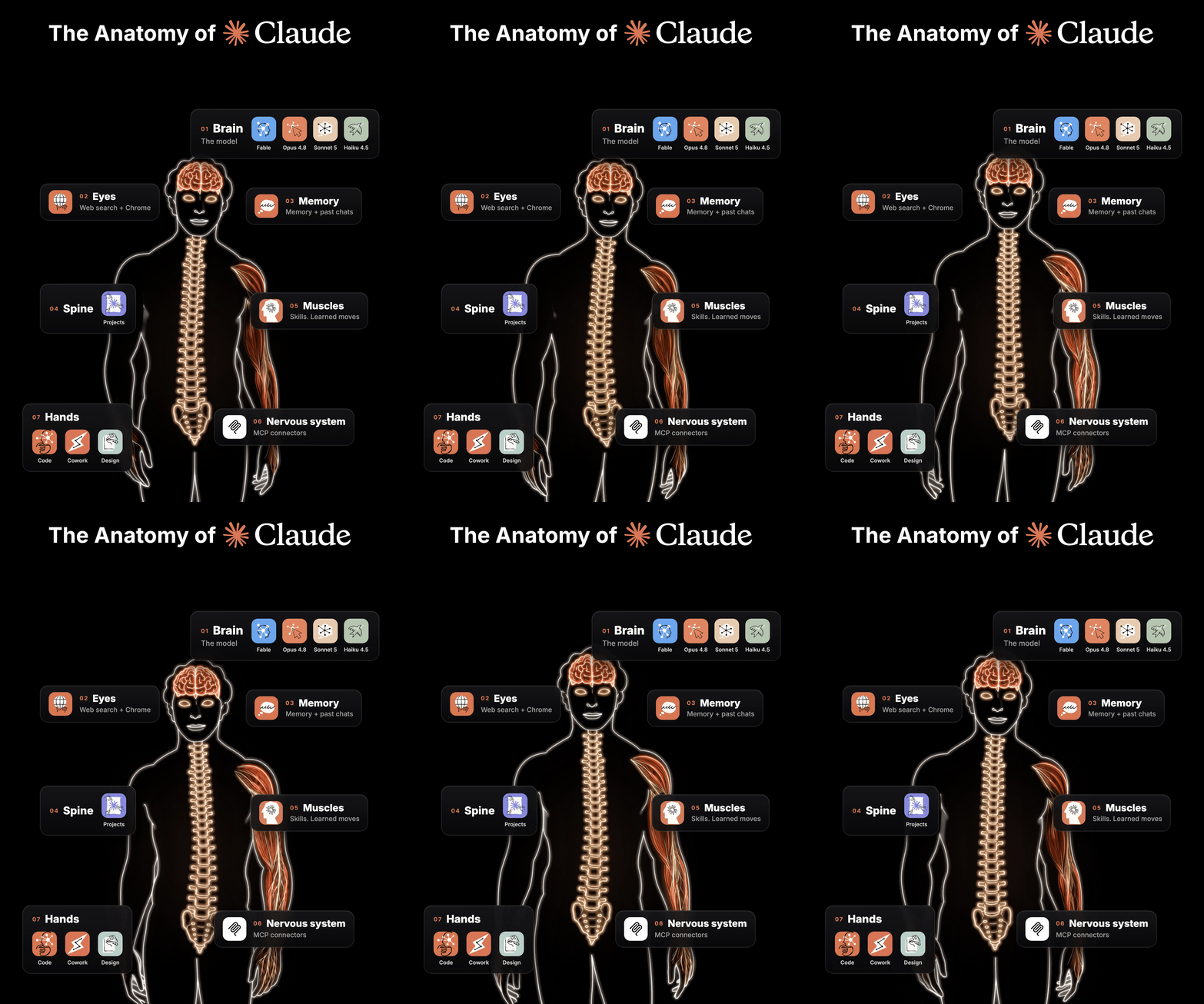
In a recent LinkedIn post, Yonathan Cohen offers a comprehensive breakdown of how businesses can leverage the full potential of AI models like Claude, arguing that most users only tap into a fraction of its capabilities. Cohen frames the AI’s functionality as an entire ‘body’ rather than just a ‘brain,’ urging users and businesses to integrate its various components for maximum impact.
Cohen highlights the common misconception that AI interaction is limited to simple prompting, stating:
People use 10% of what Claude can do. They talk to the brain & never touch the body.
He then proceeds to detail the various ‘organs’ of this AI body, illustrating how each part contributes to a more robust and integrated business application.
The ‘Brain’: Claude’s Four Gears
Cohen categorizes the core AI model, the ‘brain,’ into four distinct ‘gears,’ each suited for different levels of complexity and volume. This tiered approach allows for optimized use based on the task at hand.
- Fable: For multi-day, complex projects requiring planning, execution, and self-correction.
- Opus: Designed for intricate builds, agent-based tasks, and heavy coding demands.
- Sonnet: Positioned for daily, high-volume tasks like writing and general assistance, balancing speed and cost.
- Haiku: Optimized for instant responses in very high-volume scenarios.
As Yonathan Cohen explains, “One brain, four gears. You pick per task.” This segmentation, according to Cohen, is key to efficient AI deployment.
Integrating the Senses: Eyes and Hands
Beyond the core processing unit, Cohen emphasizes the importance of the AI’s ability to perceive and act. The ‘eyes’ represent Claude’s web search capabilities and browser extensions, enabling it to access and interact with live web data. This goes beyond static training data, allowing the AI to understand current information and perform actions like filling forms or navigating websites.
The ‘hands’ are what deliver tangible outputs. Cohen points out that this involves generating not just drafts, but usable results such as:
Working code. Structured docs. On-brand decks. Clickable prototypes. Often in minutes.
This focus on actionable outputs, as highlighted by Cohen, transforms the AI from a generative tool into a productive asset.
Connecting to the Business: Nervous System and Muscles
A crucial aspect of maximizing AI utility, according to Cohen, is its integration into existing business workflows. The ‘nervous system’ metaphor refers to the connectors that link Claude to a company’s software stack, including platforms like Gmail, Slack, HubSpot, and Notion. This integration allows the AI to pull data directly, eliminating the need for manual data input.
Furthermore, Cohen introduces ‘muscles’ as reusable ‘skills’ or actions. These are pre-defined tasks, such as “Prep this call” or “Clean this list,” which can be executed repeatedly without the need for constant re-explanation. “Define once, run anytime. No re-explaining,” Cohen notes, underscoring the efficiency gains.
Memory and Structure: The Spine and Memory
Cohen concludes his anatomical breakdown by discussing ‘memory’ and the ‘spine.’ The AI’s memory allows it to retain context about user preferences, tone, and specific business information, ensuring continuity across interactions. The ‘spine,’ represented by ‘Projects,’ provides the overarching structure for complex tasks, consolidating files, instructions, and context into a single, cohesive unit.
“Most people meet the brain,” Yonathan Cohen concludes in his post. “I wire the whole body into companies.” This sentiment encapsulates his argument that true AI integration involves connecting all facets of the technology to specific business needs, moving far beyond basic conversational use.
📝 About This Content
This article is based on insights shared by Yonathan Cohen on LinkedIn.
📅 Originally posted on July 2, 2026 | View original post on LinkedIn →