
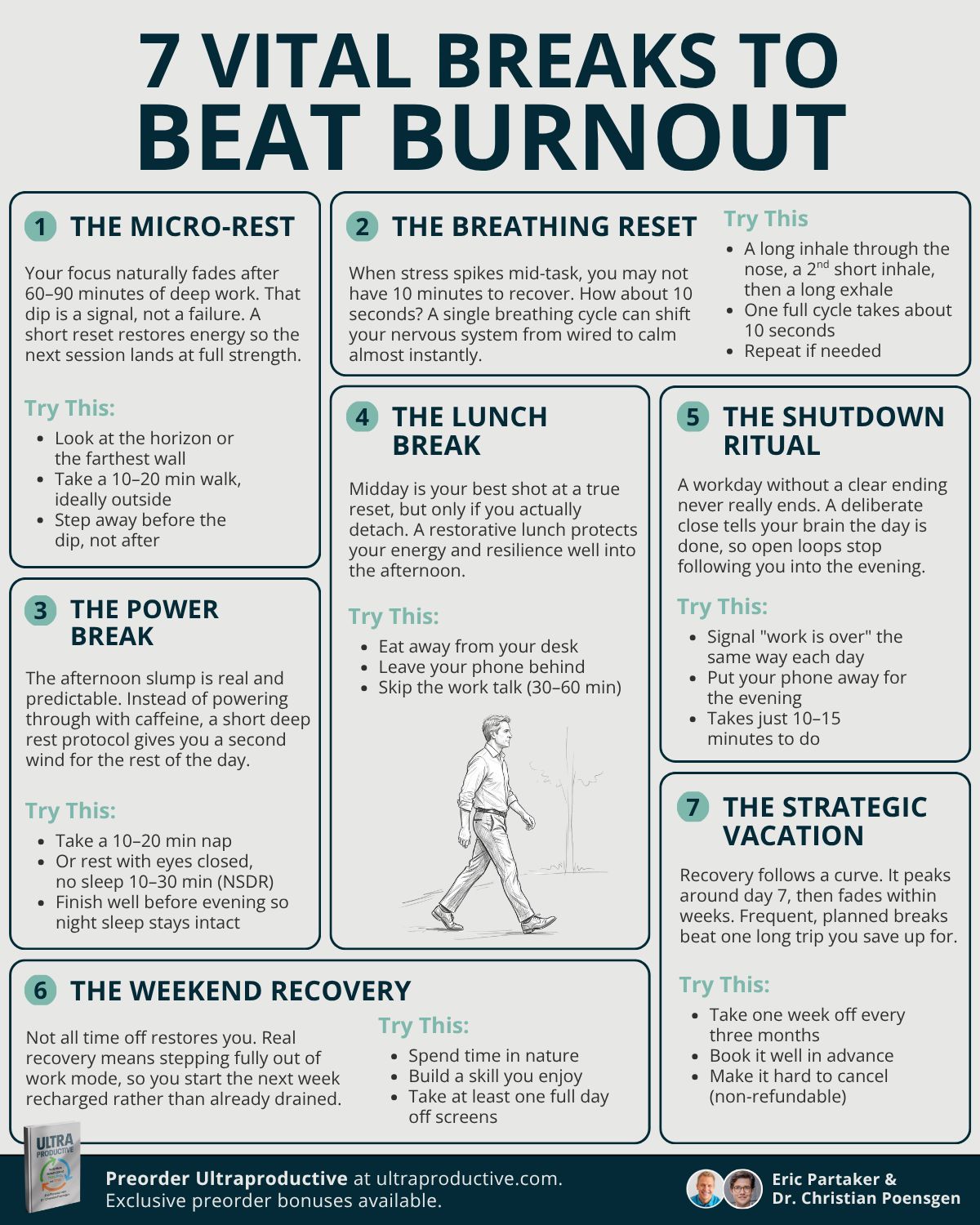
In a recent LinkedIn post, Eric Partaker challenges the conventional notion of relentless work, arguing that strategic rest is not a luxury but a fundamental component of productivity. Partaker, co-founder of the global education company Chatta, shared insights that counter the common practice of equating long hours with high output.
Partaker’s core message is that true productivity stems from understanding and implementing various types of breaks throughout the day and week. He posits that neglecting these essential resets leads to diminishing returns, despite continued effort. As he states:
“I used to wear 14-hour days like a badge of honor. I thought rest was what you did after the work was done. It took years to learn that rest is part of the work.”
The Seven Pillars of Strategic Rest
The business leader breaks down rest into seven distinct categories, each with a specific optimal timing and purpose. He emphasizes that these are not interchangeable but serve unique physiological and psychological needs. According to Partaker, ignoring these needs signals a decline in focus and output.
Micro-Rests and Breathing Resets
Partaker highlights the importance of frequent, short breaks to combat mental fatigue. He notes that deep work sessions typically lead to a dip in focus after 60 to 90 minutes. The solution, he suggests, is a brief interruption:
“Step away before it hits. Look at the horizon. Walk for 10 to 20 minutes.”
For moments when stress spikes mid-task and longer breaks are not feasible, Partaker advocates for a quick breathing exercise, which can be completed in about 10 seconds. This technique involves a specific inhale-exhale pattern designed to quickly recenter the individual.
Power Breaks, Lunch Breaks, and Shutdown Rituals
Addressing the predictable afternoon slump, Partaker recommends a ‘Power Break’—a 10 to 20 minute nap or quiet rest—to regain energy. He stresses the significance of a proper lunch break, suggesting it be taken away from the desk and free from work discussions for 30 to 60 minutes. Furthermore, Partaker introduces the concept of a ‘Shutdown Ritual’ to clearly delineate the end of the workday. He argues:
“A workday without a clear ending never really ends.”
This ritual, which takes about 10 to 15 minutes, involves putting work devices away and signaling the transition to personal time, thereby protecting evening rest.
Weekend Recovery and Strategic Vacations
Partaker extends his framework to longer periods, discussing the ‘Weekend Recovery.’ He differentiates true recovery from mere time off, stating that it requires a complete disengagement from work mode. This could involve spending time in nature or pursuing hobbies, with the crucial element of taking at least one full day completely screen-free.
Finally, he addresses ‘Strategic Vacations,’ emphasizing that recovery follows a curve and peaks around the seventh day. Partaker advocates for frequent, shorter planned breaks over infrequent, long ones. He suggests:
“Take one week off every three months. Book it non-refundable.”
This approach, he believes, ensures more consistent restoration and prevents burnout, which affects a significant portion of the workforce. Partaker concludes by encouraging readers to identify which type of break they need most, reinforcing that the key to sustained performance lies in intentionally integrating these restorative practices into their routines.
📝 About This Content
This article is based on insights shared by Eric Partaker on LinkedIn.
📅 Originally posted on July 14, 2026 | View original post on LinkedIn →