
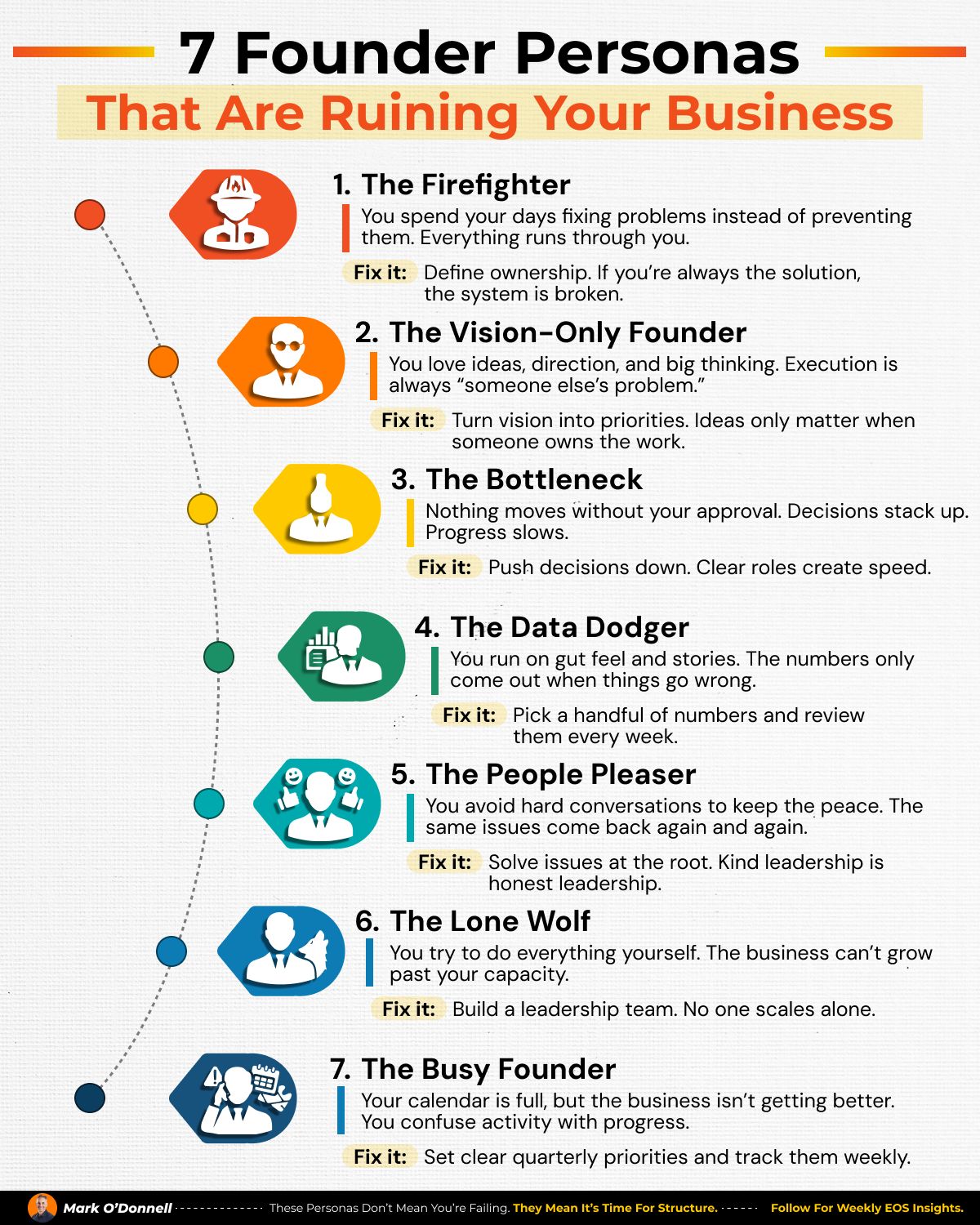
In a recent LinkedIn post, Mark O’Donnell explores the common pitfalls that cause founders to work harder without seeing corresponding business improvements. O’Donnell highlights a pervasive issue where founders find themselves trapped in roles that were once effective but have now become constraints on growth, a phenomenon he terms “founder personas.” He emphasizes that these aren’t character flaws but rather symptoms of missing foundational business structures.
O’Donnell begins by recounting a conversation with a founder who expressed frustration: “I feel like I’m working twice as hard as I did three years ago, but the business is barely growing.” This sentiment, according to O’Donnell, is often not due to a lack of effort but because the founder is stuck in a limiting persona.
“Most of the time, they’re not doing anything wrong. They’re just stuck in a role that used to serve them and now holds them back.”
The core of O’Donnell’s analysis lies in identifying and dissecting these distinct founder personas, each with its own set of behaviors and suggested remedies. He outlines seven such patterns that business leaders commonly cycle through.
The Firefighter: Reacting Instead of Building
O’Donnell describes the “Firefighter” persona as someone constantly reacting to immediate problems rather than proactively building the business. This often stems from undefined ownership, making the founder the default problem-solver.
“This happens because ownership was never defined, so you become the solution.”
To counteract this, O’Donnell advises assigning clear accountability. “If you’re always the answer, the system is the problem,” he states, advocating for the establishment of systems that distribute responsibility.
The Big Picture Founder and The Bottleneck
The “Big Picture Founder” excels at vision and strategy but struggles with the execution details. O’Donnell notes that such founders need to ensure that big ideas are translated into actionable priorities with clear owners and deadlines. “Every idea needs an owner and a timeline. Otherwise, it’s just a wish,” he argues.
Conversely, the “Bottleneck” founder impedes progress because nothing moves without their direct approval. This often occurs when roles and decision-making authority are unclear. O’Donnell’s solution is to “Push decisions down. Clarity creates speed.”
The Gut-Feel Operator, Peacekeeper, and Lone Wolf
O’Donnell also addresses the “Gut-Feel Operator,” who relies on instinct over data. The fix here is to establish a habit of reviewing key metrics consistently. “Pick a handful of numbers and look at them every week. Let the data talk first,” he suggests.
The “Peacekeeper” avoids necessary conflict, allowing problems to fester. O’Donnell stresses that “Honest leadership is kind leadership,” advocating for addressing issues at their root.
The “Lone Wolf” persona is characterized by an unwillingness to delegate or trust a leadership team, leading the founder to carry too much of the burden. O’Donnell’s remedy is straightforward: “No one scales alone. Build the team, then let them lead.”
The Busy Founder: The Illusion of Progress
Finally, O’Donnell identifies the “Busy Founder” whose calendar is full, yet the business shows little improvement. This is often a result of a lack of clear quarterly priorities, making everything seem urgent.
“Without clear quarterly priorities, everything feels urgent.”
O’Donnell recommends setting “3-7 priorities every 90 days. Track them weekly.” This structured approach, he posits, helps distinguish true progress from mere busyness.
Addressing the Root Cause: Systems, Not Flaws
Throughout his post, Mark O’Donnell reiterates that these “founder personas” are not inherent character flaws. Instead, they are “symptoms of missing structure (missing roles, priorities, honesty, etc).” He has observed that most founders recognize themselves in multiple personas and acknowledges having experienced several himself.
The path forward, as outlined by O’Donnell, involves intentionally building the systems and structures that render these limiting patterns obsolete. He also extends this advice to coaches and consultants, suggesting these patterns can impact their own practices. For those seeking self-awareness, O’Donnell offers a free quiz to assess their position relative to these patterns.
📝 About This Content
This article is based on insights shared by Mark O'Donnell on LinkedIn.
📅 Originally posted on January 31, 2026 | View original post on LinkedIn →