
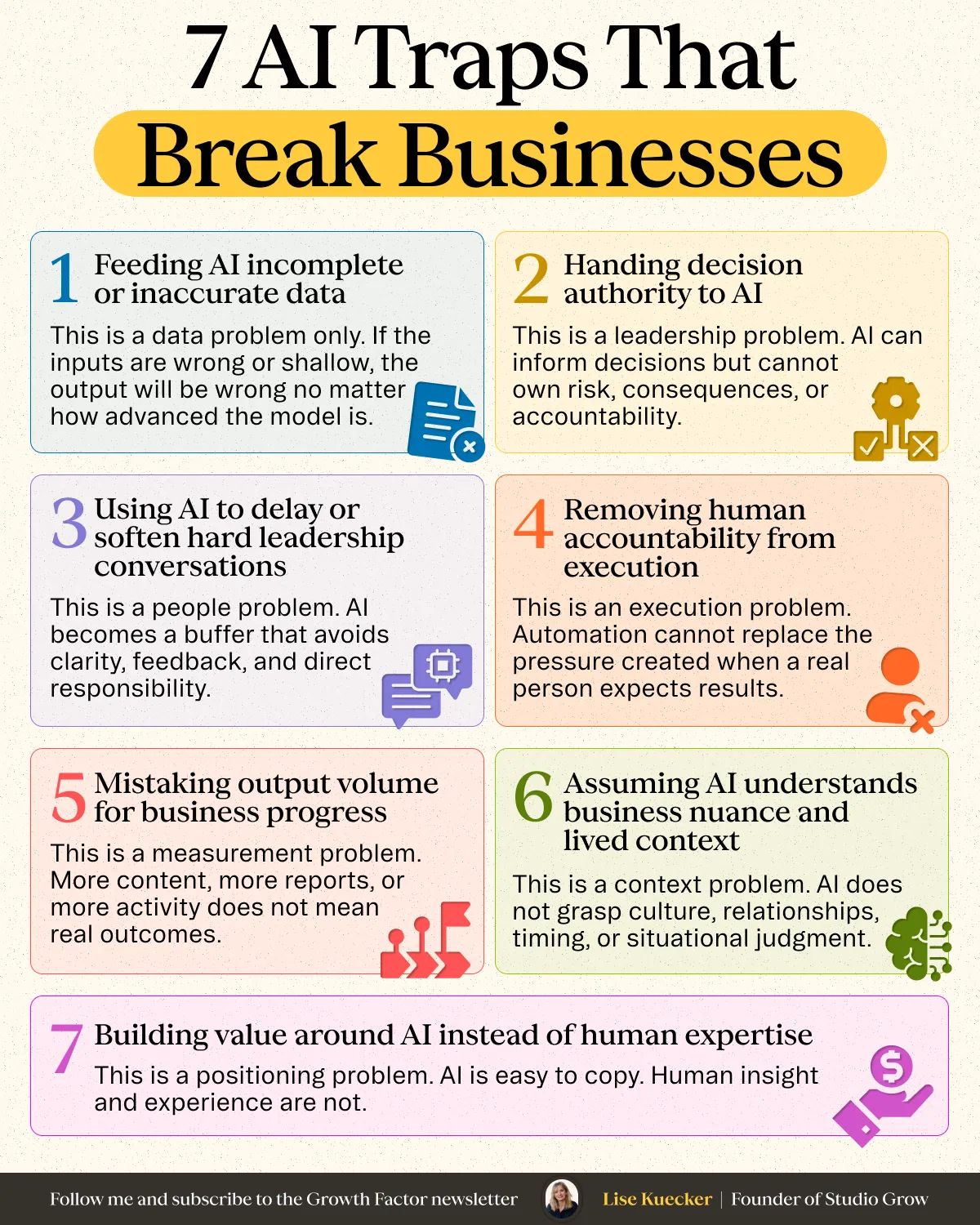
In a recent LinkedIn post, Lise Kuecker tackles the pervasive influence of Artificial Intelligence (AI) on the business landscape, arguing that while AI is a powerful tool, its effectiveness hinges entirely on how it’s wielded by human leaders. Kuecker, who leads Studio Grow, shared her perspective on how founders are often misapplying AI, leading to potential pitfalls that can harm their businesses.
The Pitfalls of AI Misapplication
Kuecker emphasizes that AI is not a universal solution but rather a tool that requires skilled operation. She points out a common misconception among founders who believe AI can solve all their problems without understanding its limitations. This often leads to several critical errors in implementation.
“AI isn’t a magic button that solves everything. It’s a tool. And just like any other tool, it’s only as good as its user.”
As Kuecker notes, the success or failure of AI integration is directly tied to the quality of human oversight and input. She outlines specific traps founders frequently fall into, highlighting that these issues stem from fundamental problems in data management, leadership, human interaction, execution, measurement, contextual understanding, and strategic positioning.
Common Traps for Founders Using AI
Data and Decision-Making Issues
One significant area of concern for Kuecker is the quality of data fed into AI systems. She states that founders often make the mistake of:
- Feeding AI incomplete or inaccurate data: Kuecker identifies this as a “data problem,” where flawed inputs inevitably lead to subpar outputs.
- Handing decision authority to AI: This is characterized as a “leadership problem.” While AI can provide valuable information for decision-making, Kuecker argues it cannot bear the risk associated with those decisions.
Human Element and Execution Challenges
Beyond data and decision-making, Kuecker also highlights how AI can negatively impact the human side of business if misused. She points out:
- Using AI to delay or soften hard leadership conversations: This is described as a “people problem,” where AI becomes an artificial buffer, preventing necessary human team-building and direct communication.
- Removing human accountability from execution: Kuecker labels this an “execution problem,” as automated processes often fail to account for external expectations or the nuances of real-world implementation.
Measurement, Nuance, and Value Creation
Further complicating the picture, Kuecker addresses issues related to how AI’s impact is measured and understood:
- Mistaking output volume for business progress: This is a “measurement problem,” as increased AI-driven activity does not automatically equate to meaningful business advancement.
- Assuming AI understands business nuance and lived context: Kuecker calls this a “context problem,” emphasizing that AI lacks the understanding of company culture and interpersonal relationships inherent in human experience.
- Building value around AI instead of human expertise: This is a “positioning problem.” Kuecker concludes that AI’s capabilities are easily replicable, whereas unique human insight and experience represent a more sustainable source of business value.
“At the end of the day, we thrive on relationships. AI can help you move faster. It can crunch huge data sets of numbers. It can handle repetitive tasks so you don’t have to. But it can’t build trust, read a room, or make someone feel seen.”
Kuecker’s core message is that while AI offers significant advantages in speed, data processing, and task automation, it cannot replace the essential human elements of business. She concludes by urging founders to:
“Use AI where it makes sense, but don’t let it replace the parts of your business that need a human touch.”
Her insights underscore the importance of a balanced approach, leveraging AI as a supportive tool rather than a substitute for human judgment, leadership, and connection.
📝 About This Content
This article is based on insights shared by Lise Kuecker on LinkedIn.
📅 Originally posted on January 17, 2026 | View original post on LinkedIn →