
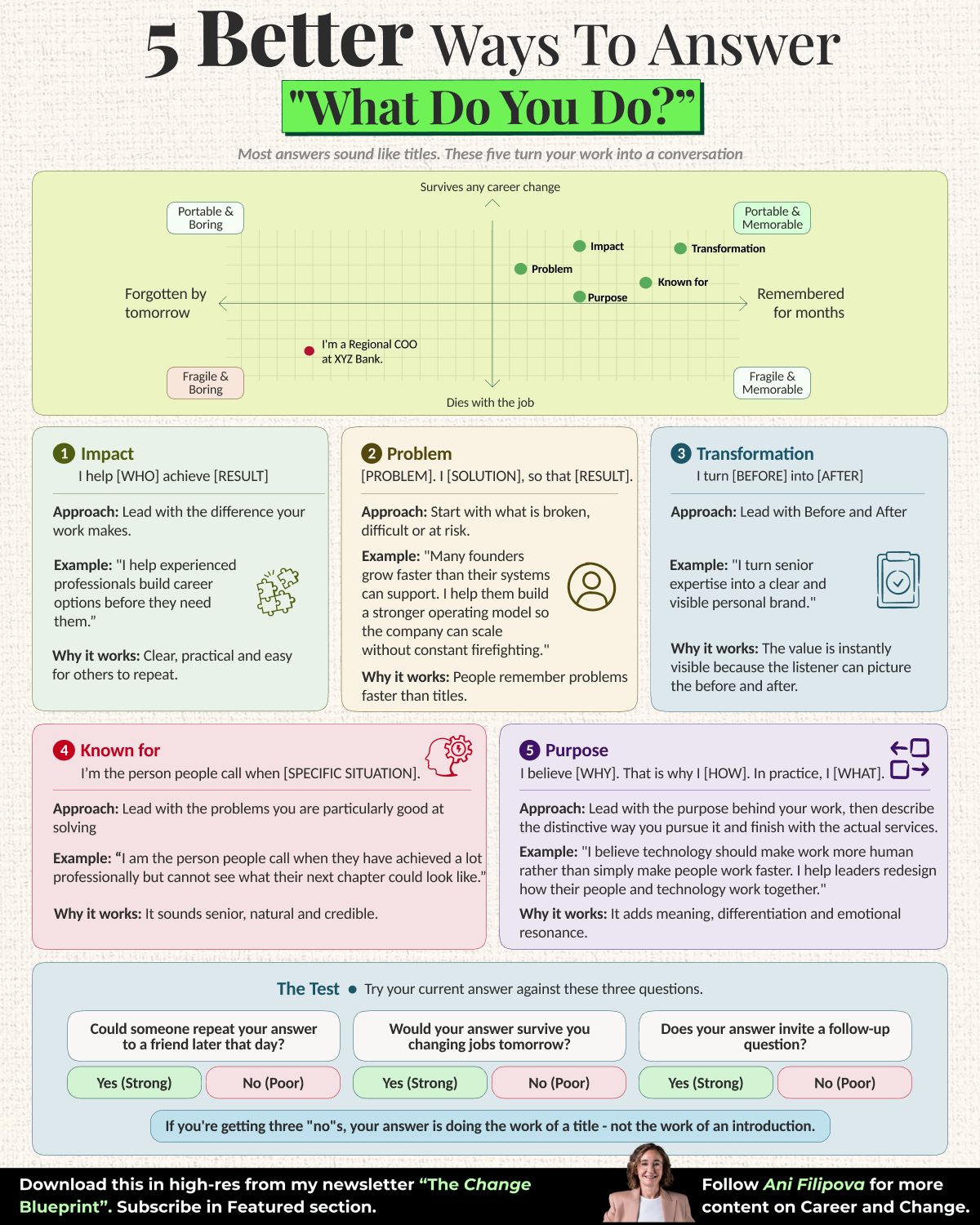
In a recent LinkedIn post, Ani Filipova offers a compelling perspective on how professionals can more effectively communicate their value in initial conversations. Rather than defaulting to a job title, Filipova advocates for answers that highlight the impact and results of one’s work, making them more memorable and actionable for the listener.
Filipova begins by identifying a common pitfall in professional introductions: the tendency to state a job title in response to the ubiquitous question, “So, what do you do?” She points out that while accurate, these answers often fall flat.
“Accurate? Yes. Interesting? Not really. And most importantly, none gives the other person much to remember or ask about.”
According to Filipova, this missed opportunity can be rectified by shifting the focus from a role to the value created. She provides several examples to illustrate this point, contrasting standard job title responses with more impactful value-driven statements.
Reframing the Introduction: From Role to Impact
Filipova argues that the goal of an introduction is not merely to state one’s profession but to provide a hook that encourages further engagement. She suggests that a more effective approach involves explaining the specific problems you solve or the benefits you deliver.
For instance, instead of identifying as an HR Director, Filipova proposes saying:
“I help growing companies keep their best people when the business is changing.”
Similarly, for a consultant, the advice is to move beyond the generic label and articulate the strategic contribution. As Filipova notes:
“I help founder-led businesses turn scattered priorities into a strategy their teams can actually execute.”
This strategic reframing, Filipova emphasizes, is about clarity and connection, not just crafting an “impressive elevator pitch.” The objective is to offer something that the other person can easily grasp, recall, and inquire about further, fostering a more meaningful exchange.
The Deeper Significance of Value Communication
Beyond the immediate conversational benefits, Filipova highlights a more profound implication of how professionals describe their work. She posits that the clarity with which one articulates their value directly reflects their own understanding of that value.
In Filipova’s view, a well-defined understanding of one’s contributions is foundational for professional growth. She explains that greater clarity about the value one provides can directly lead to enhanced visibility, stronger authority, greater income resilience, and a broader range of career opportunities.
Career Optionality and Self-Awareness
To further assist individuals in assessing their professional standing and potential, Filipova mentions the creation of a “Career Optionality Score.” This tool, she suggests, can help individuals identify areas where their career options are expanding and pinpoint potential gaps that may need attention. She encourages readers to take a quiz to evaluate their own career optionality.
Filipova’s insights, drawing on research from various thought leaders in communication and business strategy, underscore the critical importance of intentionality in professional self-representation. By moving beyond simple job titles, individuals can unlock more effective networking, deeper professional relationships, and a clearer path toward career advancement.
📝 About This Content
This article is based on insights shared by Ani Filipova on LinkedIn.
📅 Originally posted on July 22, 2026 | View original post on LinkedIn →