
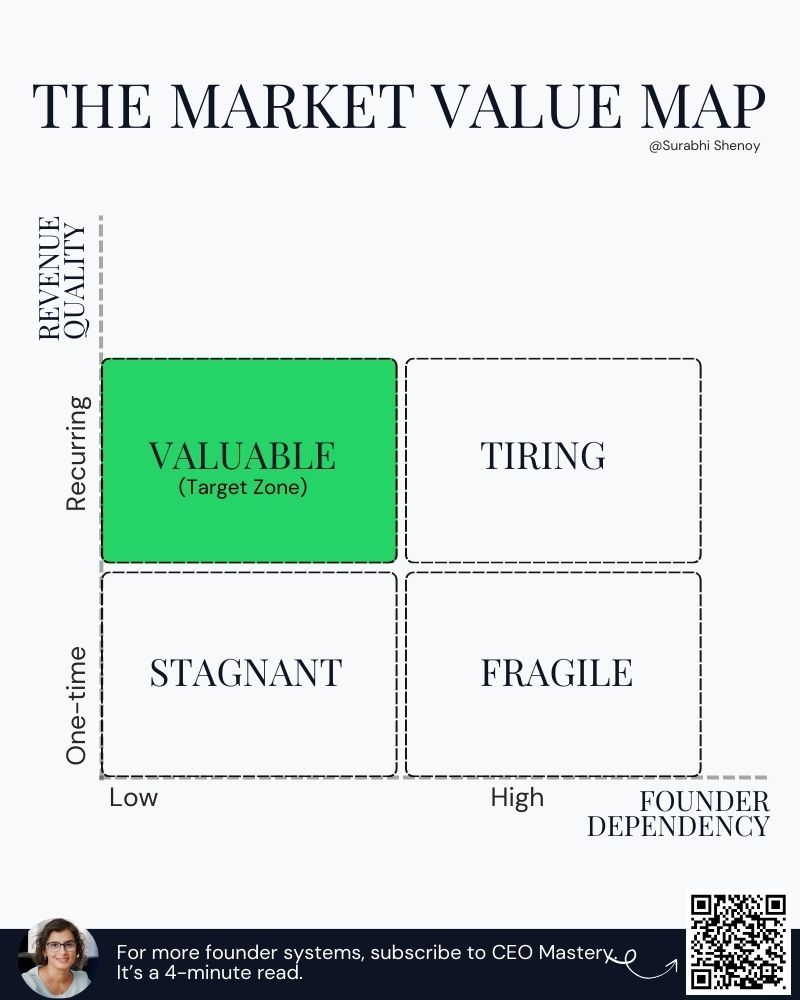
In a recent LinkedIn post, Surabhi Shenoy discusses a critical oversight many founders make: optimizing the wrong business metrics. Shenoy identifies two common founder archetypes, both of whom, she argues, are often focused on indicators that don’t reflect true business health or market value.
Shenoy introduces the concept of two founder types: the “Unicorn” Founder and the “Service” Founder. For the “Unicorn” Founder, revenue might be climbing, but it’s often driven by one-time sales, expansion efforts, or a need for constant reinvention rather than predictable, recurring income. The “Service” Founder, on the other hand, may have a profitable and stable business, but it remains heavily reliant on the founder’s personal involvement in delivery, sales, or key decision-making.
The Pitfalls of Misaligned Metrics
Both of these profiles can appear successful on the surface, but Surabhi Shenoy argues that markets ultimately value something more specific: Revenue Quality and Founder Dependency. She elaborates on this distinction:
“High-quality revenue repeats. Independent business survives when the founder steps back.”
This emphasis on revenue quality and reduced founder dependency, according to Shenoy, directly impacts how a business is perceived by the market, influencing its valuation, funding prospects, and potential for acquisition.
Introducing the Market Value Map
To help founders assess their position, Surabhi Shenoy points to a framework she calls the “Market Value Map.” This tool, she suggests, helps clarify where a business truly stands. She poses two fundamental questions that are key to plotting a business’s position on this map:
- How much of the revenue is recurring versus one-time?
- How much of decision-making, delivery, or sales depends on the founder personally?
Shenoy asserts that an honest assessment of these questions will reveal the business’s quadrant on the map. This self-awareness is presented as the crucial first step toward making strategic improvements.
Beyond the Map: Actionable Insights
While the Market Value Map provides diagnostic clarity, Surabhi Shenoy notes that determining the next steps requires further consideration. She alludes to having previously written about actionable strategies and real-life examples related to these concepts, directing readers to further resources for deeper dives into scaling businesses effectively.
In her post, Shenoy challenges founders directly, asking:
“Which quadrant does your business sit in?”
This direct question encourages introspection and highlights the practical application of her insights. By focusing on revenue quality and minimizing founder dependency, Shenoy argues that businesses can achieve more sustainable growth and command higher market valuations.
📝 About This Content
This article is based on insights shared by Surabhi Shenoy on LinkedIn.
📅 Originally posted on February 20, 2026 | View original post on LinkedIn →