
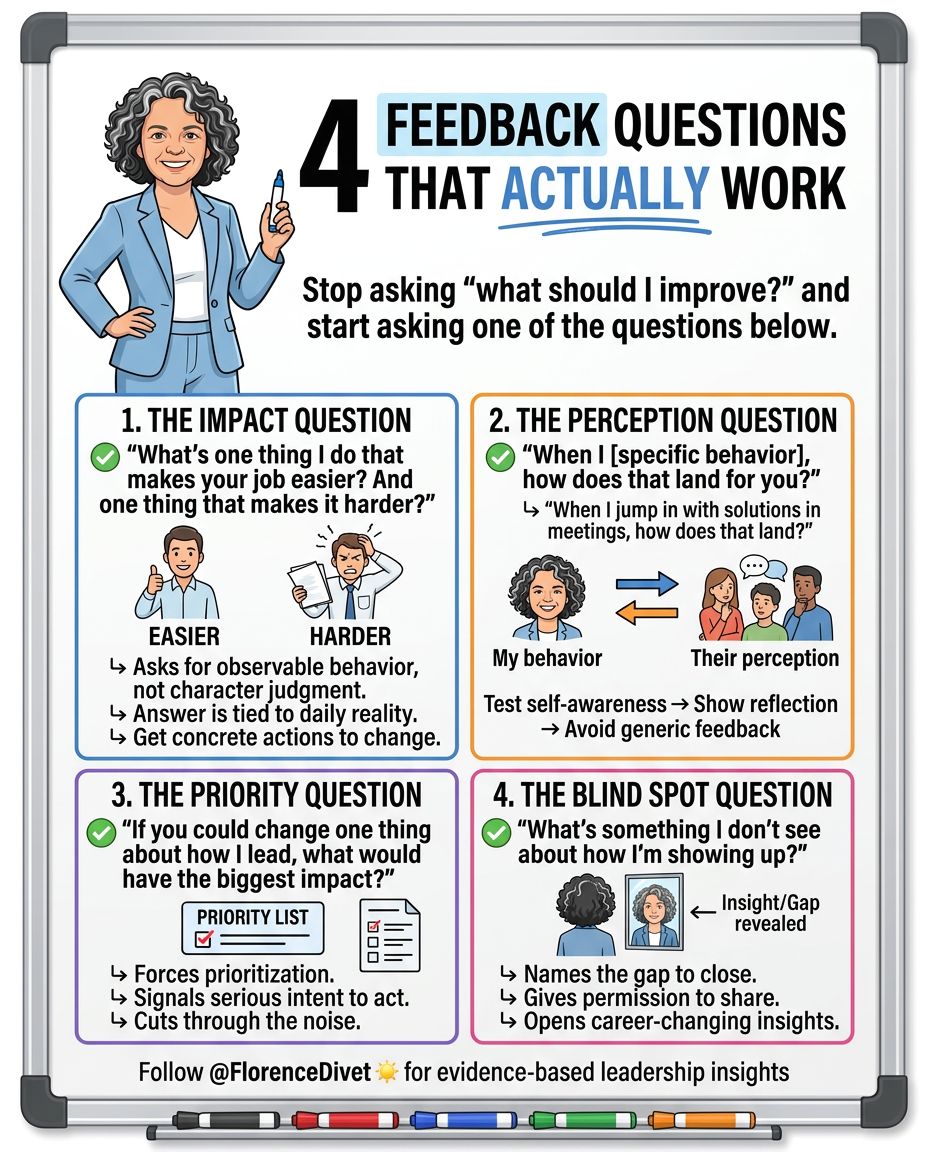
In a recent LinkedIn post, Florence Divet ☀️ explores why many leaders fail to receive actionable feedback, despite claiming to want it. The core issue, according to Divet ☀️, lies not in dishonesty from employees, but in the leaders’ own imprecise questioning. She argues that common queries like ‘What should I improve?’ are too vague and put individuals on the spot, leading to generic and unhelpful responses.
Divet ☀️ highlights the common pitfall of such questions, stating:
Most leaders say they want honest feedback. Then they ask: “What should I improve?” And get absolutely nothing useful. Not because people are dishonest. Because the question is lazy.
This observation underscores a critical disconnect in many workplace feedback dynamics. Divet ☀️ asserts that superficial responses, such as “Maybe communicate a bit more?”, are not genuine feedback but rather “verbal polite wrap.” This framing suggests that leaders often receive what they are *told* they want to hear, rather than the candid insights that could foster genuine growth.
The Power of Precision in Feedback Questions
Florence Divet ☀️ contrasts ineffective feedback-seeking with a more strategic approach adopted by high-growth leaders. The key differentiator, she posits, is the precision of the questions asked. Leaders who cultivate faster growth, according to Divet ☀️, ask questions that make it both easier and safer for their teams to provide specific, honest input.
She elaborates on this distinction:
The difference between leaders who stay stuck and leaders who improve faster isn’t openness. It’s precision. Vague questions get polite feedback. Precise questions get useful feedback.
This emphasis on precision is central to Divet ☀️’s argument. She suggests that by framing questions more thoughtfully, leaders can elicit more meaningful and impactful information.
Four Effective Feedback Questions
To illustrate her point, Divet ☀️ offers four specific questions that she believes are more effective in generating useful feedback:
- The Impact Question: “What’s one thing I do that makes your job easier? And one thing that makes it harder?” Divet ☀️ explains that this question focuses on observable actions, making it easier for individuals to answer from direct experience rather than speculation.
- The Perception Question: “When I [specific behaviour], how does that land for you?” This question encourages leaders to compare their intended actions with the actual impact on others. For instance, asking, “When I jump in with solutions in meetings, how does that land?” helps bridge the gap between intent and perception.
- The Priority Question: “If you could change one thing about how I lead, what would have the biggest impact?” By forcing a single point of focus, this question aims to cut through the noise and identify the most critical area for improvement, yielding a clear priority.
- The Blind Spot Question: “What’s something I don’t see about how I’m showing up?” Divet ☀️ identifies this as a particularly powerful question for uncovering insights that leaders might otherwise miss.
Ultimately, Florence Divet ☀️’s insights on LinkedIn serve as a practical guide for leaders seeking to move beyond superficial feedback. By adopting more precise and targeted questioning strategies, leaders can foster a more open and effective feedback culture, driving personal and organizational growth.
📝 About This Content
This article is based on insights shared by Florence Divet ☀️ on LinkedIn.
📅 Originally posted on March 11, 2026 | View original post on LinkedIn →