
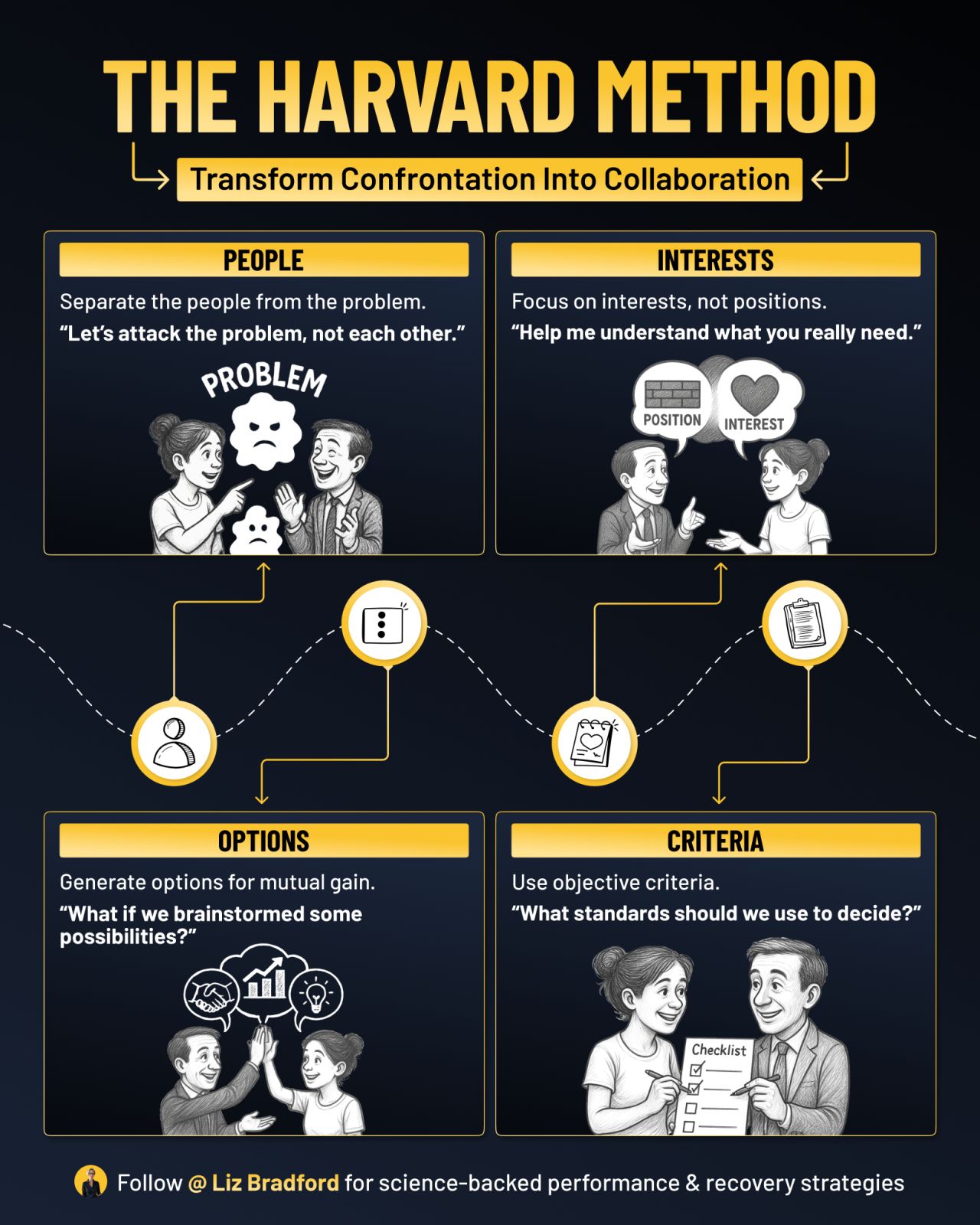
In a recent LinkedIn post, Liz Bradford challenges the conventional executive mindset around negotiation, arguing that the focus on ‘winning’ obscures a more effective and relationship-building approach. Bradford, who has coached over 200 C-suite leaders, introduces the Harvard Method as a transformative framework for achieving both better results and stronger partnerships.
Bradford contends that many executives approach negotiation with a zero-sum mentality. She writes:
“Most executives think negotiation is about winning. They’re missing the real game.”
This perspective, according to Bradford, is a fundamental misstep. The Harvard Method, as she explains, represents a crucial mindset shift from a win-lose scenario to one of mutual benefit.
The Four Pillars of Effective Negotiation
Bradford breaks down the Harvard Method into four key elements that executives should focus on:
1. People: Separate the Person from the Problem
A common pitfall, as highlighted by Bradford, is when negotiators attack the opposing party rather than the issue at hand. She advocates for transforming confrontation into collaboration by focusing on the problem itself. “Separate the person from the problem,” Bradford advises, emphasizing that attacking the individual hinders productive dialogue.
2. Interests: Uncover Underlying Needs
Instead of getting stuck on stated positions, Bradford urges leaders to delve deeper. “Focus on what they really need,” she suggests. Understanding the core interests behind a ‘no’ allows for more creative and mutually agreeable solutions, moving beyond rigid demands.
3. Options: Generate Multiple Solutions
Bradford identifies scarcity thinking as a deal-killer. She encourages generating multiple potential solutions that can satisfy both parties. “Create 3-5 solutions that serve both parties,” she states, pushing against the idea that there is only one way to achieve a positive outcome.
4. Criteria: Employ Objective Standards
To remove emotion and bias from the negotiation process, Bradford stresses the importance of objective criteria. “Use data, benchmarks, and industry standards to guide decisions,” she recommends. This reliance on external standards ensures fairness and facilitates rational decision-making.
The Counter-Intuitive Truth of Orchestration
The core of Bradford’s message lies in a counter-intuitive truth: the goal isn’t to defeat the other party, but to collaborate on a solution. “You’re not trying to beat them. You’re trying to solve WITH them,” she emphasizes. This collaborative spirit, she argues, leads to tangible benefits for her clients, including the closure of more strategic partnerships, reduced negotiation friction, and the cultivation of long-term, compounding relationships.
Ultimately, Bradford posits that great leaders don’t just negotiate; they orchestrate outcomes where all parties feel a sense of victory. She concludes with a strong statement on the significance of this skill:
“Great leaders don’t negotiate. They orchestrate outcomes where everyone feels they’ve won. Your next promotion depends on this skill.”
Bradford’s insights offer a compelling argument for reframing negotiation not as a battle to be won, but as a collaborative process to be expertly managed.
📝 About This Content
This article is based on insights shared by Liz Bradford on LinkedIn.
📅 Originally posted on November 10, 2025 | View original post on LinkedIn →