
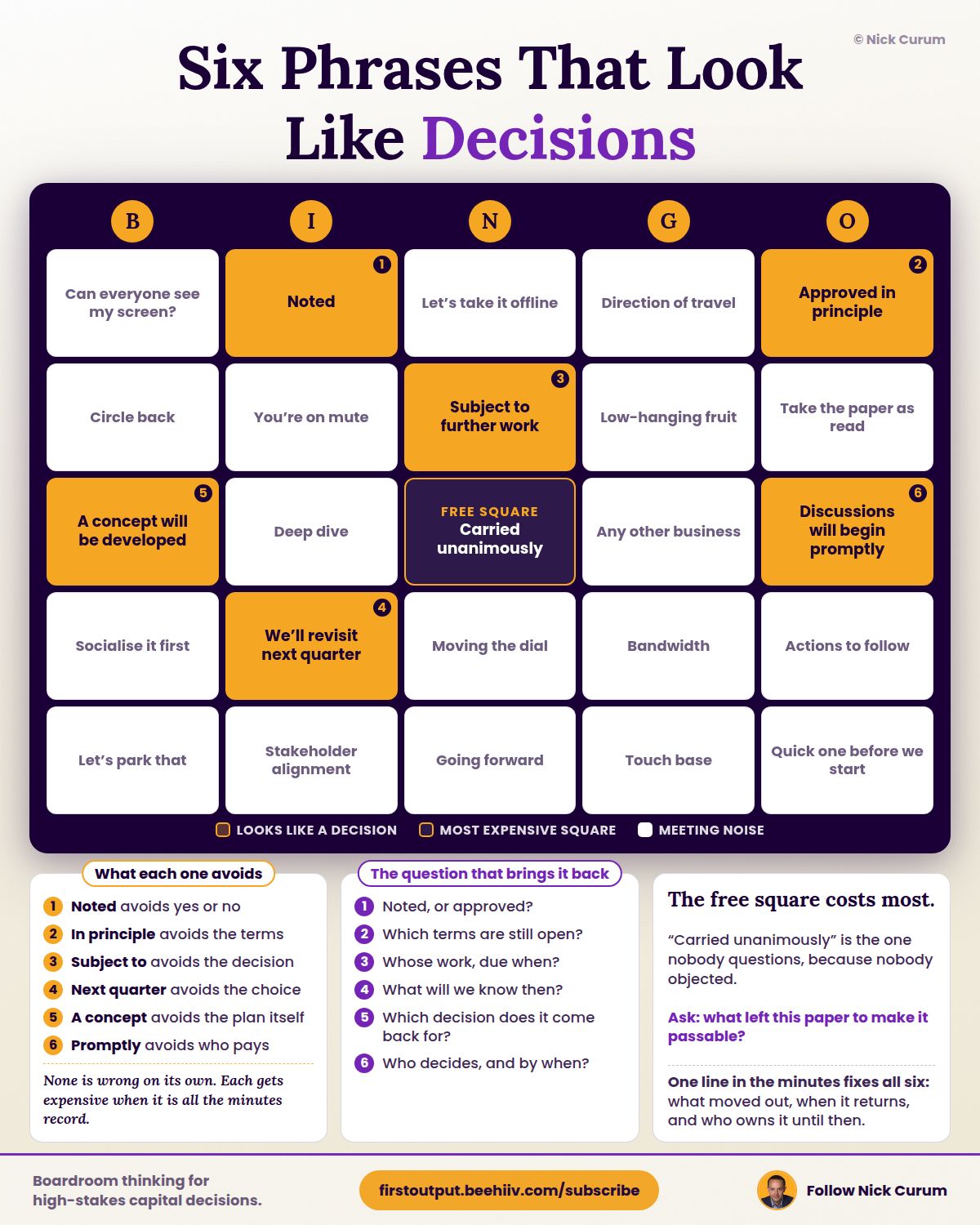
In a recent LinkedIn post, Nick Curum dissects the common language found in board minutes, arguing that seemingly innocuous phrases often serve to obscure a lack of genuine decision-making. Curum, who writes about building portfolios with boardroom discipline, highlights six recurring phrases that appear to signify progress but, in reality, settle nothing.
These phrases, including “noted,” “in principle,” “subject to,” “next quarter,” “a concept,” and “promptly,” are identified by Curum as linguistic tools that allow boards to avoid confronting contentious issues and making concrete choices. He posits that when a topic touches upon significant interests, the drafting of minutes can become a strategic exercise in deferral rather than resolution.
“Each one looks like a decision and settles nothing.”
The Illusion of Agreement in Board Minutes
Nick Curum breaks down the practical implications of these common phrases, revealing their true meaning within the context of board deliberations. He contends that what might appear as forward movement is often just an acknowledgment of receipt or a placeholder for future action, thereby delaying difficult conversations and decisions.
Deconstructing Deferral Tactics
According to Curum, the phrases function as follows:
- Noted: Simply means the paper was seen, not approved or rejected.
- Approved in principle: Indicates agreement with the general idea, not the specific terms.
- Subject to further work: Signifies a direction but defers the final decision to others.
- We’ll revisit next quarter: A placeholder date that avoids making a choice now.
- A concept will be developed: A plan to create a plan, further extending the decision timeline.
- Discussions will begin promptly: Postpones the settlement of who bears the cost until after a vote.
Curum emphasizes that while individually these phrases might not be inherently problematic, their cumulative effect can lead to a board that is perceived as active but is, in fact, stagnant.
“Minutes record what a board agreed. They rarely record what it moved.”
The Peril of Unanimous Approvals
A particularly costly phrase, in Nick Curum’s view, is “carried unanimously” when applied to contested issues. He argues that such an outcome often represents a trade-off made during the drafting process rather than genuine consensus. This unanimous agreement can mask underlying disagreements and unresolved conflicts.
Curum illustrates this point with an example from a recent supervisory board meeting concerning a restructuring. The board approved the plan, naming four plants without secured futures, but ultimately decided nothing concrete about any of them, with the concept due in June 2027. This scenario exemplifies how unanimous votes can obscure the absence of substantive decisions.
“On a contested paper, a vote with nothing against it is usually a receipt for a trade made during the drafting.”
Seeking Clarity Post-Vote
To counter this tendency towards ambiguity, Curum suggests a practical approach: asking clarifying questions *after* a vote has been taken. He proposes adding three fields to minutes for unanimous approvals: what was traded away, when the issue will be revisited, and who is responsible for it in the interim. This, he notes, should be completed by the chair, not the sponsor, to ensure objective documentation.
Curum advocates for this method because asking questions before a vote can be perceived as obstructionist. However, after a decision is made and no one has a position left to defend, individuals are more likely to provide honest answers. He concludes with a pointed observation:
“Your last unanimous approval had a price. The minutes will not tell you what it was.”
Nick Curum’s insights underscore the importance of precise language and genuine decision-making in corporate governance, urging leaders to look beyond the surface of board minutes to understand the true outcomes of deliberations.
📝 About This Content
This article is based on insights shared by Nick Curum on LinkedIn.
📅 Originally posted on September 12, 2026 | View original post on LinkedIn →