
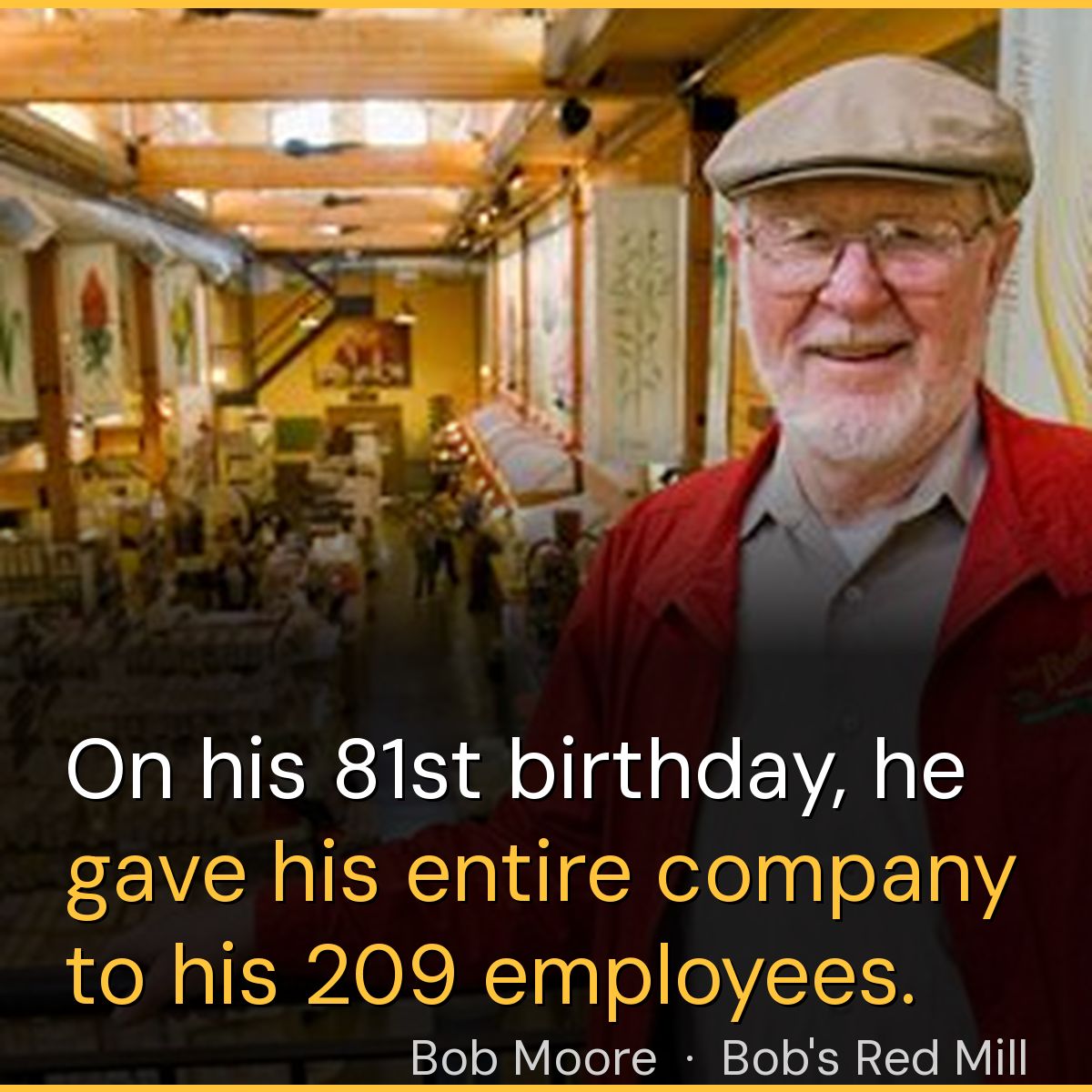
In a recent LinkedIn post, Dan Sherrard-Smith highlights the remarkable story of Bob Moore, the founder of Bob’s Red Mill, and his decision to transfer company ownership to his employees. Sherrard-Smith uses Moore’s experience to illustrate a powerful lesson for founders about the true meaning of a successful business exit.
The Founder’s Choice: Beyond Financial Gain
Sherrard-Smith begins by recounting Moore’s journey, noting that by his eighties, the founder of the well-known natural food brand Bob’s Red Mill had numerous opportunities to sell his company for significant profit. However, Moore chose a different path.
“On his 81st birthday, in 2010, he handed ownership to the 209 people who worked there. Not a slice. The whole thing, through an employee stock ownership plan.”
This act, as detailed by Sherrard-Smith, saw Moore gifting the entirety of Bob’s Red Mill to his workforce. By 2020, the company was fully employee-owned, with the number of employees having grown to 700, all of whom were now stakeholders.
Earning the Right to Own
Sherrard-Smith emphasizes Moore’s profound philosophy behind this decision, presenting it as a core tenet of responsible leadership. Moore’s reasoning, as quoted by Sherrard-Smith, was direct and principled:
“I don’t think there’s anybody worthy to run this company but the people who built it. They’re going to own the company.”
This perspective, according to Sherrard-Smith, underscores a belief that those who contribute directly to a company’s success should be the ones to benefit from its ownership. It contrasts sharply with traditional exit strategies that often prioritize external shareholders over the internal team.
The Critical Ending: A Founder’s Final Act
The core of Sherrard-Smith’s analysis revolves around the often-overlooked final stages of a founder’s journey. He points out that dedicating decades to building a business can be undermined by a flawed exit strategy.
Avoiding the ‘Wrong Ending’
Sherrard-Smith argues that the ultimate success of a founder’s legacy is deeply tied to how they conclude their involvement with the company they created. He posits:
“You can spend 40 years building something and still get the ending wrong on the very last day.”
Moore’s decision, in Sherrard-Smith’s view, represents getting that ending precisely right. It ensured that the fruits of decades of labor were distributed to the individuals who had been instrumental in its growth, from the factory floor to office roles.
A Legacy for the Builders
The post concludes with Sherrard-Smith posing a reflective question to founders, urging them to consider the ultimate beneficiaries of their life’s work:
“When you finally step back, who will you have built it for?”
This question, framed by Sherrard-Smith, serves as a call to action, encouraging business leaders to consider models like employee stock ownership plans (ESOPs) as a way to honor the contributions of their teams and ensure a lasting, equitable legacy. Dan Sherrard-Smith’s post celebrates Bob Moore’s decision not just as a business transaction, but as a profound statement on the human element of enterprise and the true meaning of building a company for the people who dedicate their careers to it.
📝 About This Content
This article is based on insights shared by Dan Sherrard-Smith on LinkedIn.
📅 Originally posted on July 15, 2026 | View original post on LinkedIn →