
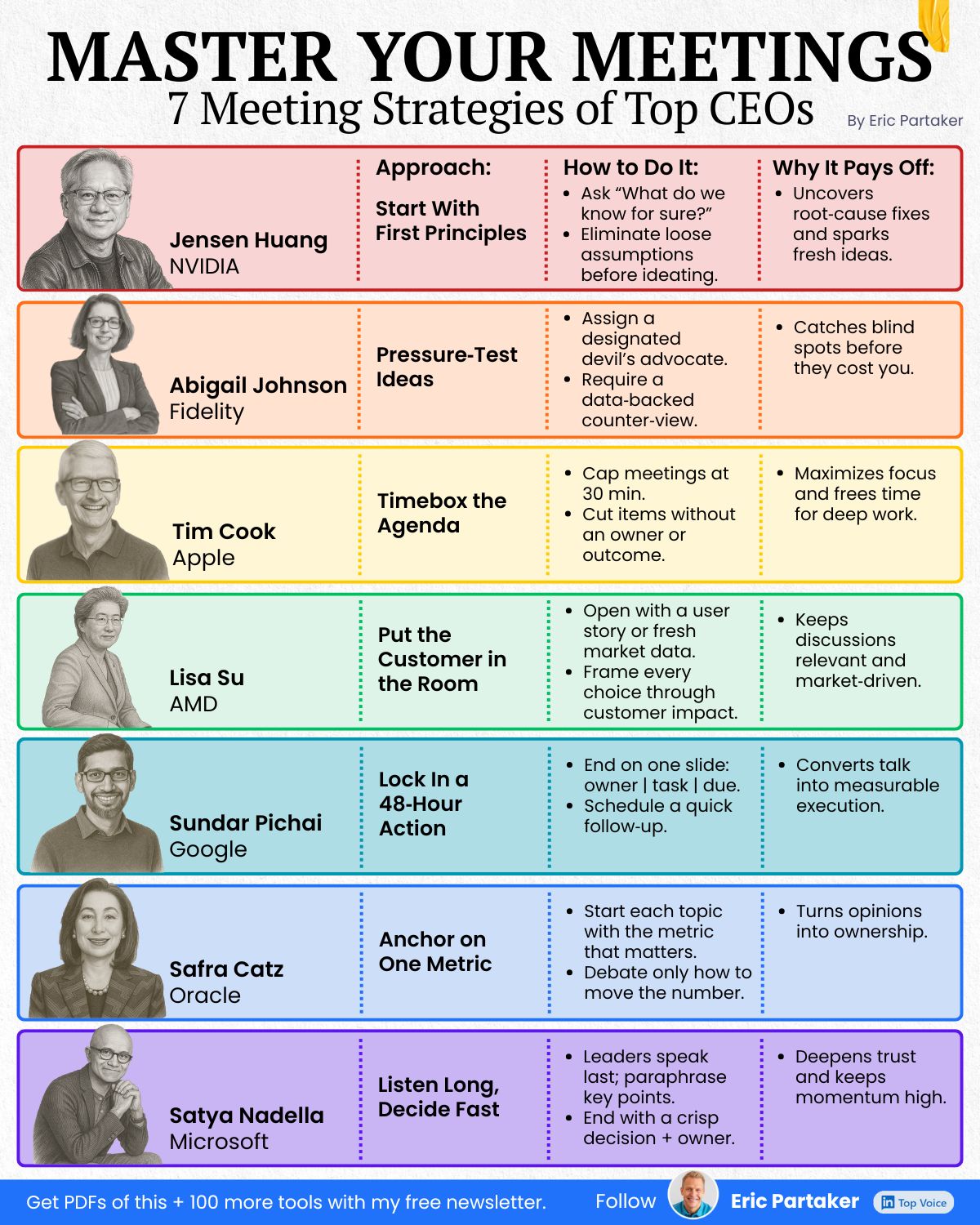
In a recent LinkedIn post, Eric Partaker discusses the perennial challenge of unproductive meetings, highlighting that only 29% are considered effective. Partaker, drawing on his study of leadership tactics from major tech companies like Apple, Google, and Microsoft, outlines seven strategies employed by top CEOs to maximize meeting efficiency and impact.
The Cost of Ineffective Meetings
Partaker opens by framing the issue, noting the significant time and resources wasted in subpar meetings. He emphasizes that mastering meeting conduct is a key differentiator for successful leaders and their organizations. To illustrate the caliber of insights, Partaker shares a direct observation from the post:
“Only 29% of meetings are considered productive.”
This statistic sets the stage for his subsequent advice, which aims to help professionals move into that elite group of productive meeting facilitators.
Seven Strategies from Elite CEOs
Partaker details distinct approaches used by renowned leaders, providing actionable insights for readers looking to improve their own meeting practices. Each strategy is presented with a clear explanation of its purpose and execution.
1. First Principles Thinking (Jensen Huang, NVIDIA)
According to Partaker, Jensen Huang of NVIDIA employs first principles thinking by asking, “What do we know for sure?” This method, as described in the post, involves stripping away assumptions before brainstorming to uncover breakthrough ideas that might otherwise be missed.
2. Pressure-Testing Ideas (Abigail Johnson, Fidelity)
Abigail Johnson of Fidelity, as highlighted by Partaker, implements a strategy of pressure-testing ideas. This involves assigning a devil’s advocate and requiring data to back up counterarguments, a technique designed to catch blind spots before they escalate into significant mistakes.
3. Ruthless Time Management (Tim Cook, Apple)
Eric Partaker points out that Tim Cook of Apple is “ruthless about time.” This strategy includes keeping meetings under 30 minutes and cutting ideas that lack a clear owner or defined outcome, thereby ensuring sharp focus and fast execution.
4. Customer-Centric Decisions (Lisa Su, AMD)
Lisa Su of AMD, according to Partaker’s analysis, prioritizes putting customers in the room. This involves opening discussions with real user stories and framing decisions based on customer impact, keeping teams aligned on what truly matters.
5. Driving Fast Follow-Through (Sundar Pichai, Google)
Sundar Pichai of Google, as Partaker explains, drives fast follow-through by ending meetings with clear next steps, ensuring each task has an owner and a deadline. This transforms discussion into tangible traction.
6. Anchoring on a Single Metric (Safra Catz, Oracle)
Safra Catz of Oracle, Partaker notes, anchors every topic on the single most important metric. This focuses debates and drives ownership of outcomes.
7. Mastering the Room (Satya Nadella, Microsoft)
Finally, Partaker highlights Satya Nadella of Microsoft’s approach to mastering the room, where leaders speak last and recap key points to demonstrate deep listening, thereby building trust and maintaining momentum.
Partaker summarizes the benefits of these strategies, stating:
“These strategies work. They save time. They build clarity. They deliver results.”
He encourages readers to adopt one strategy immediately to improve their own meeting effectiveness and join the top 29% of productive meetings.
📝 About This Content
This article is based on insights shared by Eric Partaker on LinkedIn.
📅 Originally posted on March 30, 2026 | View original post on LinkedIn →