
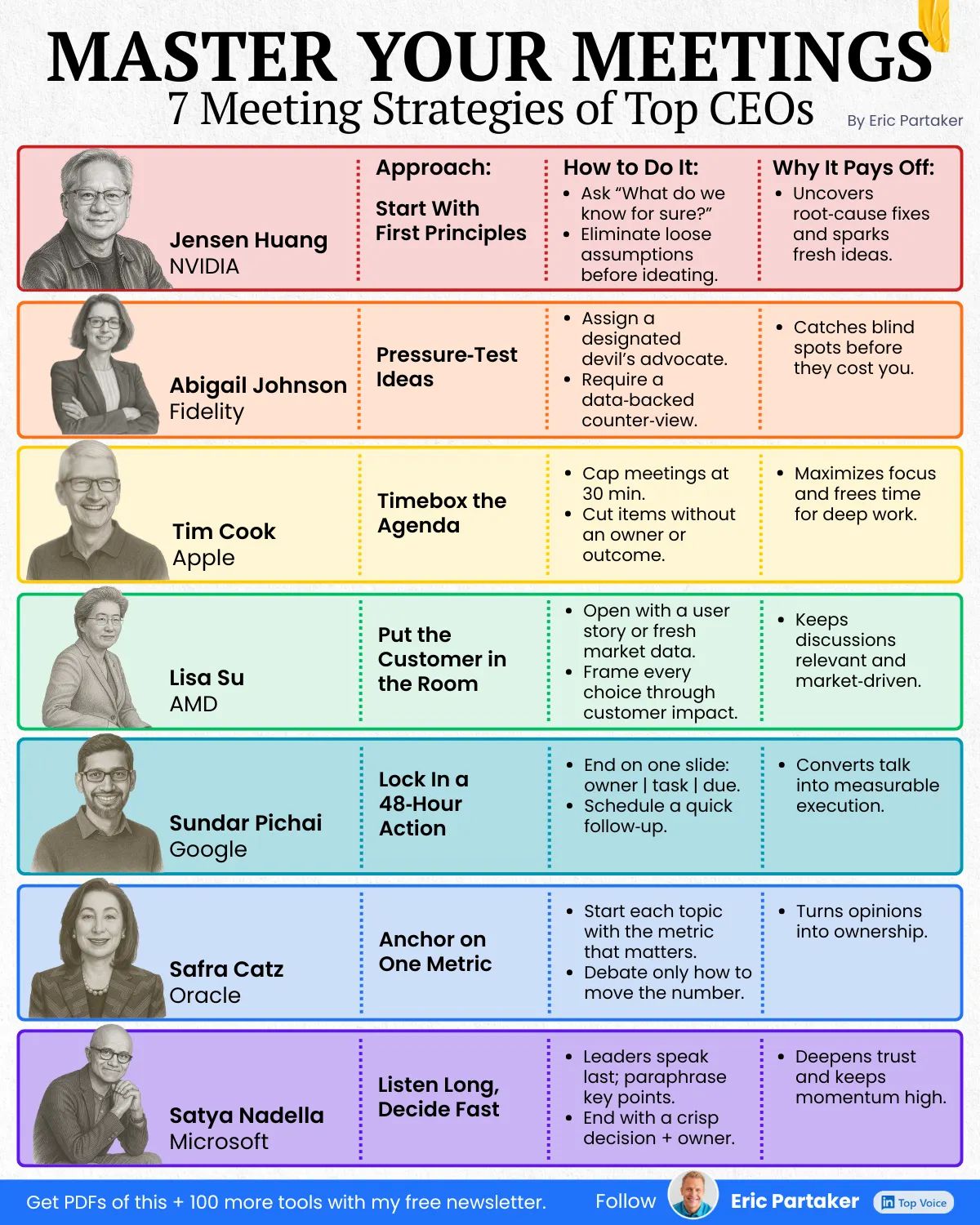
In a recent LinkedIn post, Eric Partaker delves into the common issue of unproductive meetings, highlighting that only 29% are considered effective. He shares insights gleaned from studying the practices of leaders at major corporations like Apple, Google, Microsoft, and NVIDIA, offering seven strategies to transform how business leaders conduct their gatherings.
The Challenge of Inefficient Meetings
Partaker opens by framing the pervasive problem: the low productivity rate of typical business meetings. He suggests that many leaders struggle to maximize the value of this critical communication tool. To address this, he presents a distilled set of tactics employed by some of the world’s most successful executives.
Want to know how to run insanely productive meetings? I’ve studied the tactics of leaders at Apple, Google, Microsoft, and more. Here’s what the world’s best do differently:
Key Strategies for Productive Meetings
Partaker outlines seven distinct approaches used by prominent CEOs:
1. First Principles Thinking (Jensen Huang, NVIDIA)
According to Partaker, Jensen Huang, CEO of NVIDIA, employs first principles thinking. This involves stripping away assumptions by asking fundamental questions like, “What do we know for sure?” This method aims to uncover breakthrough ideas by challenging conventional wisdom.
2. Pressure-Testing Ideas (Abigail Johnson, Fidelity)
Eric Partaker notes that Abigail Johnson, CEO of Fidelity, utilizes a strategy of pressure-testing ideas. This includes assigning a devil’s advocate to challenge proposals and requiring data to support counterarguments, thereby identifying potential blind spots before they become significant issues.
3. Ruthless Time Management (Tim Cook, Apple)
Tim Cook of Apple is presented by Partaker as an exemplar of ruthless time management in meetings. Key practices include keeping meetings under 30 minutes and cutting any ideas lacking a clear owner or defined outcome. Partaker emphasizes that this sharp focus leads to faster execution.
Sharp focus = fast execution
4. Customer-Centric Decisions (Lisa Su, AMD)
Lisa Su, CEO of AMD, is highlighted for her approach of putting customers at the center of discussions. As Partaker explains, this involves opening meetings with real user stories and framing all decisions around their impact on the customer, ensuring alignment on what truly matters.
5. Driving Fast Follow-Through (Sundar Pichai, Google)
Sundar Pichai of Google is credited by Partaker with driving fast follow-through. His method involves ending meetings with clearly defined next steps, assigning owners and deadlines to each task, and effectively turning discussions into tangible progress.
6. Anchoring on a Single Metric (Safra Catz, Oracle)
Eric Partaker points out that Safra Catz, CEO of Oracle, anchors every topic to a critical metric. This ensures that debates remain focused on moving that key number, transforming subjective opinions into actionable ownership.
7. Mastering the Room (Satya Nadella, Microsoft)
Finally, Satya Nadella of Microsoft is described by Partaker as mastering the room by ensuring leaders speak last and by recapping key points to demonstrate active listening. This approach, according to Partaker, builds trust and maintains momentum.
The Impact of Effective Meetings
Partaker concludes his post by reinforcing the benefits of implementing these strategies. He argues that adopting even one of these tactics can significantly improve meeting effectiveness.
These strategies work. They save time. They build clarity. They deliver results.
He encourages readers to pick one strategy and apply it within the week, aiming to join the top 29% of productive meetings. The post also includes promotional information for Partaker’s workshops and accelerator programs.
📝 About This Content
This article is based on insights shared by Eric Partaker on LinkedIn.
📅 Originally posted on December 14, 2025 | View original post on LinkedIn →