
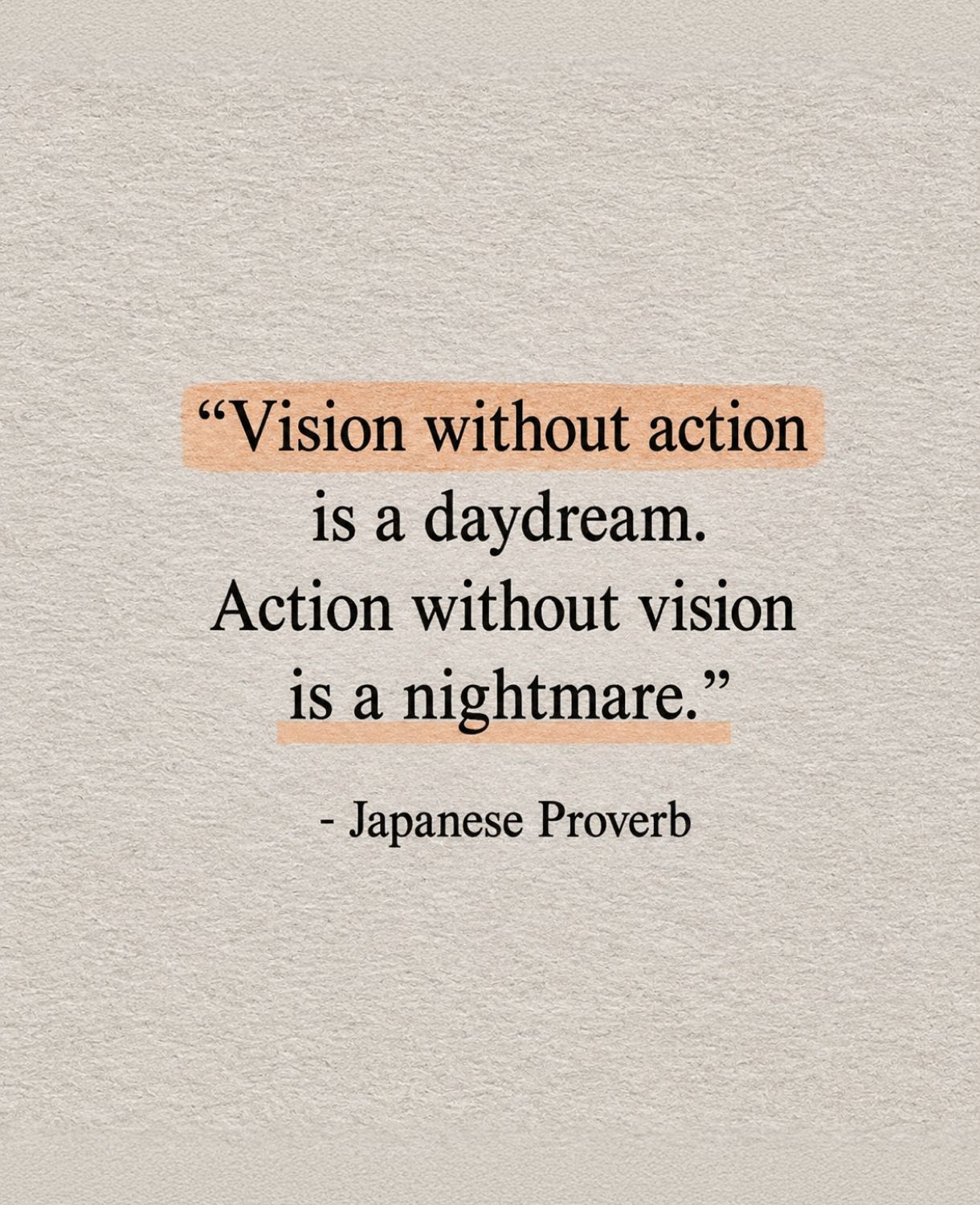
In a recent LinkedIn post, Mark O’Donnell delves into a common business pitfall, illustrating it with an old Japanese proverb: “Some businesses are all dream, no delivery. Others are all delivery, no destination.” O’Donnell uses this proverb to dissect the two primary ways businesses can become stagnant, emphasizing that these are not separate issues but interconnected facets of a larger problem.
“This quote is an old Japanese proverb… But it describes the two ways a business gets stuck better than almost anything I’ve read.”
Mark O’Donnell first examines the “daydream” scenario, which he associates with founders who are rich in ideas but lack the execution to bring them to fruition. In this state, a business may generate numerous exciting concepts weekly, but none ever progress beyond the founder’s imagination, leading to a lack of traction.
The Daydream: Abundant Ideas, Little Traction
As O’Donnell explains, the “daydream” is characterized by boundless energy and a constant stream of innovation, yet it suffers from a critical absence of follow-through. The business “never quite leaves the founder’s head,” according to O’Donnell, highlighting a fundamental disconnect between ideation and tangible results.
The Nightmare: Exhaustive Effort, No Direction
Conversely, O’Donnell describes the “nightmare” as a state where teams work tirelessly, putting in long hours and significant effort, but without a clear, agreed-upon destination. This lack of unified direction means that while there is considerable activity, there is little to no actual progress. “Plenty of motion, but no progress,” O’Donnell writes, noting that this environment can quickly lead to burnout among dedicated employees.
“Here the team is working flat out. Long days, real effort, everyone exhausted. But nobody ever agreed on where the company is actually headed, so they’re all rowing hard in different directions.”
Mark O’Donnell posits that these two scenarios are not distinct challenges but rather two sides of the same coin. He draws a parallel to the EOS (Entrepreneurial Operating System) framework, which distinguishes between the “Visionary” and the “Integrator.” The Visionary, as O’Donnell describes, is responsible for setting the company’s direction, defining its purpose, and making strategic bets. The Integrator, on the other hand, is tasked with the “how” – the execution and the operational machinery that transforms vision into reality.
The Synergy of Vision and Integration
When both roles are effectively filled and collaborate seamlessly, O’Donnell argues, businesses can transcend both the daydream and the nightmare. “You finally get vision and action pulling the same way,” he states, underscoring the power of aligned leadership.
“The Visionary owns the where and the why, the direction, the big bets, the vision for what the company could become. The Integrator owns the how, the execution, the day-to-day machine that turns those ideas into real results.”
A significant challenge O’Donnell observes is that frequently, the same individual attempts to fulfill both the Visionary and Integrator roles, particularly in the early stages of a business. This often leads to founders being stuck in the “daydream” phase due to the absence of a dedicated Integrator. O’Donnell concludes by posing a crucial question for business leaders:
“Right now, which half is your business living in? All vision and no execution? Or all execution and no clear direction?”
This reflection encourages business owners to assess their current operational state and identify whether their company leans more towards idea generation without delivery or relentless execution without a defined purpose. Mark O’Donnell’s analysis provides a clear framework for understanding and addressing these common business dysfunctions.
📝 About This Content
This article is based on insights shared by Mark O'Donnell on LinkedIn.
📅 Originally posted on July 10, 2026 | View original post on LinkedIn →