
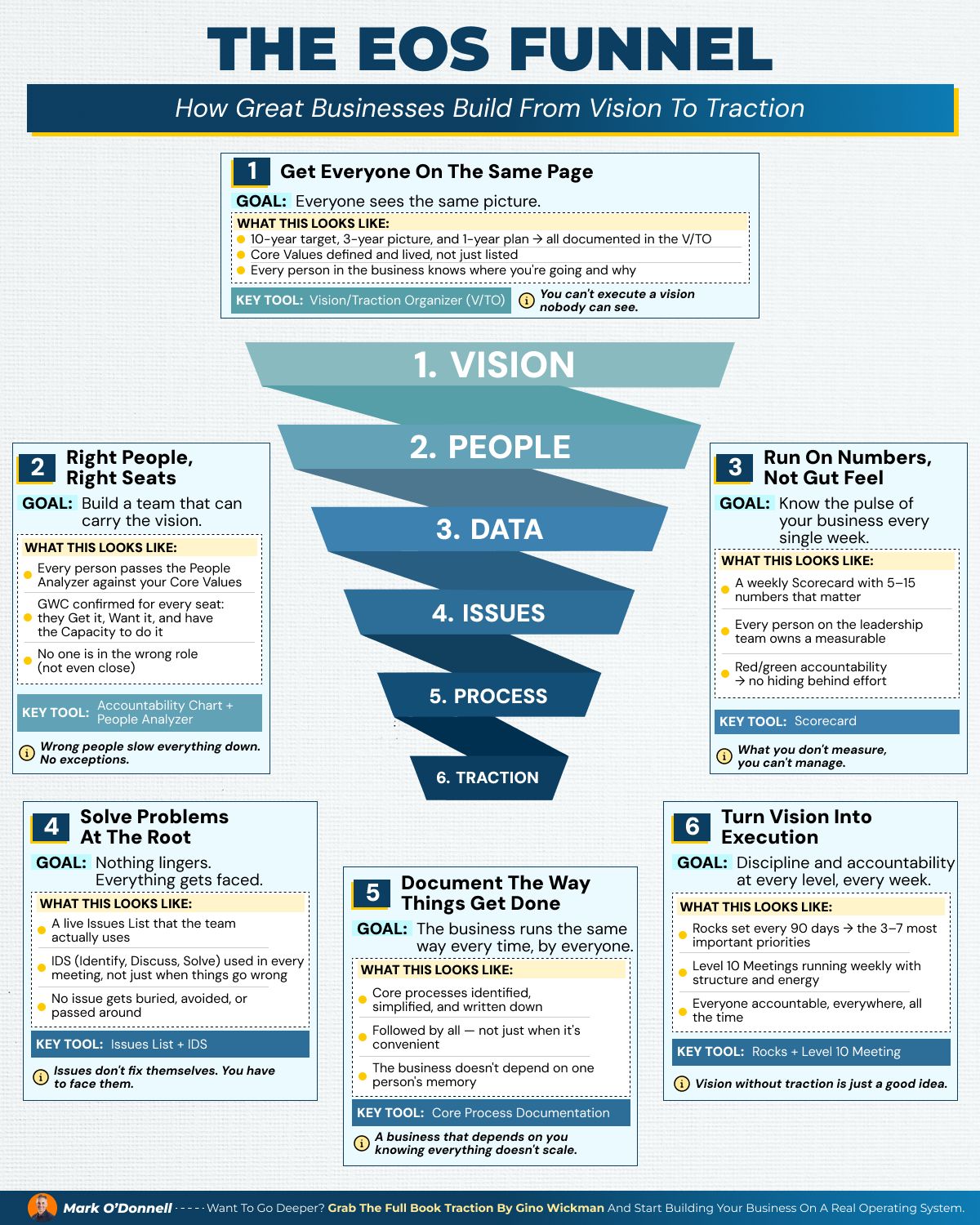
In a recent LinkedIn post, Mark O’Donnell discusses a common pitfall for business founders: prioritizing outward-facing elements before establishing a solid internal structure. O’Donnell uses the analogy of building a house, stating, “Nobody builds a house starting with the furniture. But that’s exactly how most founders build their business.” He contends that the frequent question he receives – “Why isn’t our business getting any traction?” – often stems not from poor execution, but from a weak foundation.
According to O’Donnell, many founders mistakenly view methodologies like EOS (Entrepreneurial Operating System) as a mere toolkit to be cherry-picked. Instead, he emphasizes that EOS is a comprehensive system designed to address foundational issues in a specific order across six key components.
The Six Pillars of Business Foundation According to O’Donnell
Mark O’Donnell outlines these six components as crucial for building a sustainable and scalable business. He stresses that they must be addressed in a logical sequence to be effective.
1. Vision: Aligning the Team
O’Donnell explains that the first step is ensuring clarity and alignment on where the business is headed. This involves documenting long-range targets, a three-year picture, and a one-year plan, making sure this vision is shared across the entire organization and stored in a readily accessible format like the V/TO (Visionary/Tary Organizer).
2. People: Ensuring the Right Fit
The second component focuses on having the right individuals in the right roles. O’Donnell highlights the importance of evaluating team members against core values and using tools like the People Analyzer. He also points to the GWC (Get It, Want It, Capacity to do It) check to ensure everyone is appropriately placed and capable of fulfilling their responsibilities.
3. Data: Leading with Numbers
Moving beyond opinions, O’Donnell advocates for a data-driven approach. He suggests implementing a weekly Scorecard with key metrics that provide a clear picture of business performance. As he notes, “Every person on the leadership team owns at least one measurable. Red means there’s an issue. Green means you move on.” This allows for objective assessment and timely intervention.
4. Issues: Root Cause Resolution
O’Donnell emphasizes the need to address problems at their source rather than just managing symptoms. He advocates for maintaining a visible Issues List and utilizing a structured meeting approach like IDS (Identify, Discuss, Solve) to ensure that challenges are tackled systematically and not overlooked.
5. Process: Systematizing Operations
The fifth component involves documenting and simplifying core business processes. O’Donnell argues that getting these processes out of individuals’ heads and into the business ensures consistency and reduces reliance on specific team members. This systematization makes the business more robust and less vulnerable to key person dependency.
6. Traction: Bridging Vision and Reality
Finally, O’Donnell discusses Traction as the component that connects the established vision with day-to-day execution. This involves setting quarterly Rocks (priorities) and conducting regular Level 10 Meetings to maintain accountability and drive progress. He states, “The payoff when all six are working: a business that runs on systems rather than stress.”
Mark O’Donnell concludes by challenging founders to assess their team’s alignment: “Can your whole team describe where the business is going in one sentence?” He suggests that a lack of clear vision, coupled with weak foundational components, is a primary reason businesses struggle to gain momentum.
For those seeking to deepen their understanding of how strong leadership teams overcome obstacles, O’Donnell points to his book, “Issues,” as a resource. He also invites readers to subscribe to his newsletter for regular insights.
📝 About This Content
This article is based on insights shared by Mark O'Donnell on LinkedIn.
📅 Originally posted on April 23, 2026 | View original post on LinkedIn →