
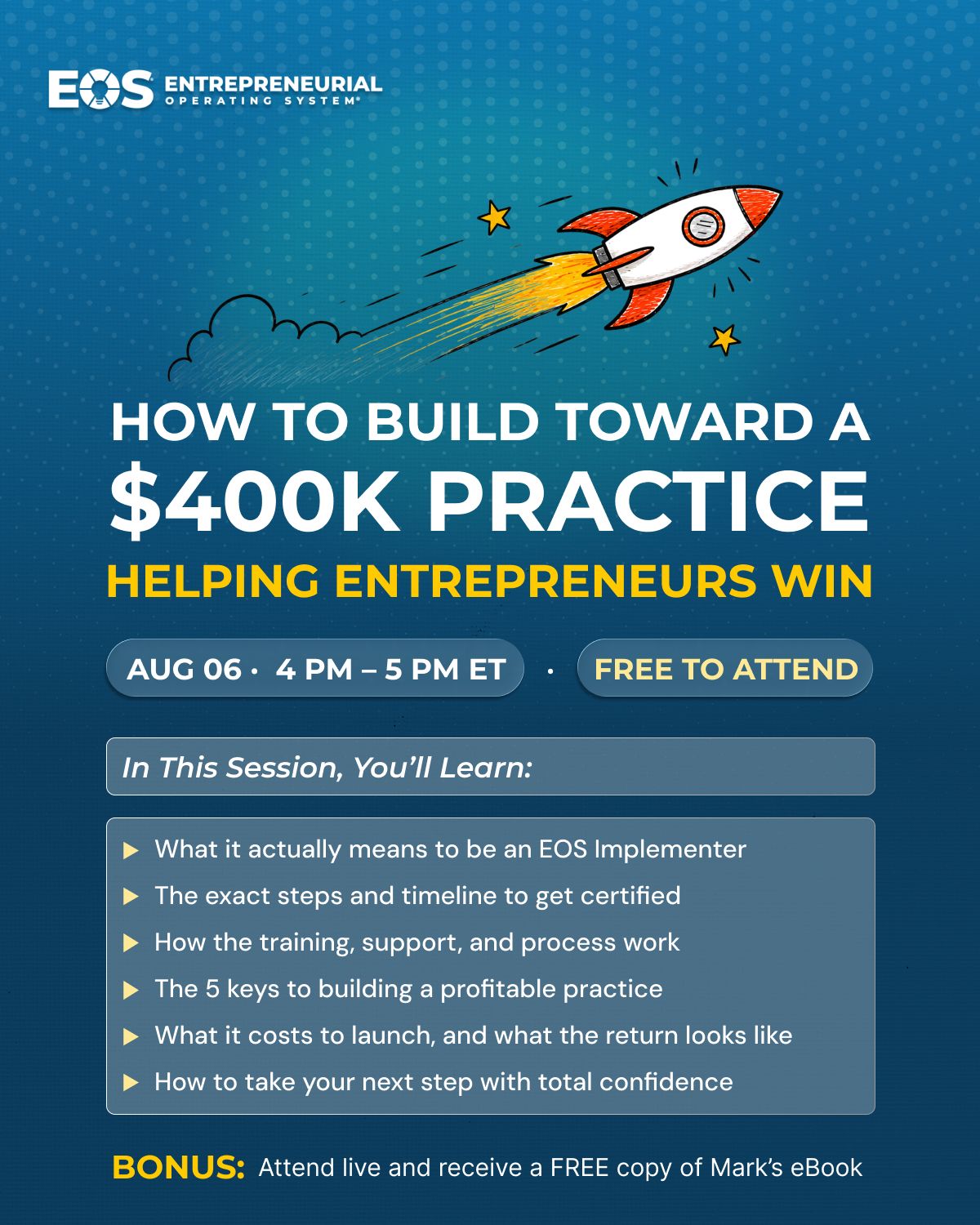
In a recent LinkedIn post, Mark O’Donnell discusses the pathway for individuals to build a successful EOS (Entrepreneurial Operating System) Implementation practice, emphasizing a structured approach and a clear business model. O’Donnell, who has observed EOS Implementers building substantial practices from the ground up, aims to demystify the process for those seeking to offer meaningful work on their own terms.
O’Donnell highlights a common question from aspiring implementers: “Is there a way to do meaningful work, on my own terms, without starting from zero again?” He asserts that the answer is affirmative and simpler than many anticipate. The core of this model, as described by O’Donnell, involves working with founders of companies typically between 10 and 250 employees who have encountered growth plateaus or persistent operational challenges.
“You work with founders running companies of 10 to 250 people. They’ve hit a ceiling. The team isn’t aligned, the same problems keep coming back, and they know they need outside help to break through.”
The proposed methodology involves engaging with the client’s leadership team to implement a structured process, with ongoing support provided quarterly. Mark O’Donnell outlines a business model characterized by its simplicity and recurring revenue:
- A single, flat monthly fee per client.
- Absence of royalties or territorial restrictions.
- Access to a community of over 870 implementers for support and collaboration.
The Financial Model and Path to Success
O’Donnell details the financial framework that enables a $400k annual revenue model. This is achieved through approximately 20 clients, leading to around 100 sessions per year, with each session priced at over $4,000.
“One flat monthly fee per client – No royalties – No territories – 870+ Implementers in a non-competitive community you can tap anytime”
According to Mark O’Donnell, there is a clearly defined, five-step sequence to guide new implementers: Right Fit → First Steps → Boot Camp → Basic Training → 3-Year Picture. This structured progression ensures that each step has a discernible outcome, removing ambiguity about progress and next actions.
Key Steps in Practice Development
In O’Donnell’s view, this systematic approach is crucial for new implementers. He elaborates on the structure:
“Every step has a clear outcome. You don’t have to guess where you are or what comes next.”
To further elaborate on this path, O’Donnell announced a free online masterclass. This session, led by EOS Franchise Advisor Lauren Shaver, is designed to cover the practical aspects of becoming an EOS Implementer. The masterclass agenda includes:
- The day-to-day realities of the Implementer role.
- Details on certification, including a realistic timeline.
- The five critical elements for building a profitable practice.
- Information on start-up costs and expected returns.
O’Donnell emphasizes the limited availability of spots for the masterclass, encouraging interested individuals to register promptly. Attendees will also receive a free copy of one of his eBooks, “Vision, Traction, Healthy: One Leader’s Journey to Living the EOS Life.” The masterclass is scheduled for Thursday, August 6th, from 4 PM to 5 PM ET, and is accessible online.
📝 About This Content
This article is based on insights shared by Mark O'Donnell on LinkedIn.
📅 Originally posted on August 5, 2026 | View original post on LinkedIn →