
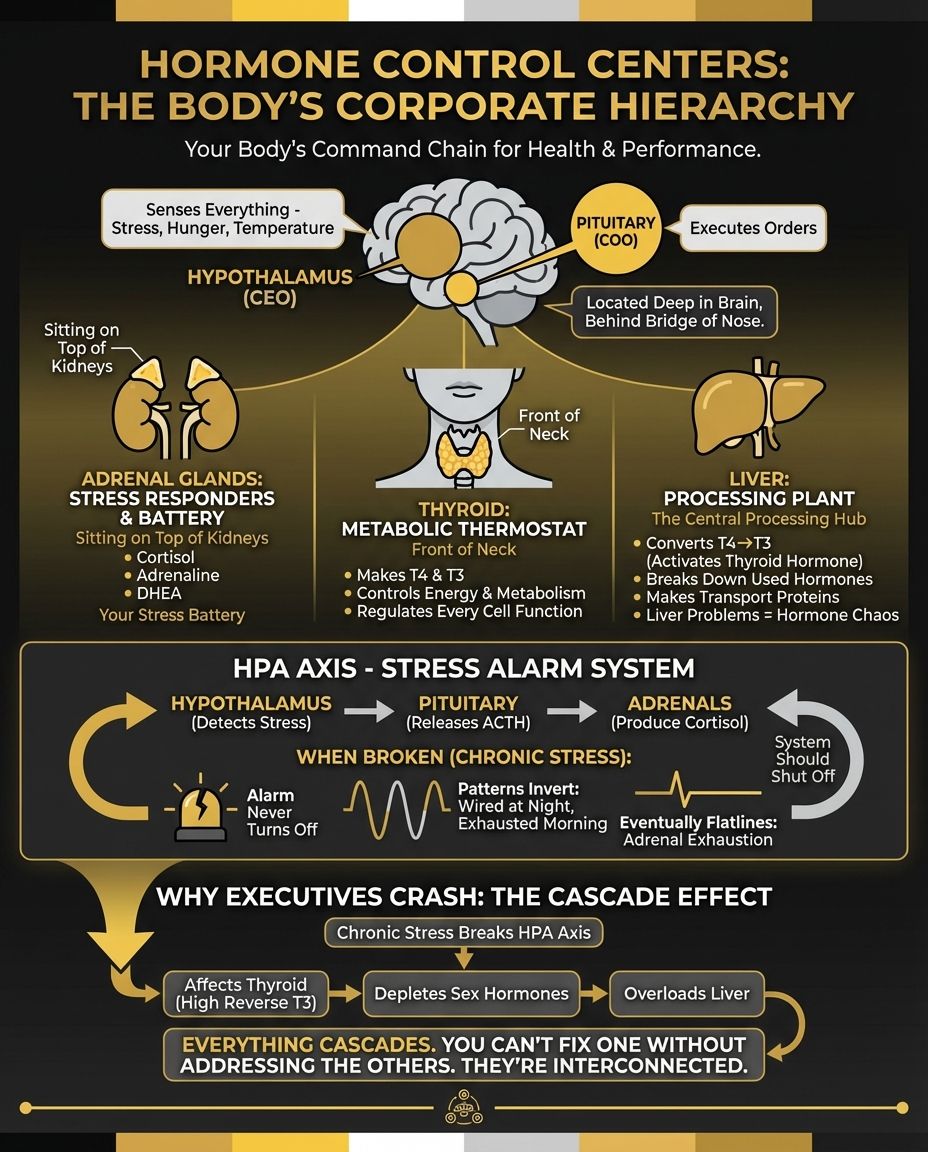
In a recent LinkedIn post, executive performance coach Liz Bradford discusses the physiological underpinnings of burnout, reframing it not as a personal failing but as a complex biological response to chronic stress. Bradford challenges the common perception of burnout as a sign of weakness, asserting instead that it represents a critical “system malfunction” within the body’s hormonal hierarchy.
Bradford draws an analogy between the body’s hormonal system and a corporate structure to explain the cascade of effects triggered by prolonged stress. She outlines how the Hypothalamic-Pituitary-Adrenal (HPA) axis, akin to a CEO, sends continuous emergency signals. This leads to a chain reaction:
- Adrenals release excess cortisol, described as a “panicked middle manager.”
- The thyroid is instructed to slow metabolic processes, mirroring “operations on lockdown.”
- Reproductive hormones are deprioritized, likened to a defunded HR department.
- Detoxification systems become overwhelmed, suggesting maintenance cannot keep pace.
As Liz Bradford notes, this breakdown can manifest even in high-achieving individuals:
“I worked with a CFO who seemed untouchable. Board presentations flawless, quarterly targets exceeded, team loyalty unwavering. But he was sleeping 4 hours a night and living on coffee and willpower.”
Bradford explains that the CFO’s laboratory results revealed a stark reality behind his seemingly invincible facade. His morning cortisol levels were alarmingly low, his testosterone levels were significantly diminished for his age, and his thyroid function indicated a severely slowed metabolism. This case, according to Bradford, underscores her central argument.
Challenging Conventional Resilience Training
The insights shared by Liz Bradford on LinkedIn directly question the efficacy of traditional resilience training methods when applied to severe burnout. She contends that “mindset” interventions are insufficient to address deep-seated biochemical imbalances.
“This is why resilience training fails. You can’t mindset your way out of biochemical chaos.”
Bradford advocates for a “systems thinking” approach, which she implements with senior leaders. This framework prioritizes a phased recovery process:
- Regulate stress signals first: Addressing the root cause of the HPA axis overactivation.
- Realign energy production and recovery: Restoring the body’s natural cycles of exertion and rest.
- Reignite output once the system is stable: Gradually rebuilding performance capacity on a solid biological foundation.
An Integrated Biological System
Liz Bradford emphasizes that leadership performance is not merely a matter of cognitive skills or willpower but is intrinsically linked to an individual’s biological state. She argues that optimizing one aspect of a leader’s life or work in isolation is ineffective if the underlying physiological system is compromised.
“You can’t optimise one node in isolation.”
According to Bradford, burnout should be interpreted as the body’s feedback mechanism functioning precisely as intended. It serves as a critical signal indicating which aspects of an individual’s internal system require urgent attention. Bradford concludes her post with a call to action for leaders:
“The question is: are you ready to listen to what your internal boardroom is saying? Because building better performance starts with building a better system.”
By reframing burnout as a systemic issue rather than a personal weakness, Liz Bradford encourages leaders to adopt a more holistic and biologically informed approach to managing their health and, consequently, their performance.
📝 About This Content
This article is based on insights shared by Liz Bradford on LinkedIn.
📅 Originally posted on January 29, 2026 | View original post on LinkedIn →