
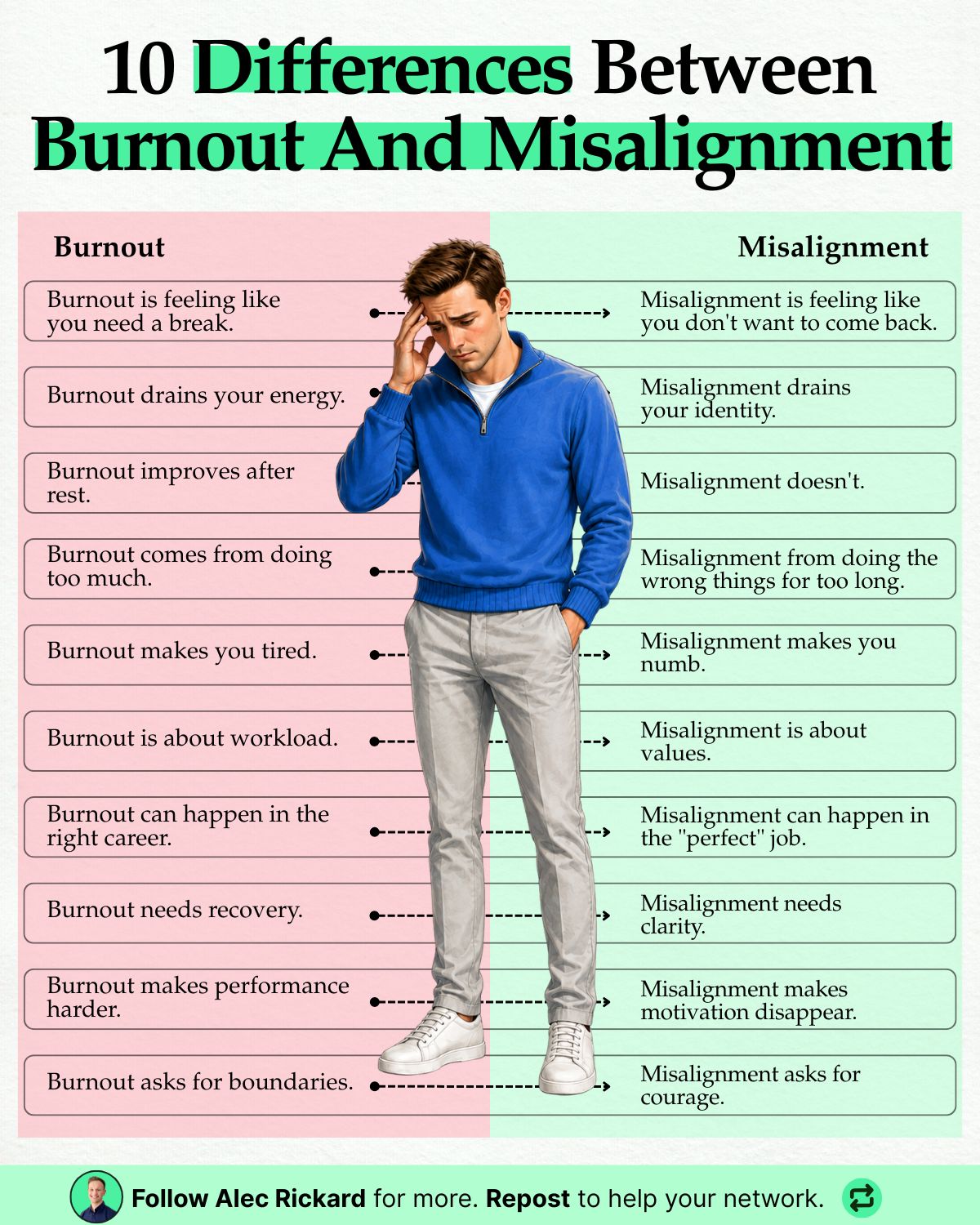
In a recent LinkedIn post, Alec Rickard explores a common point of confusion for many professionals: the distinction between burnout and career misalignment. Rickard, who has coached over 150 senior leaders through career transitions, argues that these two states, while often feeling similar, require fundamentally different approaches to resolution.
The Subtle but Significant Divide
Rickard begins by challenging the widespread self-diagnosis of burnout, suggesting that many individuals experiencing these feelings might actually be in the wrong career altogether. He emphasizes that the sensations of burnout and misalignment can be nearly identical, leading people to pursue ineffective solutions.
“Burnout and misalignment can feel identical. But they require completely different solutions.”
This core assertion sets the stage for Rickard’s detailed breakdown of the differences. He points out that while burnout often prompts a desire for a break, misalignment goes deeper, manifesting as a lack of desire to return to one’s professional life.
Identifying the Root Cause: Energy Drain vs. Identity Drain
A key distinction Rickard highlights is the nature of the energy drain experienced in each state. According to Rickard, burnout primarily drains one’s physical and mental energy, whereas misalignment attacks a person’s very sense of identity.
Key Differentiating Factors
Rickard provides a numbered list to help individuals discern which they might be experiencing. Some of the stark contrasts he draws include:
- Burnout improves after rest, while misalignment does not.
- Burnout stems from an excessive workload, whereas misalignment arises from engaging in the wrong activities for an extended period.
- Burnout makes one feel tired, but misalignment can lead to a state of numbness.
- Burnout is often a matter of workload, but misalignment is fundamentally about values.
As Rickard notes, burnout can occur even within a fulfilling career, but misalignment can fester in a job that appears perfect on the surface. This underscores his central argument that the solutions are not interchangeable.
“Burnout needs recovery. Misalignment needs clarity.”
The Danger of Misapplied Solutions
Rickard expresses concern over a common mistake he observes: individuals dedicating significant time and effort to recovering from burnout when the underlying issue is a need for career redirection. He states that while rest is indeed important, it is clarity about one’s career path that ultimately drives transformative change.
“The biggest mistake I see? People spend months trying to recharge… When they should be asking whether they’re climbing the right mountain.”
By framing the issue as a choice between recovery and realignment, Rickard encourages a more precise self-assessment. He concludes by posing a direct question to his audience, prompting them to consider their own experiences and the nature of their professional dissatisfaction.
“Rest is important. But clarity changes careers.”
Rickard’s insights offer a valuable framework for professionals navigating feelings of disillusionment, urging them to look beyond the immediate symptoms and address the fundamental alignment of their career with their values and identity.
📝 About This Content
This article is based on insights shared by Alec Rickard on LinkedIn.
📅 Originally posted on August 7, 2026 | View original post on LinkedIn →