
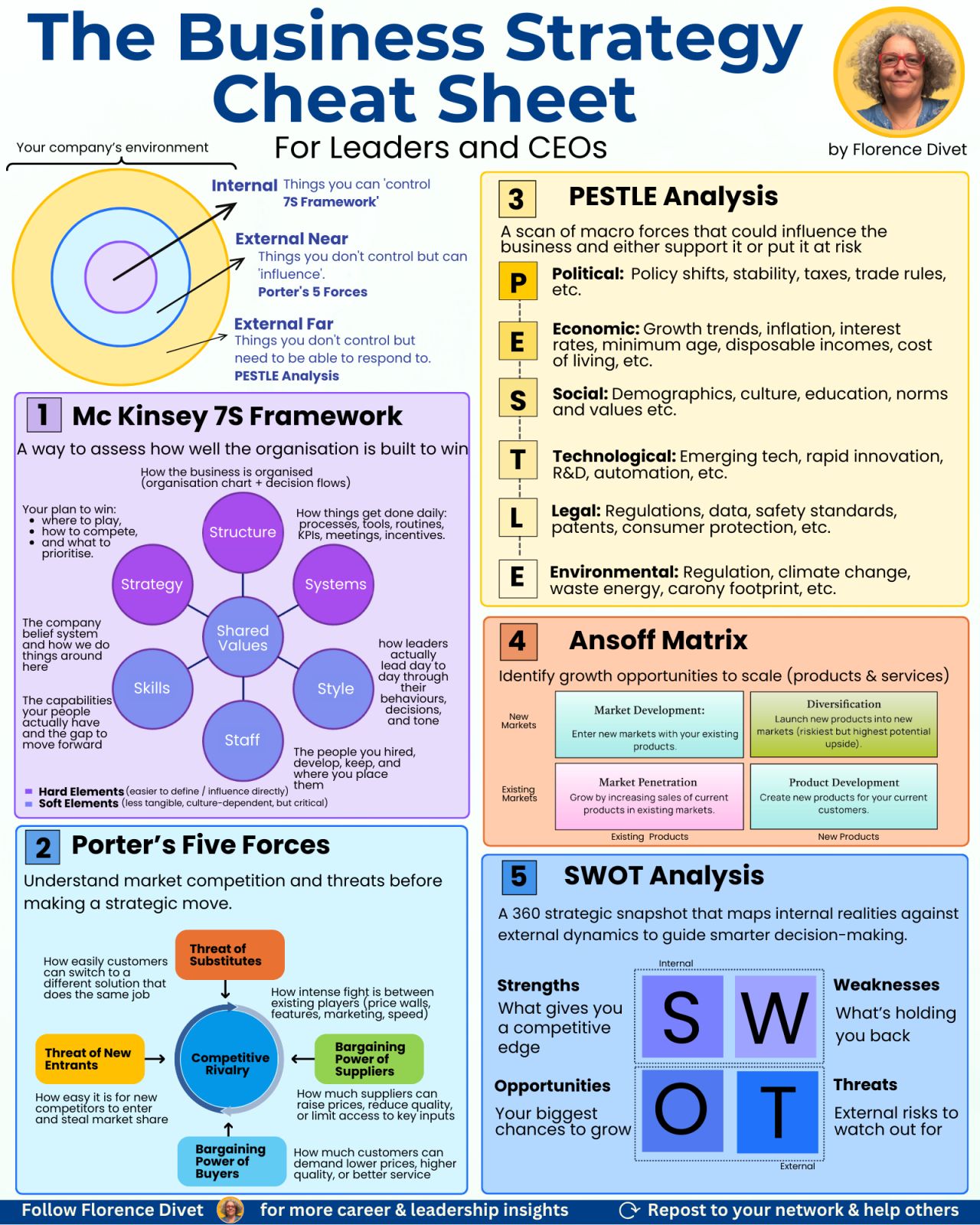
In a recent LinkedIn post, Florence Divet ☀️ offers a critical perspective on strategic planning for chief executive officers, suggesting that the core issue for many leaders is not a lack of strategy, but rather a deficiency in their ability to detect critical market shifts early. Florence Divet ☀️ frames this as a “radar problem,” emphasizing the need for faster identification of what truly matters amidst market noise.
The post highlights a common failure point: strategy unravels not within the boardroom, but when unforeseen market changes catch organizations off guard. Florence Divet ☀️ backs this assertion with stark statistics:
“90% of companies admit they struggle to adapt quickly to market changes.”
Florence Divet ☀️ argues that the challenge is not a deficit in corporate intelligence, but a failure to establish robust early warning systems. The post elaborates on the practical realities leaders face:
“You build a plan. Then reality hits. Pricing changes, Clients freeze spend, New regulations land overnight, Margin pressure intensify, Key people leave, Burnout spreads. And the strategy falls apart.”
The Strategy vs. Radar Dichotomy
Florence Divet ☀️ challenges the conventional wisdom that strategy hinges on sheer brilliance. Instead, the author posits that effective strategy is fundamentally a system, and great CEOs require earlier warnings more than just more ideas. This perspective is encapsulated by a simple analogy:
“Build the ship. Check the weather. Steer.”
According to Florence Divet ☀️, the focus should shift from crafting perfect plans to building resilient systems capable of sensing and responding to environmental changes. This involves a proactive approach to understanding the forces at play, both internal and external to the organization.
Tools for Enhancing Strategic Radar
To help leaders develop this crucial “radar,” Florence Divet ☀️ proposes leveraging established strategic frameworks through three distinct lenses:
1. Internal Engine (What You Control)
This lens focuses on internal capabilities and execution capacity. Florence Divet ☀️ suggests using frameworks like the McKinsey 7S model to assess whether the organization can genuinely execute its plans or if it’s merely engaging in wishful thinking.
2. Market Battlefield (What You Can Influence)
Here, the focus is on understanding the competitive landscape and industry dynamics. Florence Divet ☀️ recommends frameworks such as Porter’s 5 Forces to identify where power truly lies within the industry and what subtle pressures might be impacting the business.
3. Macro Weather (What You Can’t Control)
This aspect addresses the broader external environment. Florence Divet ☀️ advocates for using PESTLE analysis to anticipate and prepare for significant shifts in political, economic, social, technological, legal, and environmental factors that could impact the business, framing them as “storm forecasts” that are often ignored until they cause damage.
Florence Divet ☀️ further suggests integrating these external scans with a SWOT analysis (Strengths, Weaknesses, Opportunities, Threats) to provide a comprehensive view of the strategic landscape. The Ansoff Matrix is also mentioned as an optional tool for identifying the most effective growth opportunities.
A Proactive CEO Exercise
To foster this early warning capability, Florence Divet ☀️ proposes a concise yet powerful exercise for executive committees: asking, “What external shift could make our strategy obsolete within 12 months?” The author notes that a lack of immediate, thoughtful responses to this question signals a significant blind spot, rather than strategic alignment.
The insights shared by Florence Divet ☀️ underscore the dynamic nature of modern business and the critical need for leaders to cultivate a proactive, sensing approach to strategy, moving beyond static plans to embrace adaptive systems.
📝 About This Content
This article is based on insights shared by Florence Divet ☀️ on LinkedIn.
📅 Originally posted on January 20, 2026 | View original post on LinkedIn →