
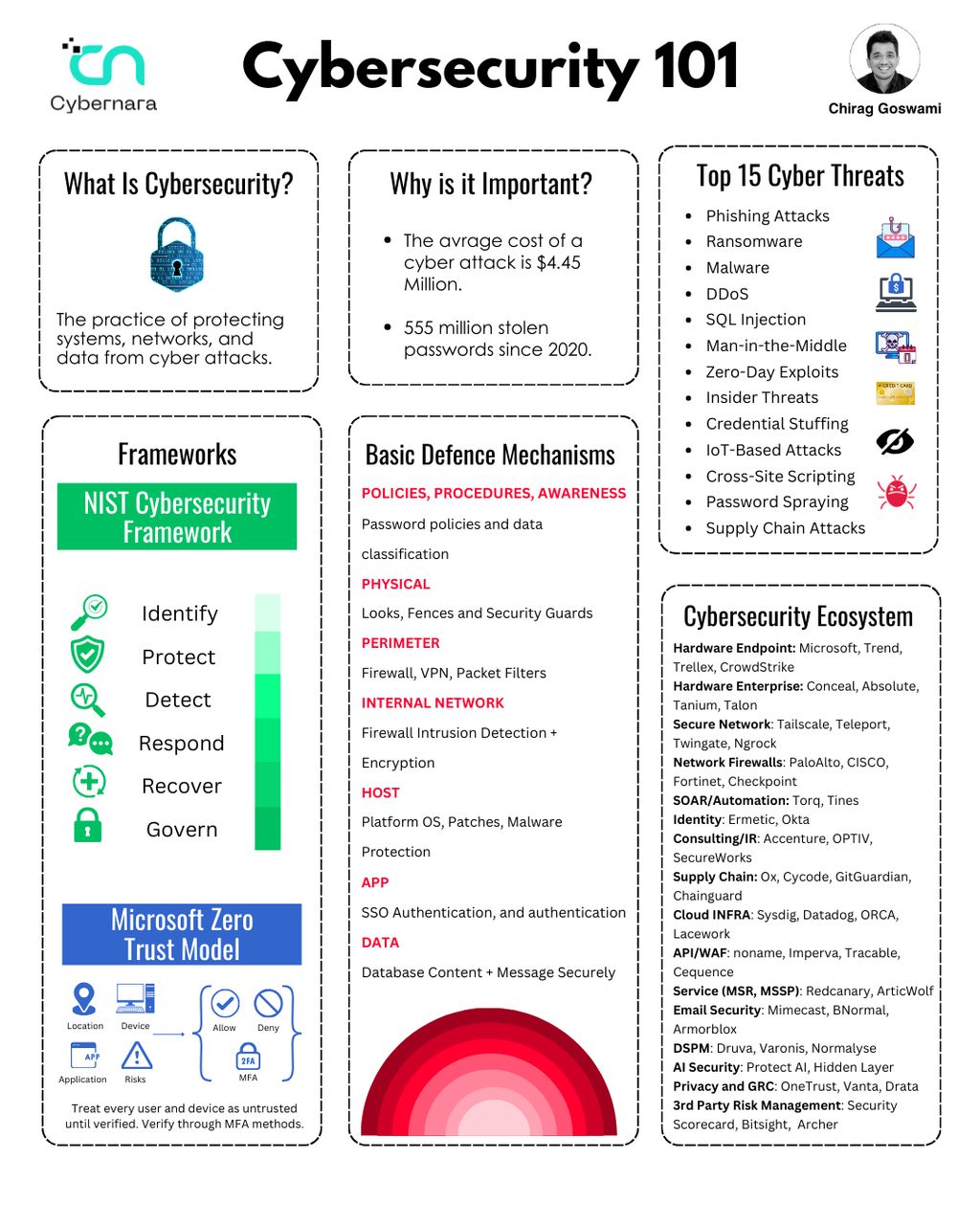
In a recent LinkedIn post, Chirag Goswami provides a foundational overview of cybersecurity, emphasizing its complexity beyond just firewalls and technical defenses. Goswami frames cybersecurity as an “entire ecosystem working together,” urging those new to the field or looking to build a solid security posture to understand its multifaceted nature.
The Core of Cybersecurity: Protection and Importance
Goswami begins by defining cybersecurity as the practice of protecting systems, networks, and data from cyber threats. He underscores the critical importance of this protection by highlighting the significant financial repercussions of breaches and the alarming scale at which credentials are stolen. As Chirag Goswami notes:
“Breaches cost millions. Credentials are stolen at massive scale.”
This stark reality, according to Goswami, necessitates a robust understanding of the threats and defenses involved.
Navigating Common Threats and Guiding Frameworks
The post delves into the array of common threats that organizations and individuals face daily. Goswami lists phishing, ransomware, malware, Distributed Denial of Service (DDoS) attacks, insider threats, and cloud misconfigurations as prevalent dangers. To navigate this complex threat landscape, Goswami points to established guiding frameworks.
Key Frameworks for Security Guidance
Chirag Goswami highlights two key frameworks that provide structure and best practices for security initiatives:
- NIST Cybersecurity Framework: A widely adopted framework offering guidelines for managing and reducing cybersecurity risk.
- Microsoft Zero Trust Model: An approach that assumes no user or device, inside or outside the network, can be trusted by default.
Goswami argues that these frameworks are essential for building a comprehensive security strategy.
Layered Defenses: The Ecosystem Approach
A central theme in Goswami’s post is the concept of layered defense. He breaks down the basic layers that contribute to overall security, illustrating that effective protection is not a single solution but a combination of multiple controls.
Understanding the Security Layers
According to Chirag Goswami, these layers include:
- Policies and awareness training for personnel.
- Physical security measures.
- Perimeter and network controls.
- Endpoint and server security.
- Application security and identity management.
- Data protection and encryption.
Goswami emphasizes the interconnectedness of these components, stating:
“Security is layered. There’s no single tool that fixes everything.”
He further elaborates on the broader cybersecurity ecosystem, noting that various components such as endpoints, networks, identity systems, cloud infrastructure, APIs, Security Operations Centers (SOCs), Incident Response (IR), and risk management all play a crucial role. This holistic view is critical for developing resilient security architectures.
Conclusion: A Call for Comprehensive Security
Chirag Goswami concludes his post by reiterating that effective cybersecurity requires a comprehensive, layered approach rather than relying on isolated tools or solutions. He frames security as an ongoing, collaborative effort involving multiple components and continuous vigilance. As Chirag Goswami puts it:
“It’s an entire ecosystem working together 🔐🧩”
The insights shared by Goswami offer a valuable starting point for anyone seeking to understand the fundamental principles and interconnected nature of modern cybersecurity.
📝 About This Content
This article is based on insights shared by Chirag Goswami on LinkedIn.
📅 Originally posted on December 23, 2025 | View original post on LinkedIn →