
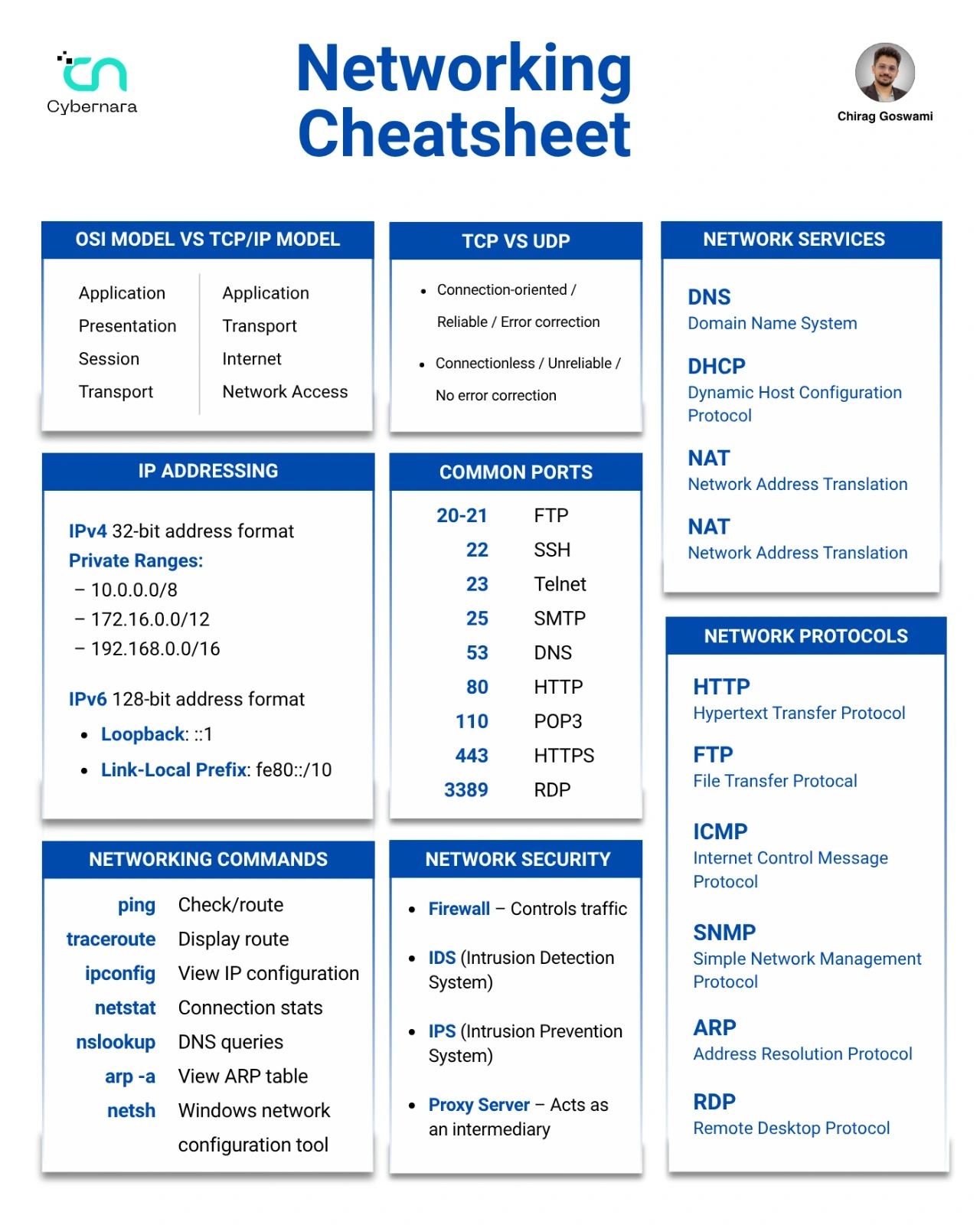
In a recent LinkedIn post, Chirag Goswami provides a comprehensive overview of fundamental networking concepts crucial for professionals in cybersecurity, cloud computing, and network administration. Goswami emphasizes that a solid grasp of these principles forms the bedrock for modern IT infrastructure.
The Importance of Foundational Networking Knowledge
Chirag Goswami highlights the foundational role networking plays in modern IT systems. According to Goswami, understanding how devices communicate securely and efficiently is not just beneficial but essential for career progression in key IT domains.
“Networking is the foundation of modern IT, enabling devices to communicate securely and efficiently. Understanding these core concepts is essential for anyone working in cybersecurity, cloud, or network administration.”
Goswami’s post breaks down complex networking topics into digestible key concepts, making it an accessible resource for those looking to solidify their understanding or enter these fields.
Key Networking Concepts Explained
The post delves into several critical areas of networking. Goswami differentiates between the 7-layer OSI model and the 4-layer TCP/IP model, explaining their structural differences. Furthermore, the distinction between TCP and UDP is clarified, with Goswami pointing out that TCP offers reliable, connection-oriented communication, whereas UDP prioritizes speed through a connectionless approach.
IP addressing is another core area covered. Chirag Goswami notes the significant difference in address space between IPv4’s 32-bit addresses and IPv6’s 128-bit addresses, which is vital for the scalability of the internet.
Understanding Common Ports and Services
Goswami also lists commonly used ports and their associated services, including HTTP (80), HTTPS (443), and SSH (22). This practical information is invaluable for understanding how different applications and services communicate over a network. The post further elaborates on essential network services like DNS for domain name resolution and DHCP for IP address assignment, alongside NAT for IP address translation.
“Services like HTTP (80), HTTPS (443), SSH (22), DNS (53), SMTP (25), and RDP (3389) use well-known ports.”
Protocols, Commands, and Security
The article extends to network protocols, mentioning HTTP, FTP, and ICMP, among others, each serving distinct communication purposes. Chirag Goswami also provides a list of useful command-line tools such as ‘ping,’ ‘traceroute,’ and ‘ipconfig,’ which are indispensable for network troubleshooting.
Crucially, Goswami addresses network security, outlining key components like firewalls, Intrusion Detection Systems (IDS), Intrusion Prevention Systems (IPS), and proxy servers. These are presented as vital tools for monitoring, filtering, and securing network traffic.
“Mastering these fundamentals provides a strong foundation for networking, cybersecurity, cloud computing, and infrastructure management.”
In conclusion, Chirag Goswami’s LinkedIn post serves as a concise yet thorough cheatsheet, reinforcing the idea that a strong foundation in networking principles is paramount for success in various high-demand IT roles.
📝 About This Content
This article is based on insights shared by Chirag Goswami on LinkedIn.
📅 Originally posted on July 15, 2026 | View original post on LinkedIn →