
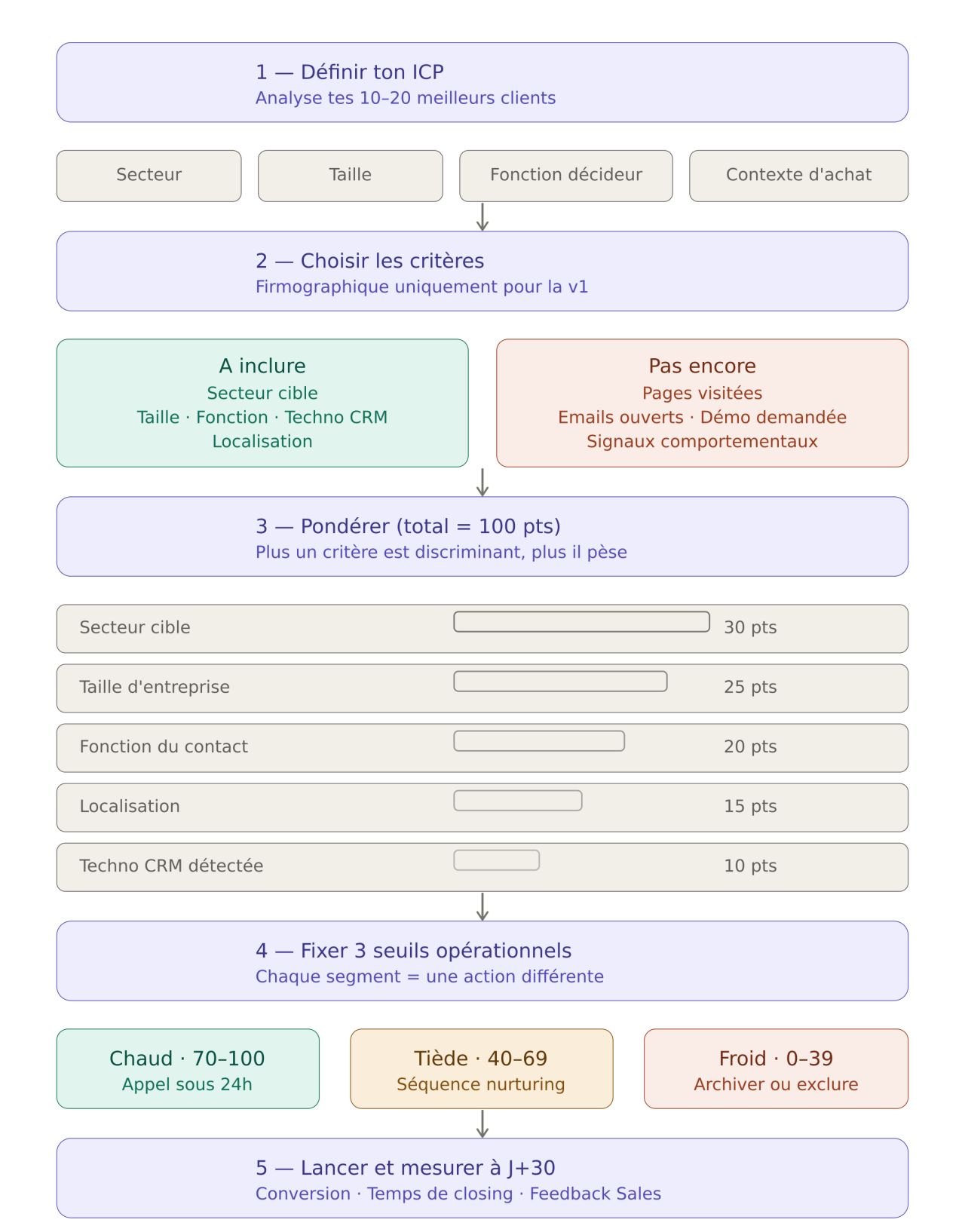
In a recent LinkedIn post, Christian Francois offers a pragmatic, step-by-step approach to implementing lead scoring, emphasizing simplicity and iterative improvement over perfection. Francois asserts that while lead scoring isn’t an exact science, a well-defined, albeit simple, process can yield significant results if executed and refined based on real-world feedback.
Demystifying Lead Scoring: A Data-Driven Foundation
Francois begins by stressing the importance of grounding lead scoring in tangible data rather than abstract discussions. The foundational step, he explains, is to meticulously define the Ideal Customer Profile (ICP) by analyzing existing top-performing clients. This involves identifying commonalities in sector, company size, decision-maker function, and purchasing context.
“Prends tes 10 à 20 meilleurs clients. Cherche ce qu’ils ont en commun : Secteur – Taille d’entreprise – Fonction du décideur – Contexte d’achat”
As Christian Francois notes, this data-centric ICP serves as the bedrock upon which all subsequent scoring criteria are built. He advocates for a focused approach in the initial phase, prioritizing firmographic data over behavioral metrics. This includes targeting specific sectors, company sizes (e.g., 50–200 employees), and contact functions, with the understanding that behavioral signals can be incorporated later.
Weighting Criteria and Setting Actionable Thresholds
To move beyond a generic assessment, Francois details the process of weighting different criteria to reflect their relative importance in identifying a qualified lead. He suggests assigning a total of 100 points across various factors, with more discriminating criteria receiving higher weights. An illustrative example provided by Francois includes:
- Secteur: 30 pts
- Taille: 25 pts
- Fonction du contact: 20 pts
- Localisation: 15 pts
- Techno détectée: 10 pts
According to Christian Francois, the next critical step is establishing clear thresholds for lead segmentation. He proposes three tiers:
“Chaud (70–100) → appel dans les 24h → ton Tier 1
Tiède (40–69) → séquence nurturing → ton Tier 2
Froid (0–39) → archiver ou exclure → ton Tier 3″
Francois cautions that if all leads fall into a single category, the scoring system is not effectively differentiating prospects, rendering it ineffective.
Action, Measurement, and Iteration
The core of Francois’s philosophy is immediate implementation. He encourages launching a basic scoring model, even if it’s managed initially through a simple spreadsheet, and distributing it to the sales team. The emphasis is on getting the system into use to gather crucial field data.
“Un scoring imparfait mais utilisé vaut infiniment mieux qu’un scoring parfait… jamais lancé.”
Christian Francois recommends measuring three key metrics over an initial 60-day period: conversion rates by segment, average time to close for hot leads, and qualitative feedback from the sales team. This feedback loop is essential for refining the scoring model.
In conclusion, Christian Francois argues that the initial version of any lead scoring system will inevitably be imperfect. This imperfection is not a flaw but an intended part of the process, designed to facilitate learning and adaptation. He asserts that the most impactful adjustments will emerge from the practical experiences of the sales team, making the immediate deployment of a functional, even if basic, scoring system the most critical factor for long-term success.
📝 About This Content
This article is based on insights shared by Christian Francois on LinkedIn.
📅 Originally posted on March 25, 2026 | View original post on LinkedIn →