
In a recent LinkedIn post, Clare Kitching discusses the common pitfall of businesses rushing towards the latest artificial intelligence trends, such as Generative AI (GenAI) and AI agents, without first considering simpler, more established AI approaches. Kitching argues that this haste can lead to overlooking solutions that might be more effective, efficient, and reliable for specific business problems.
Kitching highlights that AI is not a monolithic entity but rather a spectrum of capabilities, each offering distinct value. The key, she emphasizes, lies in matching the right technology to the problem at hand. She states:
“The mistake is jumping straight to the newest one. Agents. GenAI. Big bets. While overlooking simpler approaches that may solve the problem better, faster and more reliably.”
Understanding the AI Spectrum
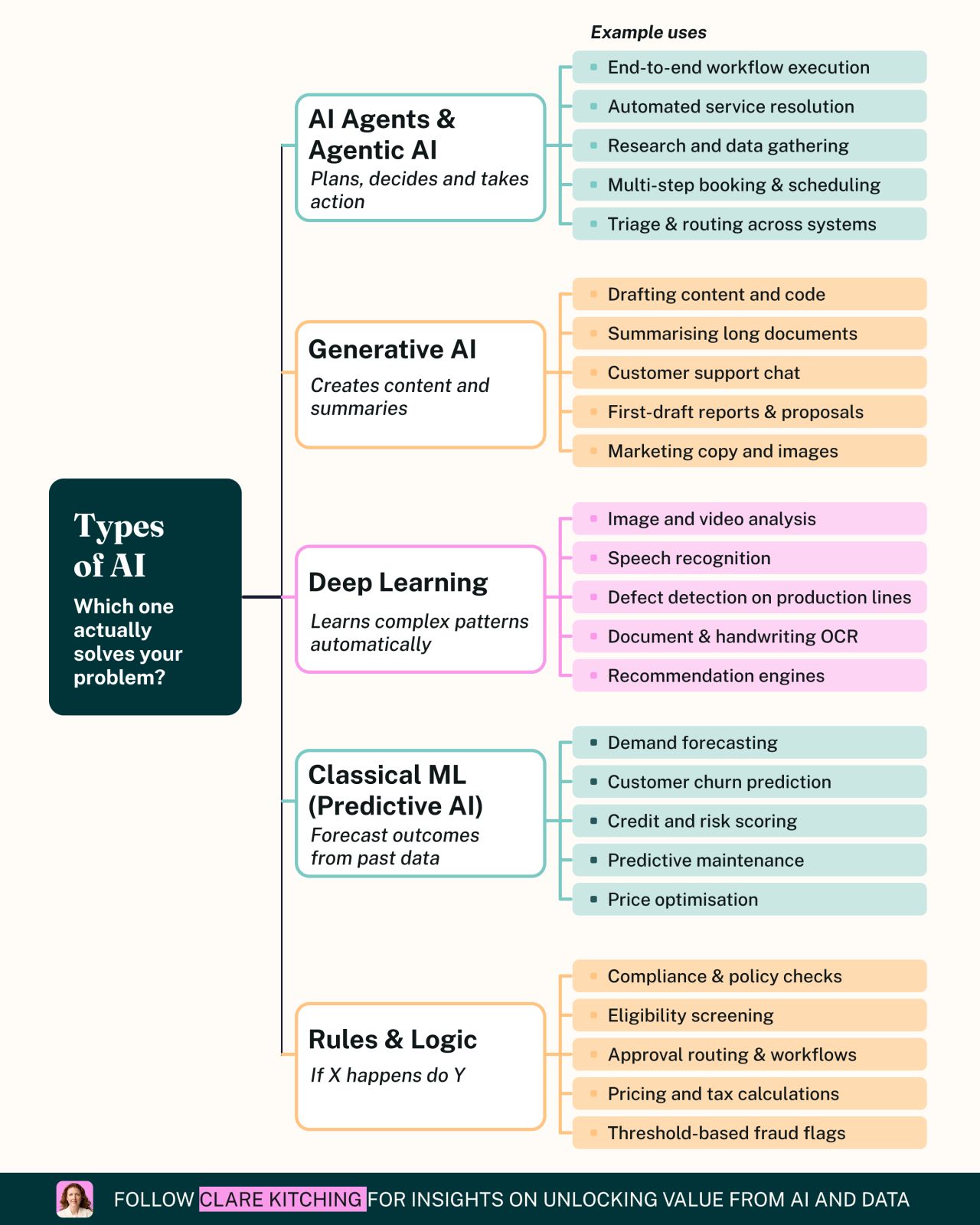
Clare Kitching breaks down the various AI capabilities, providing a clear framework for understanding their applications:
- Rules and Logic: Kitching notes that these create certainty, which is invaluable when decisions require consistency and explainability.
- Predictive Models: These have a long history of driving business value, according to Kitching, by providing foresight for revenue, demand forecasts, and risk management.
- Deep Learning: This capability, as Kitching explains, excels at perception, enabling the identification of subtle patterns, defects, and anomalies that might elude human observation.
- Generative AI: Kitching defines this as a tool for creation, capable of generating content, analysis, code, and innovative ways for users to interact with technology.
- Agents: These are software solutions that can plan, utilize tools, and take actions to achieve specific outcomes, as Kitching points out.
The Value of Strategic AI Implementation
Kitching strongly advocates for a strategic approach to AI adoption. She asserts that no single AI technology is inherently superior; rather, their value is determined by their suitability for the problem being addressed. She writes:
“None is inherently better. The value comes from matching the technology to the problem.”
In Kitching’s view, organizations must treat AI as a portfolio of diverse capabilities that require active management. This involves starting with the most straightforward solution that effectively addresses the issue and only introducing greater complexity when genuinely warranted.
Prioritizing Business Impact Over Hype
The core message from Clare Kitching’s post is a call for pragmatism in the face of rapidly evolving AI technologies. She suggests that a more measured approach, focusing on demonstrable business impact rather than the allure of cutting-edge tools, will yield better results. Kitching concludes with a forward-looking statement:
“We’d may see fewer impressive slides but a lot more business impact.”
By encouraging businesses to begin with the simplest effective AI solutions and gradually incorporate complexity, Kitching aims to guide leaders toward more impactful and sustainable AI implementations.
📝 About This Content
This article is based on insights shared by Clare Kitching on LinkedIn.
📅 Originally posted on August 16, 2026 | View original post on LinkedIn →