
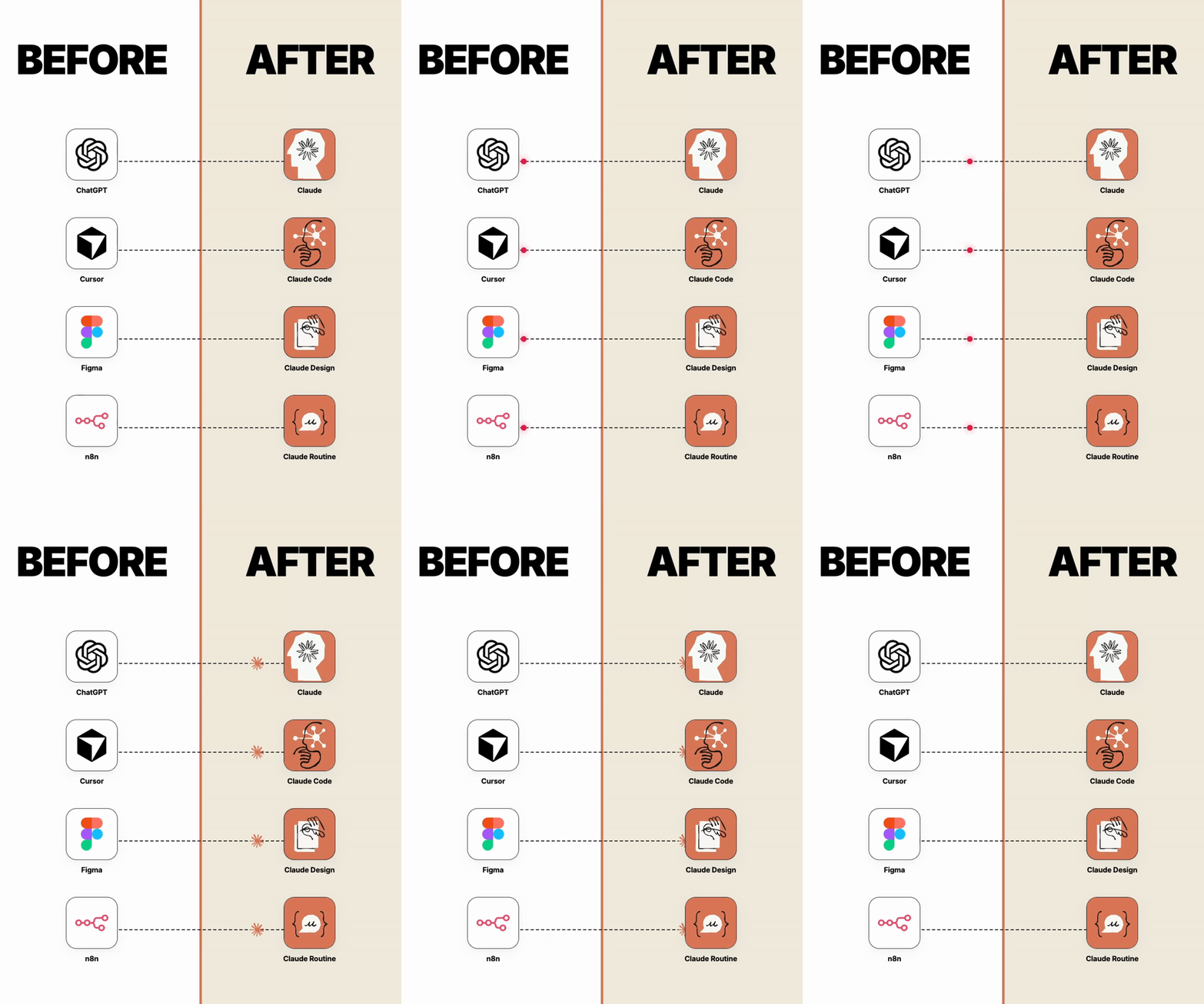
In a recent LinkedIn post, Yonathan Cohen has put forth a bold assertion: that Anthropic’s Claude AI is rapidly making other artificial intelligence tools irrelevant. Cohen, writing on the professional network, details how Claude’s advanced capabilities are beginning to supersede specialized AI applications across various domains, from coding and design to automation and general task management.
Cohen’s argument centers on Claude’s perceived superior reasoning, precision, and ability to deliver production-ready outputs, contrasting it with tools like ChatGPT. He highlights the AI’s versatility and argues for its growing dominance.
“Claude is making every other AI tool irrelevant.”
Claude’s Ascendancy in Coding and Design
A significant portion of Cohen’s analysis focuses on how Claude is challenging established players in specific technical fields. For coding, he suggests that Claude Code is now capable of handling complex tasks that previously required dedicated tools like Cursor. Cohen claims a substantial speed increase with the latest iteration.
“Now Claude Code handles full features, refactors, and architecture. With Opus 5, 4-5x faster for me,” Yonathan Cohen states in his post. This implies a significant leap in efficiency and capability for AI-assisted software development.
Similarly, Cohen posits that Claude is disrupting the UI/UX design space, previously dominated by tools like Figma. He describes a new functionality, Claude Design, which he claims can generate interactive prototypes from simple descriptions.
Challenging Traditional Automation and Information Management
Beyond coding and design, Cohen extends his argument to automation and information retrieval. While acknowledging the continued utility of tools like n8n for heavy production workflows, he suggests Claude is poised to take over simpler automation tasks.
“Now I tell Claude what to do and it runs every morning on autopilot. For heavy production workflows, I still run those on n8n. (for now),” Cohen writes, indicating a potential future where Claude could manage a broader spectrum of automated tasks.
Furthermore, Cohen addresses the common issue of managing multiple browser tabs and tools for research and task completion. He introduces ‘Cowork’ as a solution integrated with Claude, which he says operates directly within a user’s folder structure and tools, eliminating the need for a separate terminal interface.
A Call to Action for Users
Concluding his post, Yonathan Cohen encourages readers to experiment with Claude by integrating it with existing paid tools. He suggests a practical approach:
“Start with one: connect two tools you already pay for, and give Claude a job you’d normally do in three tabs.”
Cohen’s insights suggest a paradigm shift in the AI landscape, driven by the perceived all-encompassing capabilities of Claude. As he notes, the tool’s ability to reason deeply, follow instructions precisely, and execute tasks across diverse functions positions it as a formidable competitor to a range of specialized AI applications.
The implications of Cohen’s assessment point towards a future where a single, powerful AI model could streamline numerous professional workflows, potentially reducing the reliance on a multitude of single-purpose AI tools.
📝 About This Content
This article is based on insights shared by Yonathan Cohen on LinkedIn.
📅 Originally posted on July 30, 2026 | View original post on LinkedIn →