
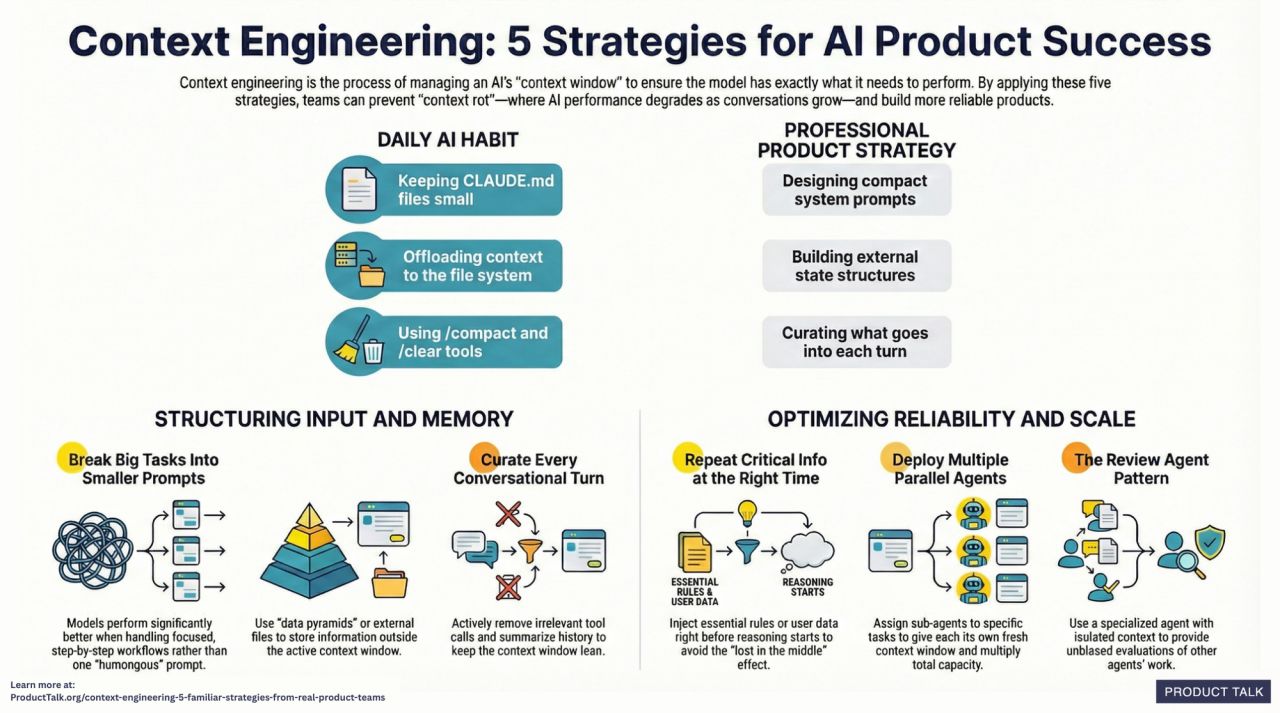
In a recent LinkedIn post, Teresa Torres explores the surprising parallels between using everyday AI tools and the complex process of building production-grade AI products. Torres highlights how individuals experimenting with AI, like using Claude Code for personal productivity, are inadvertently developing crucial skills in “context engineering”—a discipline vital for creating robust AI applications.
Torres points out that the same challenges faced by individual users are mirrored in the development of AI products. She writes:
“When I started using Claude Code, I thought I was just building personal productivity tools. I didn’t realize I was also learning context engineering—the same skills that product teams use to build production AI products.”
Bridging the Gap: Personal Productivity and Production AI
The core argument presented by Teresa Torres is that the techniques individuals employ to manage AI interactions for personal tasks are directly transferable to the development of sophisticated AI products. She identifies several key areas where this overlap occurs:
Task Decomposition and Prompting
Torres notes that breaking down complex tasks into smaller, manageable prompts is a fundamental skill. This mirrors the process of creating effective prompts for LLMs in production environments. As she explains, this is akin to the practice of keeping CLAUDE.md files concise and focused.
External Memory Systems
A significant challenge in AI development is managing context that exceeds the model’s window. Torres highlights how users building personal tools are already experimenting with ways to store context externally, a technique essential for production AI. This involves creating systems that act as an external memory for the AI.
Context Curation and Repetition
According to Teresa Torres, product teams, much like individual users, must learn to curate the information fed into each conversational turn to avoid overwhelming the AI. Furthermore, she emphasizes the importance of repeating critical information to ensure it remains fresh and relevant when decisions are being made. This practice is crucial for maintaining coherence and accuracy in AI outputs.
Leveraging Multiple Agents
Torres also touches upon the use of multiple AI agents. She suggests that deploying several agents can effectively multiply the available context windows, enabling more complex problem-solving and a broader understanding of the task at hand. This approach is increasingly being adopted in production AI systems to handle multifaceted challenges.
Real-World Applications and Proven Strategies
In her post, Teresa Torres references real-world examples from companies like Incident.io, Rest, and Trainline. These companies have reportedly learned and implemented these context management patterns through iterative trial and error. Torres distills a key piece of advice that encapsulates this approach:
“If you’d break it down for a human, break it down for the LLM” – solid advice that applies whether you’re coding or building products.
This principle underscores the idea that effective AI development often relies on the same intuitive problem-solving skills used in human-to-human communication and task management. By applying these fundamental principles, developers can navigate the complexities of context engineering and build more effective and reliable AI products.
Teresa Torres’s insights suggest a democratization of AI development skills, where everyday users are unknowingly honing the expertise required for professional AI product creation. Her analysis provides a valuable framework for understanding how personal AI interactions can serve as a training ground for the future of AI development.
📝 About This Content
This article is based on insights shared by Teresa Torres on LinkedIn.
📅 Originally posted on February 11, 2026 | View original post on LinkedIn →