
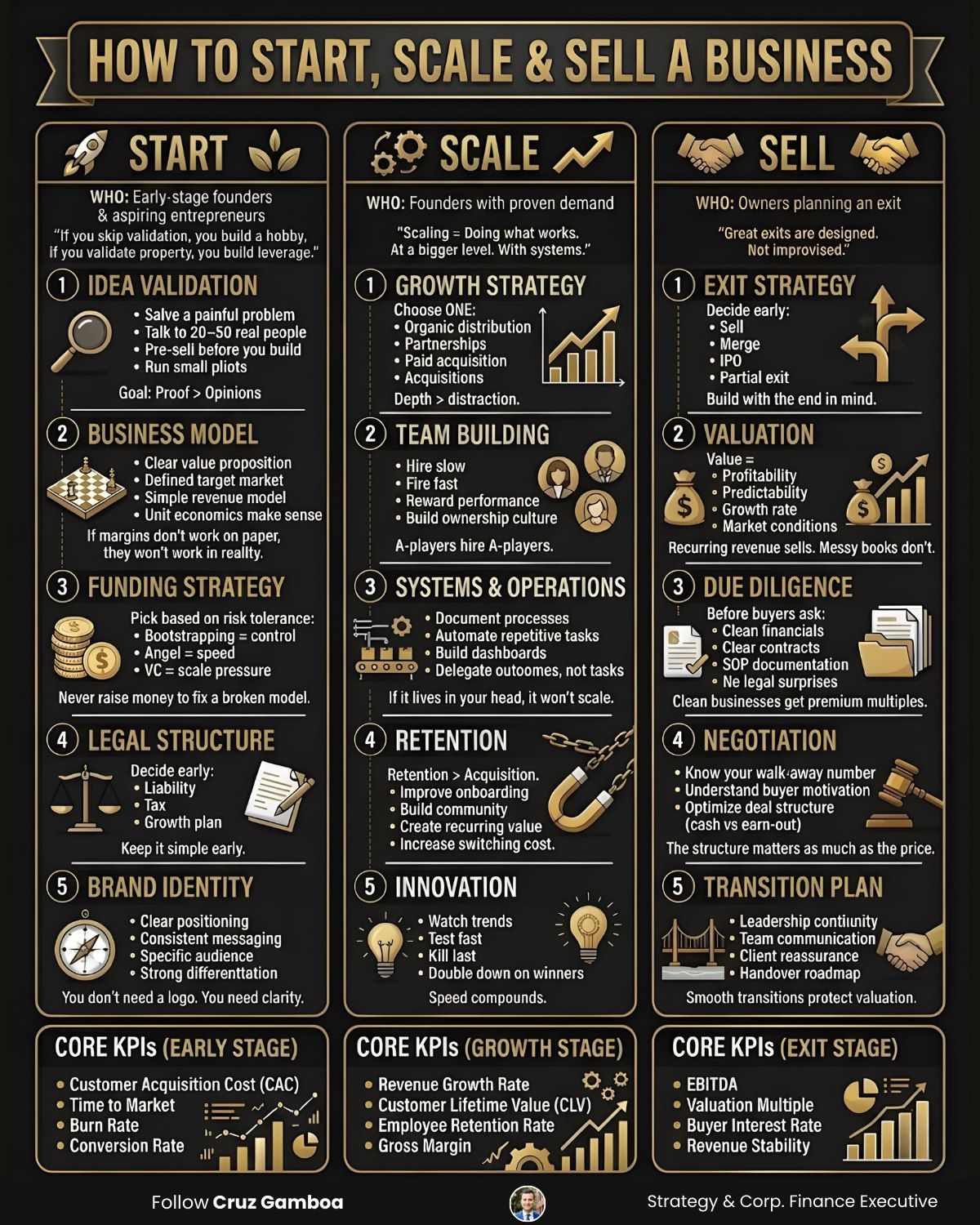
In a recent LinkedIn post, Cruz Gamboa discusses a common pitfall for founders: attempting to scale a business before validating market demand. Gamboa, a proponent of a structured approach to business building, argues that many entrepreneurs reverse the essential steps, leading to significant challenges and stress.
According to Gamboa, the conventional path often sees founders prioritizing product development and then struggling to find customers or build a truly scalable entity. He outlines a reversed, and in his view, more effective sequence for building a sustainable and valuable business.
“99% of founders do this backwards. They try to scale a business that no one has proven they want. Then they try to sell a business that only works because they exist.”
The Gamboa Framework: Sell, Scale, Exit
Cruz Gamboa proposes a three-step process that prioritizes market validation and operational efficiency from the outset. This approach, he contends, is key to building a company that generates consistent profits rather than perpetual anxiety.
Step 1: Start by Selling
Gamboa’s foundational advice is to validate the business idea by selling it before significant resources are invested in product development. He emphasizes that without initial customer commitment, an idea remains speculative.
“Don’t build the product. Sell it first. If no one pays, it’s not a business. It’s a fantasy.”
As Gamboa points out, this initial sales process serves as crucial market research. It provides tangible proof of demand and helps founders understand what potential customers are truly willing to pay for. This early traction is the bedrock upon which a viable business can be built.
Step 2: Scale with Systems, Not Dependency
Once market demand is proven, Gamboa advises founders to focus on scaling through systematic processes rather than personal involvement. He advocates for a lean approach, concentrating on a single offer, audience, and channel initially.
“Do less. Better. One offer. One audience. One channel. Systemize everything. If it needs you to survive, it’s not scalable.”
This principle of systemization, according to Gamboa, is critical for true scalability. A business that relies heavily on the founder’s direct input for every operation is inherently difficult to grow and ultimately, to sell. Building robust systems ensures that the business can operate and grow independently of the founder’s constant presence.
Step 3: Prepare for Sale with Predictable Revenue
The final stage in Gamboa’s sequence is the sale of the business, which he argues should be approached with a focus on financial predictability and reduced founder dependency. Buyers, he notes, are less interested in market hype and more in demonstrable financial health.
“Buyers don’t pay for hype. They pay for predictable cash flow. Clean books. Recurring revenue. Low founder dependency.”
Gamboa suggests that by following the ‘sell first, scale second’ model, founders naturally build the financial discipline and operational efficiency that attract buyers. This includes maintaining clear financial records, establishing recurring revenue streams, and minimizing the business’s reliance on the original founder.
Building Value Through Strategic Sequencing
In conclusion, Cruz Gamboa’s insights highlight a strategic reordering of priorities for entrepreneurs. By focusing on market validation first, then on building scalable systems, and finally on presenting a financially sound and operationally independent entity, founders can move from building a source of stress to creating a valuable asset.
Gamboa encourages founders who wish to identify their most significant opportunities to utilize the free assessment available at scalingcfo.io.
📝 About This Content
This article is based on insights shared by Cruz Gamboa on LinkedIn.
📅 Originally posted on March 3, 2026 | View original post on LinkedIn →