
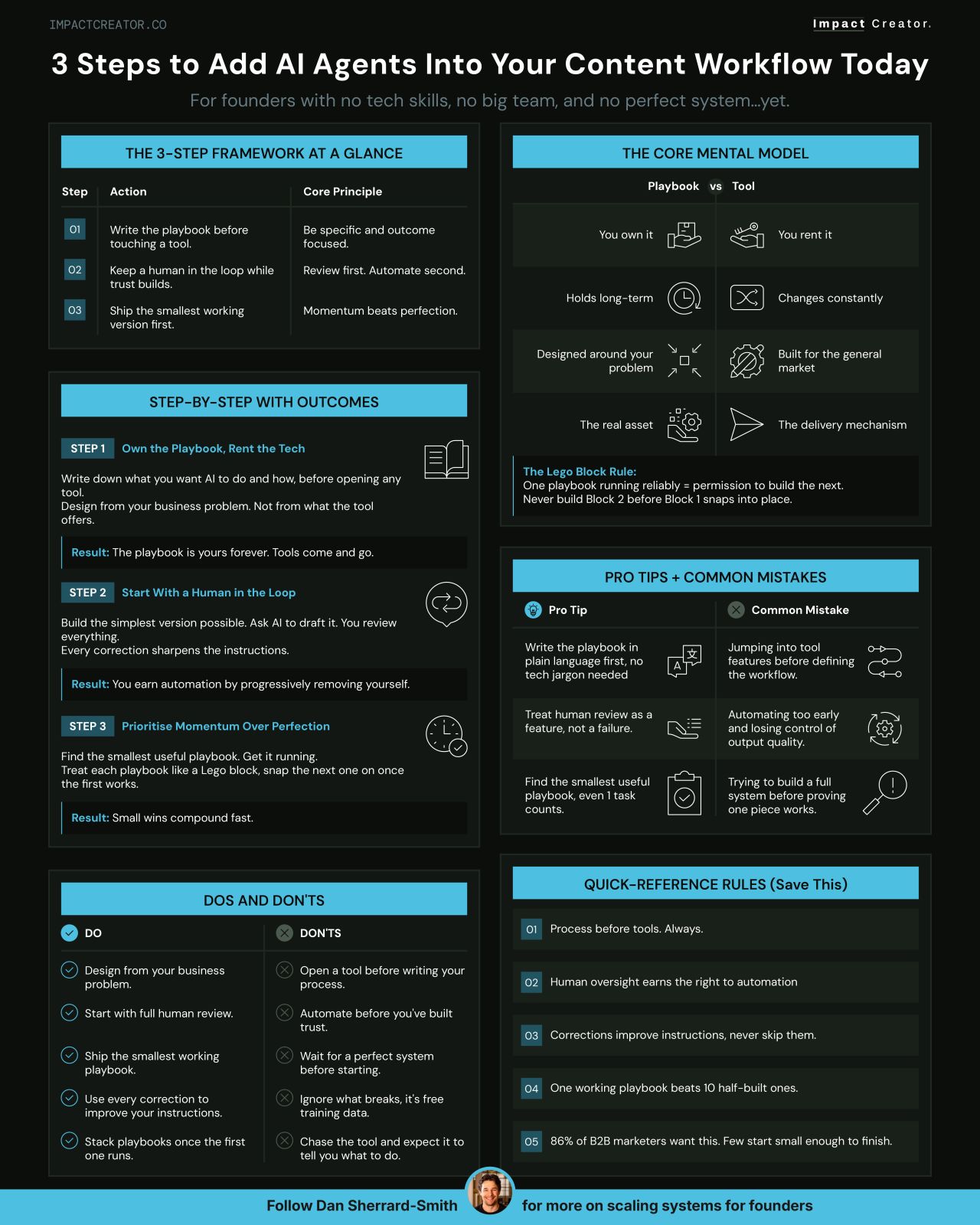
In a recent LinkedIn post, Dan Sherrard-Smith discusses a practical, three-step framework for founders and marketers to integrate AI agents into their content workflows without requiring technical expertise, large teams, or a perfectly established system. Sherrard-Smith emphasizes that many individuals delay action by waiting for an ideal scenario, ultimately hindering progress.
The ‘Own the Playbook, Rent the Tech’ Philosophy
Sherrard-Smith introduces a core principle: prioritizing the creation of a custom workflow over immediate adoption of specific AI tools. He explains that the initial step involves meticulously documenting what one wants AI to achieve and the desired process, a strategy he terms “owning the playbook.” This approach, he argues, is rooted in solving business problems rather than being dictated by tool capabilities.
“The playbook is the asset you own. The tool is a rental. Tools change. A well-designed playbook holds.”
According to Sherrard-Smith, this foundational step ensures that the workflow remains resilient even as AI technologies evolve rapidly. By focusing on the ‘how’ and ‘what’ before the ‘which tool,’ users build a sustainable asset.
Integrating AI with Human Oversight
The second step proposed by Sherrard-Smith centers on maintaining human involvement throughout the AI integration process. Instead of aiming for full automation from the outset, he advocates for starting with the simplest possible version of a process, where AI handles initial tasks and a human reviews the output.
“Don’t automate first. Build the simplest version possible. AI handles what it can. You review everything. Every correction feeds back into your instructions.”
This iterative approach, Sherrard-Smith explains, allows for gradual learning and refinement. As the user reviews and corrects the AI’s work, the instructions become more precise, leading to progressive improvements. He frames this as earning automation through demonstrated trust and consistent feedback, stating, “Trust first. Autonomy second.”
Prioritizing Momentum and Iteration
Sherrard-Smith’s third step addresses the common pitfall of striving for perfection, which can lead to inaction. He advises users to prioritize “momentum over perfection” by identifying the smallest, most useful AI-driven task and getting it operational.
“Find the smallest useful playbook. Get it working. Think of playbooks like Lego blocks. Once the first one runs, snap the next one on. Small wins compound fast.”
This incremental strategy, likened to building with Lego blocks, allows for quick wins that build confidence and create a foundation for subsequent integrations. Sherrard-Smith contrasts this with the common mistake of chasing after the latest tools without a defined process, which often results in efforts that “don’t stick.” He concludes by noting that while a significant percentage of B2B marketers desire AI workflow training, only those who adopt a small-scale, iterative approach are likely to achieve their goals.
📝 About This Content
This article is based on insights shared by Dan Sherrard-Smith on LinkedIn.
📅 Originally posted on June 25, 2026 | View original post on LinkedIn →